
Two years ago, ZZEUS Training marked a landmark moment for the fire and security sector when the first candidates successfully completed the EAL Level 3 Diploma in Providing Electronic Fire and Security Systems – with their achievements formally presented by Dame Judith Hackitt DBE and EAL Managing Director Al Parkes, who praised Zzeus as ‘Pioneers in Fire Alarm Training’.
At the time, the qualification represented a major breakthrough. For the first time, experienced fire alarm engineers had access to a meaningful, practical, competence-based route that recognised real-world skills across design, installation, commissioning, maintenance, testing and auditing. Two years on, the NVQ has not only proved its value – it has become an established benchmark for professionalism, progression and accountability within the industry.
Competence expectations have tightened – and the NVQ has met the moment
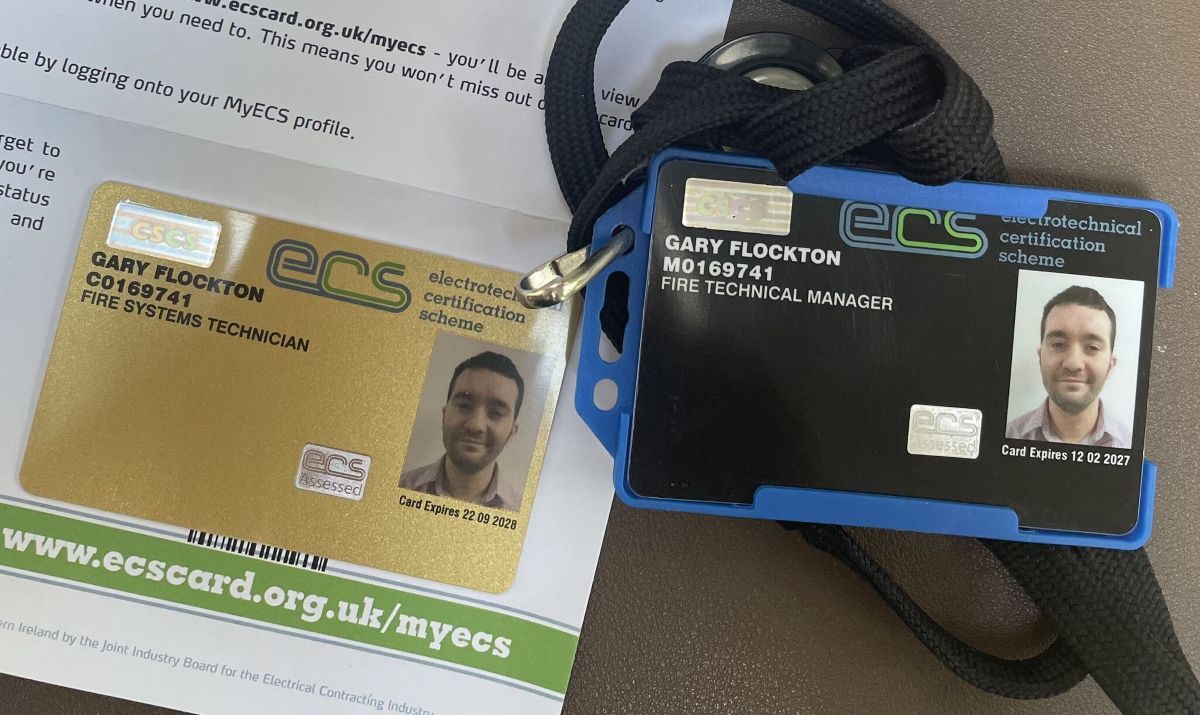
Since the introduction of the Building Safety Act in 2023, the competence landscape for fire safety has continued to evolve. Duty holders, principal contractors and clients now increasingly expect clear evidence of technician competence, auditable training and skills records, structured responsibility for system sign-off, and technicians able to demonstrate currency and professionalism. The EAL Level 3 NVQ has become a core part of that picture. For many organisations, it provides a credible and defensible competence framework, while enabling engineers to obtain the ECS Fire Gold Technician card – now widely recognised as the standard for those managing or leading fire alarm system work. Rather than being a course taken simply to gain a certificate, the work-based qualification has embedded itself as a working tool for safer practice.
Creating a professional pathway for experienced engineers
Before the diploma was introduced, many highly experienced engineers had no formal way to evidence their competence, despite years – and in many cases decades – of industry service. The NVQ has helped to change that. Through portfolio evidence, assessment against real workplace activities and an on-site audit, engineers can formalise and validate their practical knowledge, gain recognition for the responsibilities they already hold, progress from operative to technician or lead role, and strengthen their professional standing with employers and clients. For many candidates, the qualification has also provided a stepping-stone to professional registration through the IET and, ultimately, EngTech – reinforcing the view that fire alarm engineering is a professional engineering discipline in its own right.
A competence model built around real work – not paperwork
A defining strength of the ZZEUS delivery approach remains its emphasis on hands-on, practice-led assessment. Every programme includes a minimum of four days’ practical, real-equipment training; assessors and trainers who are active, working fire alarm technicians; structured portfolio evidence built from genuine workplace activities; and a site audit to validate competence in context. All trainers and assessors hold EQA, Assessor and Teaching qualifications, with lead trainer Buddy Squires holding a master’s-level teaching qualification – ensuring that assessment standards are rigorous, consistent and professionally delivered. This model has reassured employers that the NVQ is about competence, not box-ticking.
Supporting employers with accountability and assurance
For employers, the qualification has helped strengthen competence evidence for audits and client assurance, internal progression and technician development pathways, confidence in appointing “lead person” roles under BAFE SP203-1, and alignment with FESS occupational standards. Organisations report clearer structures around who is competent to sign-off work, how technicians progress to greater responsibility, and how competence is demonstrated and recorded over time. In an environment where accountability matters more than ever, the NVQ has become part of a wider culture shift towards professionalisation in the sector.
From pioneering initiative to recognised pathway
Reflecting on the qualification’s journey so far, ZZEUS Training Managing Director and FSA Chairman Dr Tom Brookes said: “When the first four ZZEUS candidates completed the EAL Level 3 Diploma, it was a milestone not just for them, but for the fire safety industry. Two years on, I’m proud to see the qualification firmly embedded as a recognised pathway for experienced engineers who want their competence to be properly evidenced and respected.” He added: “Our ambition was always to raise standards in a way that was practical, fair and rooted in real engineering work. Seeing learners progress in their careers, achieve their ECS Gold Cards and gain professional recognition shows that the NVQ is doing exactly what it was designed to do. The early endorsement from Dame Judith Hackitt – acknowledging ZZEUS as a pioneer in competency-led fire system training – continues to resonate as the industry matures in response to new expectations around safety and responsibility.”
A route that continues to support career progression
Across the last two years, a growing number of engineers have used the qualification to step into supervisory or senior technician roles, take formal responsibility for systems and sign-off, strengthen their employability and mobility across the sector, and gain recognition for years of previously unrecognised experience. The outcome now? More competent practitioners, better-evidenced skills, and stronger confidence in the people entrusted with critical life safety systems.
Looking ahead
The role of structured, practical, independently assessed qualifications will only increase and Zzeus Training are constantly collaborating with industry bodies to develop qualifications that reflect real-world engineering practice, support technicians and employers through evolving standards, and champion professionalism across the sector.
From the horse’s mouth – a perspective from one of the first engineers to complete the NVQ
Gary Flockton – Technical Specialist (Active Fire Systems) at Part B partb.co.uk/
“I was fortunate to be among the first individuals to achieve a Gold Card through the Experienced Worker Route by completing the Level 3 NVQ in Electronic Fire Alarm Systems. This pathway enabled me to demonstrate my 20+ years of experience at the same level as newly qualified technicians and to hold the same industry-recognised Gold card, without needing to return to full-time education – something that would not have been feasible given my lifestyle commitments.
I am grateful to Zzeus for championing the needs of experienced engineers and creating an accessible route to qualification. The team has clearly considered how mature engineers work. The online portal is exceptional – intuitive, easy to use, and suitable for users of any age or ability. It allows evidence to be uploaded remotely, eliminating unnecessary travel and disruption. In addition, Zzeus assessors visited me on-site to review my work, which made the process even more practical and flexible.
This approach offers a fair and robust way to evidence competence for people from a wide range of backgrounds, while keeping both costs and logistics reasonable. The financial investment is also very manageable. For any experienced fire alarm engineer, I genuinely don’t see why you wouldn’t pursue it.
Some people assume the qualification is simply a tick-box exercise, but that has not been my experience. In my role at Part B, I act as a Active Fire Systems Specialist within a fire engineering consultancy, and I am often involved in evaluating contractors during competitive tenders. When several companies come forward for an active fire project and one of them has engineers who hold Gold Cards, it immediately stands out.
The Gold Card tells me they have been rigorously assessed, that they have invested time and effort into demonstrating their technical competence, and that their work has been reviewed by some of the most knowledgeable and respected assessors in the industry. From a consultant’s perspective, that level of verified professionalism carries real weight – it reassures me that they are serious about standards, capability, and the quality of the systems they are delivering.
Zzeus have made gaining this qualification straightforward and accessible – and moving forward, I would be asking any professional in this field why they don’t have it.”
More about Part B
Part B is an award-winning fire engineering consultancy recognised for its ability to resolve complex fire safety challenges across projects of every scale throughout the UK. What sets the business apart is its commitment to looking at fire safety holistically – not only from a passive fire perspective, but also with the role and performance of active fire systems.
By investing in a dedicated Active Fire Systems Specialist role, Part B has strengthened the way fire systems are considered within the overall fire strategy. Gary’s position ensures these systems are technically robust, properly integrated and aligned with both the engineering design intent and real-world operational performance – adding significant value to clients, design teams and end users alike.
About the Author

Dave Staddon - Publisher
Co-Founder of MDM Publishing Ltd. He has worked in fire publishing for close to 30 years. The company's portfolio includes International Fire Protection, International Fire Fighter, Asia Pacific Fire, Gulf Fire & UK Fire.
