
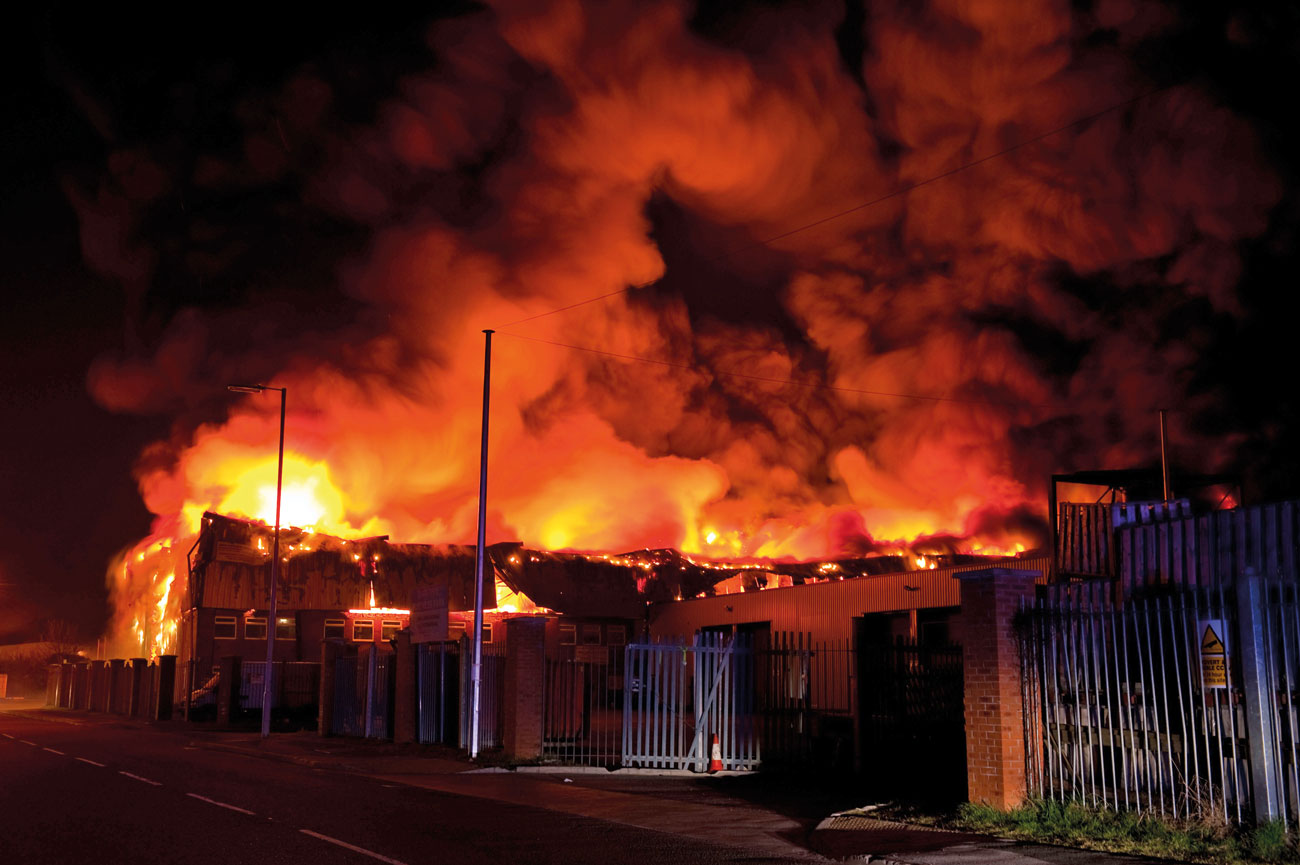
Fire can ruin a business and change things in an instant. According to a recent study carried out by the Business Sprinkler Alliance, only 16% of respondents considered the risk of fire to their business as a significant factor when deciding whether to install sprinklers. The majority were not committed and/or relied on their insurance to cover any potential risk yet the leading cause of property loss continues to be fire.
Automatic sprinkler systems offer the business owner reliable, long-lived and proven technology which can reduce the risk to life and the degree of damage caused in a fire event, whilst at the same time at a competitive and potentially reduced cost. The misconception surrounding the cost of sprinkler systems can be dispelled by looking at the true costs of a building over its lifespan. Why, for example, deliver a warehouse or school as cheaply as possible but leave out fire-safety measures, only to find five years later it is lost completely due to a fire event, resulting in greater costs?
It’s often the case that we spare no expense in value engineering projects to get them down to the lowest price, meaning things such as sprinklers are taken out. However, in doing so compromises are made that can have a major impact on the building through their lifetime of use. When people realise their mistake, it is too late. Sadly, this was the case when a devastating fire destroyed a recently opened 40,000m2, un-sprinklered warehouse in Daventry. Despite more than 50 firefighters tackling the blaze, the Gardman garden supplies distribution centre was completely destroyed, impacting not only the business and its employees but also retailers, the local economy and the environment.
The ripple effect from the destructive fire came at the height of the supply season in March 2018 with the loss of £20 million of Gardman stock felt by retailers who relied on the 4,000 lines of garden products. There were disruption and smoke warnings issued following the fire while fire-water run-off needed to be monitored by the environment agency. There was the environmental impact of disposing of the damaged property, where the costs, resources and materials required to rebuild it would be in excess of £30 million, significantly more than the cost to install sprinklers which would have been in the region of £900k. Whilst thankfully there was no loss of life, the lasting effect is undeniable as the business went into administration before the end of 2018.
A similar fate befell Asian snack manufacturer UK Snacks, which collapsed into administration nine months after a major fire destroyed areas of its warehouse. Whilst there might have been other reasons for the company’s unfortunate fate, the fire would have caused disruption to the business and showcases how companies are not always resilient after fire. Although insurance can support replacing equipment, the move to an alternate location to maintain business operations and support continuity efforts takes an inordinate amount of time and effort. Unless trading can continue quickly, businesses feel the financial pressure of maintaining cash flow and often flounder.
Building fires such as this occur at a higher frequency than people expect and have an impact that goes way beyond that of the owners and its immediate occupiers. The fire-safety guidance of the Building Regulations (provided by Approved Document B – ADB) is based on a consideration of life-safety impacts. However, as recent fires in the city centres of Belfast and Glasgow have shown, the impact of a fire is wider with economic, social and environmental implications. So why is property protection and business resilience not given greater consideration, and why are businesses willing to take the risk?
Impact of fire
Fire remains the leading cause of commercial property loss, with the Association of British Insurers (ABI) predicting that UK businesses could stand to lose £10bn between 2010 and 2020 as a result of fire. However, businesses should take note of findings from the Chartered Institute of Loss Adjusters (CILA) which found that 43% of business interruption policies were underinsured by an average of 53%. Businesses are not valuing what they own in terms of property and think they are going to recover a lot quicker than they do. They are failing to see the real impact of fire and leaving themselves exposed.
Home office figures1 show that the Fire and Rescue service in England has attended over 26,000 fires in industrial and commercial buildings in the past three years. From offices to industrial buildings, healthcare facilities to hotels; the impact of a major fire can be devastating, and many businesses never recover. But the cost of fires in industrial and commercial buildings goes far beyond the expense and impacts on individual businesses and insured costs. Fires are the cause of significant economic, environmental and community costs, which are ultimately borne by the taxpayer.
To reduce the risk to life and the degree of damage in a fire event, the inclusion of automatic sprinkler systems are proven time and time again to be both effective and efficient in a wide range of fire scenarios and building types, affording greater levels of fire protection to people, property and the environment.

Sprinkler effectiveness
There is clear evidence that sprinklers work. In fact, the National Fire Chiefs Council (NFCC) and the National Fire Sprinkler Network (NFSN) have worked together to investigate the effectiveness and reliability of sprinkler systems. In an independent report carried out by Optimal Economics, thousands of incidents have been studied to provide detailed and comprehensive analysis of the activation and performance of sprinkler systems used to control fire in buildings. The evidence indicates that sprinkler systems have an operational reliability of 94% and demonstrate, when called to work, they have a very high reliability. Furthermore, it is evident that when they do operate they extinguish or contain the fire on 99% of occasions across a wide range of building types2. This is why they are chosen to protect people, buildings and businesses, ensuring continuity and productivity.
Automatic sprinkler systems offer the business owner reliable, long-lived and proven technology which can reduce the risk to life and degree of damage caused in a fire event. These systems make buildings and businesses resilient to fire incidents because they control or extinguish a fire before the fire and rescue service arrive. The impacted business can be back up and running within hours, avoiding the economic and social costs.
The contrast between two buildings with and without a sprinkler system in a fire can be quite stark. In the event of a fire, many businesses with sprinkler systems suffer a minor interruption and find they are back up and running in a matter of hours. Those without can see five to six times the damage and suffer longer spells of interruption. These systems make buildings and businesses resilient to fire incidents because they control or extinguish a blaze before the fire and rescue service arrive. The impacted business can be operational within hours, avoiding the economic and social costs.
For more information, go to www.business-sprinkler-alliance.org
References
1. Home Office Fire Statistics – Fire Statistics Collection – Other Buildings Fire Dataset 2018/19
2. Efficiency and Effectiveness of Sprinkler Systems in the United Kingdom: An Analysis from Fire Service Data – Optimal Electronics May 2017
About the Author

Although retired Iain is still active in the fire safety sector, working in various bodies and committees to promote fire safety in general, especially promoting third party certification and the greater use of sprinklers. He is Vice Chair of the National Fire Sprinkler Network and leads the Sprinkler Water Liaison Group.
Iain served in Royal Berkshire Fire and Rescue Service for 34 years, appointed Chief Fire Officer in 2003 he was awarded the Queen’s Fire Service Medal in 2009 and retired in 2013. He served as the Chief Fire Officers Association’s Director for Protection and Prevention between 2009 and 2011. Iain is currently the Chair of the Business Sprinkler Alliance and is a board member of BAFE. Iain holds a BSc from Reading University and an MA in Management from Coventry University.

You must be logged in to post a comment.