

Iain Cox, Chair of the Business Sprinkler Alliance explains why one of the most efficient and effective ways to reduce the impact of fire is by ensuring that when one starts it is quickly extinguished, so that the threat to occupants and damage is minimised.
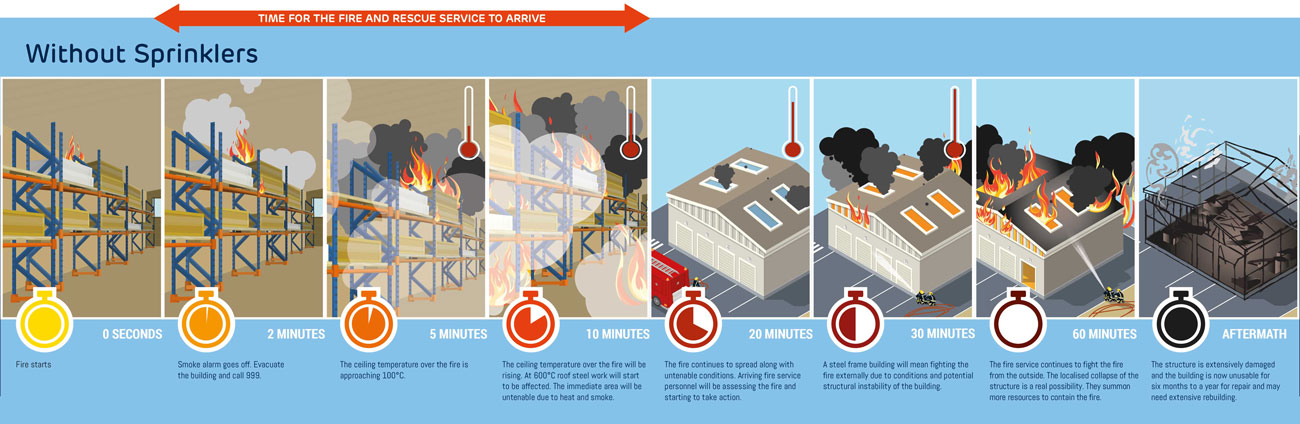
A company’s reputation for performance and delivery can be built up over many years but the damage from a disruptive event such as fire can take only seconds to destroy it. It’s why a rapid response time is critical for fire incidents in large commercial buildings, as these fires can often result in major losses for the businesses affected. The critical aspect is time. When a fire has been initiated it needs to be dealt with quickly or it can grow to a point where it is beyond reasonable intervention by manual means. By looking at the sprinkler timeline, it is possible to see how a fire can progress within a building with and without a sprinkler system installed.
There are on average 1900 fires in a range of industrial properties each year.1 Some have made the headlines, but they have highlighted the scale and significant damage to buildings, the number of firefighters involved, the pollution involved and the outcomes. Even though the fires happened many months ago, large numbers of these buildings are still under reconstruction, and some will never be rebuilt.
Plastics factory
On 24 November 2021, a major incident was declared when fire engulfed and completely destroyed an unsprinklered plastics factory in Hessle, East Yorkshire. The devastating blaze consumed about 300 tonnes of rigid plastic and required a multi-agency response to the plant which is nestled amongst residential properties. While staff escaped the blaze unharmed, the impact on the local community and environment was significant with local road closures, residents forced to evacuate their homes due to harmful smoke and a number of measures employed to minimise the impact of pollution to the local environment.
Two months later, a major fire on 31 January that destroyed an unsprinklered recycling plant in Nottingham led to disruption in the local area, asbestos warnings and unnecessary damage to the environment. It required 60 firefighters, 12 appliances and specialist equipment including aerial ladder platforms and high-volume pumps from Nottingham Fire and Rescue to tackle the blaze.
Another major incident was declared on 26 February when over 130 firefighters and 25 fire engines were called to battle a blaze at the Armadillo Self Storage facility in Cheadle. The fire brought disruption to the local area, with the building close to an arterial road out of Manchester, and residents were forced to shut all windows due to smoke. Fortunately, there were no fatalities, but the wider impact to the hundreds of people who had rented units and lost stored goods will be felt long after the fire was extinguished by the fire and rescue service.
Laundry fire
And then in early May, there was a huge fire at the Clean Laundry in Ross-on-Wye. Despite the efforts of 60 firefighters, 12 appliances and two aerial ladders to bring the blaze under control, the 2,600m2 laundry facility was destroyed and local residents were advised to close windows and doors, with smoke and ash from the blaze reaching the nearby town centre.
The business, which specialises in laundry services for the hospitality industry, moved into the purpose-built, state-of-the-art facility in 2005. Sadly, the loss of their building will cause business disruption. A decision on rebuilding is yet to be made, orders are being redistributed to other laundries and staff redeployed at other sites in the wider group. It is reported the business, which is part of Clean Linen Services, is said to be launching ‘disaster recovery and contingency plans’.
Every second counts
People often focus on the response time of the fire service to a fire. It is recorded and reported by the Home Office for England. The average total response time for the first vehicle to primary fires in the year ending March 2022 was 8 minutes and 50 seconds. However, it is important to understand what this means. This covers the time to receive the call by the FRS and then travel to the fire (see diagram). However, we must remember that this is an average and that other actions precede it and follow that time. Fires are not always immediately discovered, and people may delay calling the fire service to complete their own checks of their premises to ascertain the scale and nature of the fire. Then we must consider an arriving FRS seeking to assess the situation they face, whether people have evacuated, understanding access to the building, and importantly access to water supplies.
All the time the fire in the building is developing based on the arrangements and combustibles within. As the fire grows it means the amount of water needed to control it is increasing along with the number of service personnel needed to cope with the scale of the fire. They need access and the teams to do this. Hence, we see fires in larger buildings, such as those listed above that are not protected with sprinklers, escalating to need many firefighters and resources. Tackling the fire at the earliest opportunity is the best way to minimise the damage.
In stark contrast to the fires we have discussed are a series of fires where the internal fire spread was contained by an automatic sprinkler system leading to very different outcomes. When fire broke out at a Winsford packaging factory in January 2022, the premises’ sprinkler system operated and contained the fire, preventing any major damage prior to the arrival of the Fire and Rescue Service. In March, fire broke out in the storage area of a warehouse premises in Lutterworth, Leicestershire and was attended to by crews from the Leicestershire Fire and Rescue Service. The fire started in the storage rack system, but because the premises had sprinklers fitted the fire was contained, helping the fire service to extinguish the fire. Therefore, what could have been a very large fire was in fact over quite quickly and was only a minor inconvenience. The business was operational the following day.
In May 2022, there was minimal disruption to a manufacturing business in Carlisle. An overheated bearing in a conveyor belt had caught alight, shutting down the conveyor belt and activating a set of fire doors and an automatic sprinkler system. The fire was contained by the activation of one sprinkler head with the fire service intervention minimal. The impact on the business, disruption and environmental damage were kept to a minimum. The production line was shut for only eight hours and the sprinkler system reinstated, checked and serviced prior to the restart of the production line.
A similar fire occurred within a conveyor belt at a recycling manufacturer in Wrexham on 13 July. The fire was contained and controlled by the commercial sprinkler system, preventing the fire from spreading within the building. The disruption to the business was minimal with operations returning within 48 hours.
The costs
Fires start in businesses across the country every day and the costs to UK PLC, to both private enterprise and the public purse, continue to rise. It is the leading cause of commercial property loss, with the Association of British Insurers (ABI) noting UK businesses with fire property claims of £940 million in 2018 as a result of fire. Let’s be clear that was what was covered by insurance and not everything lost in a fire will be. These fires are the cause of significant economic, environmental and social costs. The latter items are ultimately borne by the taxpayer and go far beyond the measurable costs and impacts on individual businesses and insured costs.
It is why risk-aware businesses understand the importance of physical resilience and recognise the need for effective methods to protect their property. An effective method to do this is through the use of an appropriately designed and installed sprinkler system.
The contrast between two buildings with and without a sprinkler system in a fire can be quite stark. In the event of fire, many businesses with sprinkler systems suffer a minor interruption and find they are back up and running in a matter of hours. Those without, such as those we have discussed, can see five to six times the damage and suffer much longer spells of interruption. These systems are part of making buildings and businesses resilient to fire incidents because they control or extinguish a blaze before the fire and rescue service arrives. The impacted business can be operational within hours, avoiding the economic and social costs. Why can’t we protect the building as well as the people in the building? Because with a sprinkler system, both outcomes can be achieved.
One thing is clear, whether you are building an office, school, warehouse or industrial facility, the consideration of automatic sprinklers as a key part of the fire strategy at the earliest stages of the design process will enable stakeholders to defend their asset in terms of its long-term sustainability and value. A disposable building will no longer be the ‘right thinking’.
For more information, got to www.business-sprinkler-alliance.org
References
1. Primary fires in industrial premises, 2017-18 to 2021-22 sourced from the Home Office’s Incident Recording System (IRS)
About the Author

Although retired Iain is still active in the fire safety sector, working in various bodies and committees to promote fire safety in general, especially promoting third party certification and the greater use of sprinklers. He is Vice Chair of the National Fire Sprinkler Network and leads the Sprinkler Water Liaison Group.
Iain served in Royal Berkshire Fire and Rescue Service for 34 years, appointed Chief Fire Officer in 2003 he was awarded the Queen’s Fire Service Medal in 2009 and retired in 2013. He served as the Chief Fire Officers Association’s Director for Protection and Prevention between 2009 and 2011. Iain is currently the Chair of the Business Sprinkler Alliance and is a board member of BAFE. Iain holds a BSc from Reading University and an MA in Management from Coventry University.

You must be logged in to post a comment.