

For over 100 years, Dräger has been driven by the desire to help protect and save people’s lives. From the release of the first self-contained breathing apparatus (SCBA) in the 1940s, to the latest innovations housed within the Dräger PSS AirBoss standard-duration BA (SCBA) and the Dräger BG ProAir long-duration BA (LDBA), the focus has remained the same: placing the person at the forefront of contemporary technological development and innovation.
Not only must manufacturers utilise technological developments but they must also cater for the evolving demographic of the fire and rescue service, developing equipment designed with the wearer as an individual. Ensuring that respiratory and personal protective equipment is lightweight, supports freedom of movement and is adjustable to the physiological differences of men, women and religious or ethnic groups is paramount to being safe in operation, more comfortable to wear and meets the needs of an increasingly diverse workforce. Dräger’s priority is, and always will be, to enhance the health, safety and wellbeing of the firefighter.
Prioritising the person
Physical strain and fatigue, particularly in long-duration operations, can significantly impede upon a person’s respiratory system, as well as their immediate and long-term health. Modern personal protective equipment (PPE) and respiratory protective equipment (RPE) must address these concerns and also accommodate the physical impact that undue strain can place on the back and joints of the wearer, a challenge made more prevalent by the emerging expectation that a firefighter will work longer in their career than in previous years. Key to this is being able to monitor in real time the wellbeing of the person in respect of the impact of elevated core body temperature and the effects of heat stress, which significantly impacts general cognition and decision-making, leading to safety events and potentially tragic outcomes.
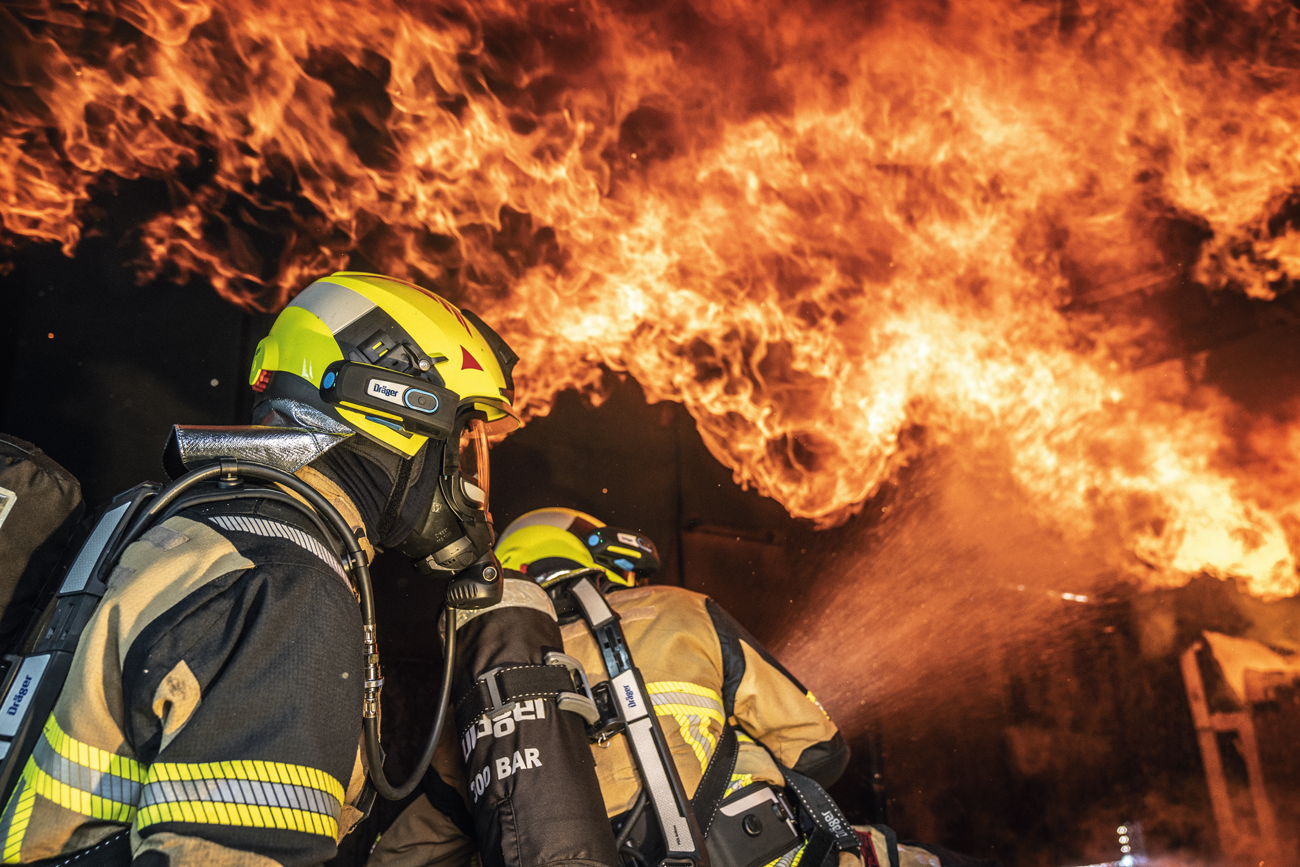
Modern protective equipment, such as Dräger’s PSS® AirBoss, helps support the modern-day firefighter, offering a lightweight, ergonomic harness and waist belt to adapt the distribution of weight to each individual user, carried by the legs and pelvis, rather than the shoulders and back.
Adjustability of equipment is also key to enhance user comfort and experience, so that equipment can be adjusted quickly and correctly to suit different environments. Similarly, adjustable and adaptable equipment means it is far less of a challenge to accommodate individuals observing cultural or religious practices (e.g. the wearing of religious headwear or having facial hair) whilst remaining compliant with requirements of regulations issued by the Health & Safety Executive (HSE).
Focusing on comfort and decreasing the effects of physiological stress also extends the potential working duration of firefighters at the scene of an incident. The air cylinder attached to the PSS® AirBoss, for example, is engineered to optimise user-experience and reduce carried weight. In fact, the Type 4 Nano Cylinder offers a weight reduction of more than 75% when compared with Type 1 cylinders and is even 30% lighter than the widely used Type 3 carbon-composite cylinders. When coupled with a complete set including the Dräger FPS 7000 full-face mask, lung demand valve and 6.8-litre Dräger Nano cylinder, it weighs just 10.2kg, almost 8kg lighter than the industry standard.
Patented Nanotechnology as used in the Dräger Nano Type 4 cylinders has enabled Dräger to be able to supply the lightest cylinders in the world, compared to other cylinders in the market. But Dräger will not stop here, and we expect the next trend in industry to involve an even lighter set, with breathing cylinders eventually being lighter than the air they hold. This can only be seen as a significant technological revolution.

Cultivating connection and a Dräger eco-system for the firefighter
Enhancing personal safety in high-risk environments is not just achieved through comfort. It is also delivered through technology to provide sufficient information, foresight and communication to fire crews before, during and after entering a dangerous environment. The ability to streamline, integrate and utilise a combination of different safety technologies into one central system is therefore key to reducing unnecessary risk. Not only must fire personnel be communicating; so too must their kit.
Dräger’s FPS® 7000 full-face mask serves as a prime example, with its seamless integration with the Dräger HPS 7000 and HPS Safeguard helmets, the respiratory support system and in-mask communication equipment. This is further enhanced by the addition of integrated thermal-imaging technology, provided by the in-mask head-up thermal display, which is connected to the UCF FireCore thermal camera, enabling hands-free operation of thermal imaging. By combining these technologies in one centralised system, firefighters benefit from true system integration, reducing risk and enhancing personal and crew safety in the same instance – a true Eco-system designed to make our firefighters as individual people much safer.
Similarly, the PSS® AirBoss connects to Dräger’s FireGround telemetry and accountability system, which immediately registers the user onto the Entry Control Board (ECB) as soon as the air cylinder valve is opened. By automating this process, human error is eliminated during entry-control procedures, and makes rapid deployment of SCBA wearers automatic by presenting a more streamlined and safer process. Whilst logged onto the ECB, air consumption, breathing rates and cylinder pressures are wirelessly transmitted to the control board, allowing the incident commander to make tactical and operational decisions at an incident to reduce potential risks to life. By integrating RPE and PPE in this way, firefighters are given a direct line to a tactical radio to enhance their immediate health and safety.
Monitoring personal safety
Providing fire crews with holistic, inclusive protection solutions, as previously discussed, is critically important. Monitoring their live physical condition and exact location also supports a safer fire and rescue operation. Incident commanders have the ability to analyse and adapt incident strategies according to the status, location, health and wellbeing of individuals placed on the ground, which is done in real time.
Biometric monitoring is not in itself new. Utilised predominantly in the health, sport, military and aerospace industries, biometric data is used to monitor heart rates, breathing patterns and other vital markers – data which is of significant value to firefighting. However, what works in the health and sport industry differs dramatically from its potential use in the hostile, uncompromising environments that firefighters must operate. Biometric monitoring and 3D firefighter tracking and location have become key focuses for Dräger, working closely with fire and rescue services to develop the most applicable solution.
Traditionally, location tracking has relied on GPS and their contact with relevant satellites. Inside a building, the environment is GPS denied, which in itself renders a GPS-based system entirely impractical. Emerging digital technology provides more reliable and accurate localisation and tracking, and the system being developed between Dräger and Arwain augments real-time visibility for incident command and the BA Entry Control Officer. Presented in 2D or 3D form, real-time data is provided showing a firefighter’s horizontal and vertical location, including the room and floor they are in. It provides the ability to effectively see through buildings and locate and deploy fire personnel where they are needed most.
Integrating software into intelligence systems and mapping solutions must be a consideration in the future. And if we can combine this with biometric monitoring, asset management systems and accountability systems such as Dräger’s FireGround, as well as hosting them under a cloud-based platform, we can be sure that fire personnel are monitored, protected, accounted for and far safer whilst performing their critical role of saving lives.
Future trends and developments
It is the responsibility of a modern manufacturer to prioritise the health, safety and wellbeing of the individual at all stages of research and technological development, particularly when considering the high-risk environments that firefighters often encounter.
Optimising the ergonomic condition of the human body, protecting respiratory systems and enhancing the visual abilities of firefighters in extreme environments, are key to developing future technologies.
Dräger’s priority is, always has been and always will be to enhance the health, safety and wellbeing of a firefighter, and to ensure that in an industry where a split second can be the difference between life and death, firefighters return home safely.
About the Author

Brian Hesler is a Consultant and Specialist Advisor at Draeger Safety UK and former Chief Fire Officer for the Northumberland Fire and Rescue Service.

You must be logged in to post a comment.