
The modern-day Fire and Rescue Service (FRS), much like the world around it, has evolved following generations of technological development and improvement.
Technology must enhance and not impede operations, with fire-safety equipment designed with the wearer in mind. Communication channels must be live at all stages of a mission, and firefighters must be sufficiently aware of any potential hazards and complex structural challenges before entering an incident.
Similarly, the physical and mental condition of the wearer, and their location, must be constantly monitored in real time to support any adaptations in tactics or strategy to minimise casualties and maximise effective success. This can only be achieved through utilising a multi-faceted, technologically driven approach.
What must not be lost in the research and development of new systems and equipment is the focus of our work, prioritising the health, safety and wellbeing of the firefighter. Through listening to the user, and adapting and enhancing existing equipment to their requirements, we can ensure that firefighters return home safely after each and every shift.
Not only are FRS call-outs increasing in number1 but their nature, origin and approach are diversifying rapidly. Urban development, and the construction of modern high-rise structures, built to cope with the demands of population migration and an overflowing housing market, have created new challenges for the modern FRS.
Locating and rescuing individuals from complex multi-storey structures is a difficult task and monitoring the status and operation of fire crews is similarly challenging. To combat this, modern manufacturers like Dräger have placed increased emphasis on augmented location-based mapping and tracking technology and biometric monitoring to ensure that a firefighter’s physical condition and location is known at all times.
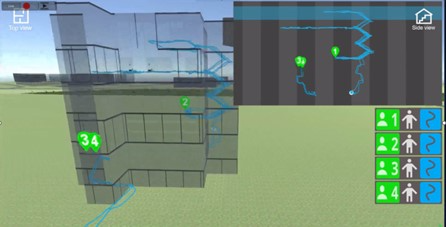
Developed in partnership with Dräger, Arwain’s digital localisation and tracking system supports real-time visibility for Incident Command and the BA Entry Control Officer, enabling both parties to track the live progress and location of fire crews once they enter a building. Presented in 2D or 3D form, real-time data is provided, showing the horizontal and vertical location of a firefighter, including the room they are in, and floor they are on. This technology differs from more traditional GPS-enabled or direction-based location systems that are rendered unavailable, inaccurate or impractical within the confines of an enclosed building. Coupling digital localisation with heads-up in-mask thermal imaging cameras such as Dräger’s UCF® FireCore gives the ability to navigate smoke-filled rooms and unfamiliar structures with maximum safety. Adding building plans and open-protocol digital mapping software into this combination has unlocked the next step towards creating a holistic real-time picture of the firefighters’ activities as the incident unfolds. Any operational firefighter knows that once a breathing apparatus crew has entered a building, identifying their precise real location is impossible. With the tracking system developed between Dräger and Arwain, this possibility has become a reality.
Monitoring the location of a firefighter on its own, however, is not enough. If Incident Command had the ability to access the physical wellbeing of a firefighter and their vital signs, the operation can be adapted to become more efficient and effective, with personnel withdrawn or deployed accordingly based on their physical condition.
Biometric monitoring is no new phenomenon. Sports, military, health and aerospace industries harness such technology on a daily basis, used to monitor heart rates, core body temperature, breathing patterns, oxygen levels and more – this is critical information that can directly impact and support fire and rescue missions. The practical technology utilised for an athlete, however, differs dramatically to the high-heat, hostile environments that an individual would encounter in the fire and rescue profession. We expect this to change in the near future and for such technology to become a mainstay for years to come.
Using and hosting a combination of biometric monitoring, hand-free heads-up thermal imaging and digital localisation technologies into one centralised platform will be a marked development for the industry. Enabling both firefighters and Incident Command to access this information in real-time would ensure that firefighters within the building, Entry Control Officers and Incident Commanders are always situationally aware and accounted for at all stages of a mission, thereby enhancing personal safety and operational effectiveness in equal measure.
Communication, integration and accountability
Whilst technological developments such as augmented visibility and biometric monitoring will advance the industry significantly, we must ensure that existing and future equipment is connected and communicating with each other and its users. This ensures that all communication channels remain live and open at all times, whilst at the same time ensuring automatic prioritisation of critical safety events and availability of key lifesaving information. Anything less than this can be fatal. In these extreme environments, a variety of different technologies must be utilised and used together to ensure safety at the scene of danger.
Systems such as Dräger’s FireGround system transmit vital information and host live incident reporting into one connected and communicating platform. Its ability to process digital data and integrate complementary technologies such as Dräger’s PSS® Airboss Connect SCBA set gauge, for example, is driving transformational change, reducing human error, supporting individual firefighter safety, and helping to create a documented audit trail of each stage of an operation. It is through accessing these audit trails that incident commanders can analyse the performance of equipment and individuals to determine what actions should be taken in future operations to secure an even safer, more effective outcome. It proves invaluable for post-incident or training-scenario analysis and feedback, as well as supporting easy access to holistic data in the event of any investigation, inquiry or fatal-accident inquiry.
Integrating and hosting multiple technologies is a priority for Dräger, ensuring that they not only communicate with one another but also with the wearer and incident commander overseeing them. This component is essential if we are to reduce unnecessary risk to life in the hazardous environments that firefighters often encounter. This applies equally to the safety of our firefighters and the victims they are striving to rescue.
It is important to note, however, that not all FRS organisations and brigades source their equipment from a single manufacturer. Multiple technologies may often be used, and this makes the importance of ‘true’ integration capabilities even more important. To this end, the evolution of cloud-based and Bluetooth-enabled technology is helping and providing the foundations to connect future innovations with existing hardware and devices. More simply put, technology – and the lack of true integration –must not confuse or complicate fire and rescue operations; it should enhance it. Integrating multiple and relevant technologies successfully, whilst developing easy-to-navigate solutions that enhance firefighter operations and protection, requires collaboration and close consultation across all parties.
Fostering partnerships and collaboration
To this end, Dräger is proud to have a close partnership with the Fire Service College (FSC) and a large number of Fire and Rescue Services across the UK and internationally, working together to further advance technical innovation and optimise product development that our firefighters want and need.
The FSC trains more than 7,000 firefighters and leaders every year using various scenarios across vehicle-based, high-rise, domestic and industrial structures – all of which are used for real and simulated fire and rescue exercises on a daily basis. Across the term of this partnership, products including Dräger’s PSS® AirBoss Connect SCBA kits, telemetry, thermal imaging and communication technologies have all been trialled and tested to ensure what works in the R&D centre, also works in real life. It is this partnership that reflects Dräger’s commitment to turning ‘technology’ into ‘Technology for Life’.
For more information, go to www.draeger.com/en_uk/Safety
References
About the Author

Brian Hesler is a Consultant and Specialist Advisor at Draeger Safety UK and former Chief Fire Officer for the Northumberland Fire and Rescue Service.
