

Siemens Building Products and one of its partners Jackson Fire & Security are focusing on the importance of competence in the provision of fire-safety systems in care homes.
Care homes have their own specific requirements in terms of effective fire protection, the nature of the elderly occupants and their mobility issues obviously being a particular focus in selecting an appropriate method of protecting the occupants and the building itself from the threat of fire.
This issue of competence is a point raised in a report to CROSS-UK (Collaborative Reporting for Safer Structures UK), a confidential reporting system where professionals involved in the built environment can flag up fire and structural safety issues that they have encountered. The report followed the fire and rescue service sharing two incidents that exposed residents to risk. It concluded that it believes a wider issue potentially exists across the entire care-home sector.
It is vital to have a clear understanding of what is required when it comes to ensuring fire safety in a care home. That starts with effective and sufficiently regular fire-risk assessments carried out by a competent fire-risk assessor who takes both the environment and the types of residents and their specific needs into account.
Many care homes operate with older conventional fire-alarm systems. The British Standard recommends addressable systems to enable the location of an incident to be identified quickly. Upgrading to an addressable system has cost implications with some systems requiring not only the replacement of devices but also reconfiguration of the wiring into a loop. Others, such as those from Siemens, do not require such wiring changes (providing the cable is of a good standard), thereby offering considerable savings in installation costs.
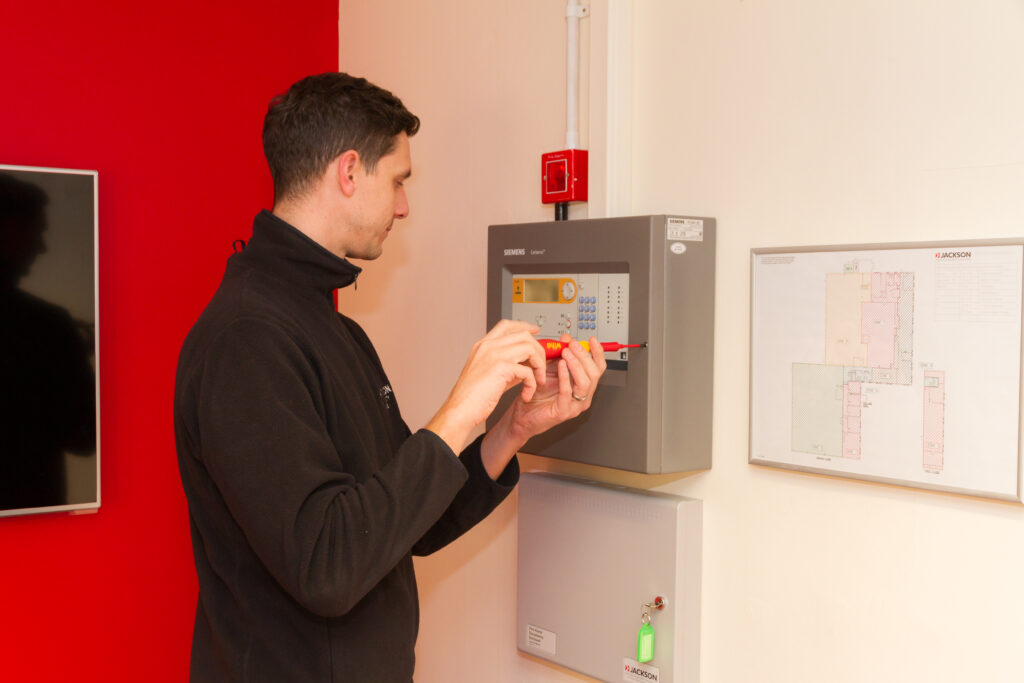
The British Standard recommends L1 (maximum life protection automated fire alarm system coverage throughout) in large nursing homes and many specifications for smaller homes will also specify L1 after the appropriate risk assessment. Minimising false alarms is obviously paramount given the inability for occupants to evacuate quickly. Zero false alarms is an even better scenario in an application where an alarm can cause panic, confusion and considerable disruption. Jackson Fire & Security uses Siemens ASA detectors which include a guarantee of no false alarms, with multi-criteria detection technology which detects a fire incident quickly. Crucial to this is the ASA (Advanced Signal Analysis) which dynamically responds to different fire and deceptive phenomena signals such as toasters or steam. Drift compensation, whereby the detector ensures a constant sensitivity despite any build-up of dust or dirt within the chamber, is another essential feature that ensures consistent performance during a detector’s lifespan.
Training of the personnel responsible for the installation, commissioning and maintenance of a fire-alarm system is also fundamental. Steve Jackson is Managing Director of Jackson Fire & Security. He comments: ‘Whenever we bring a new franchisee on board, we ensure that they receive full training directly from Siemens in the equipment they will be installing. It is important that any care-home owner or operator checks the competence of anybody employed to carry out work connected to fire safety. There should be no compromise on competence given that this is a life-safety issue. We have wide-ranging experience in designing and installing systems for care homes and appreciate the particular challenges they represent.’
Rob Yates is Siemens Head of Building Products Fire Safety in the UK and Ireland. He adds: ‘Training has always been an important focus in our relationships with our partners, whether it is online or face-to-face. We are constantly looking at our training programmes to make them more customer-focused, ensuring that the full benefits of our systems can be realised. I can only reiterate Steve’s comment about the importance of ensuring the competence of engineers employed.’
For more information, go to www.siemens.com
About the Author

Siemens
Siemens AG (Berlin and Munich) is a leading technology company focused on industry, infrastructure, transport, and healthcare. From more resource-efficient factories, resilient supply chains, and smarter buildings and grids, to cleaner and more comfortable transportation as well as advanced healthcare, the company creates technology with purpose adding real value for customers. By combining the real and the digital worlds, Siemens empowers its customers to transform their industries and markets, helping them to transform the everyday for billions of people. Siemens also owns a majority stake in the publicly listed company Siemens Healthineers, a globally leading medical technology provider shaping the future of healthcare. In fiscal 2023, which ended on September 30, 2023, the Siemens Group generated revenue of €77.8 billion and net income of €8.5 billion. As of September 30, 2023, the company employed around 320,000 people worldwide.

You must be logged in to post a comment.