
Battery fires within energy storage systems (ESSs) aren’t as rare as one might think.
The reason they are often underpublicized and, fortunately, there haven’t been more tragedies is because ESSs are often installed away from residential or commercial areas.
However, with the ongoing adoption of renewable energy production, in addition to electric vehicles, microgrids and other green-energy solutions, ESSs will no longer be isolated to solar farms located in the desert or wind farms located in ‘fly-over’ country but rather will soon be found almost everywhere you look as they continue to push further into our suburbs and cities.
For example, in the near future EV owners may fuel up at their local grocery store’s fast-charging station, powered by roof-top solar panels and discharged from an ESS.
This is why it is critical for local AHJs (authorities having jurisdiction), firefighters, city planners and decision makers to adapt to where technology is leading society. They must understand the hazards of ESSs and be educated on the best methods to protect them from the phenomenon known as ‘thermal runaway’.
The threat of thermal runaway
Lithium-ion batteries may catch fire when they’ve been abused or when a defective cell begins thermal runaway, a self-perpetuating process of a battery cell overheating and releasing heat into adjacent cells and modules.
Common methods of treating these fires are by using Class B sizing and protective methodologies and proving the results with small-scale testing. Yet, Fike internal testing and anecdotal evidence have proven that these fires continue to burn for quite some time, releasing enormous amounts of toxic and explosive gases and thermal load to other adjacent structures.
For example, during the unfortunate ESS fire incident in Surprise, AZ in 2019, fire suppression systems such as these were used to attempt to combat the hazard, as explained by Tom Farrell, Fike Principal Engineer of Test and Validation.
‘Did the fire protection system put out the fire? Arguably, yes it did,’ Farrell said. ‘It triggered, reduced the initial heat and diffused flames that were being generated from those batteries. But the pictures from the event, and the injuries sustained by the firefighters, tell a different story. The fire suppression system didn’t address the real problem, the problem of propagating thermal runaway. It’s extremely dangerous and unpredictable, and traditional fire suppression systems simply don’t solve the issue.’
Because there hasn’t been a reliable solution to cascading thermal runaway, AHJs are cautious to allow ESSs into their jurisdictions and one of the primary reasons why ESSs are usually isolated to remote locations.
Why don’t traditional systems work?
Indeed, the fire can be suppressed with various traditional means – chemical agents, water, water mist and inert gases – but the threat remains as a thermal management problem.
Because most of those systems discharge and deplete, and because these events may occur over a fairly long period of time, the next time a cell experiences thermal runaway and generates more toxic gases, it pushes the protective gases out of the system, and that element of protection no longer exists within that module.
This leads to a situation where a solution is needed that’s not just a fire protection solution but also a thermal management solution to deal with the threat of cascading thermal runaway – when the hazard propagates from cell to cell, resulting in a chain reaction of increasing heat and explosive offgassing.
Far too many owners of ESSs are unaware of this issue, as they believe they are protected by their traditional fire protection systems.
Findings from initial battery module testing
Fike’s Innovation and Testing Center located in Blue Springs, Mo., just outside of Kansas City, focuses on unit- and installation-level testing, and more specifically on battery modules and racks of modules.
‘We take a lot of measurements on temperatures, heat flux, thermal load and much more, and we have high-speed cameras and thermal imagery to visualize the data,’ said Farrell. ‘We perform Battery Hazard Analysis, which is basically a UL 9540A test without the gas sampling, which we will have implemented in Summer 2024. We can test a variety of battery types, and this facility is where we’ve done the vast majority of our R&D work to date.’
When Farrell’s team first began performing these tests, after several weeks of initial testing with a customer’s lithium-ion batteries, the end result frustratingly confirmed to him and his team the theory that everyone else was believing: thermal runaway cannot be stopped.
‘We did an initial module test and all we did was let it burn and set into thermal runaway,’ Farrell said. There was an extreme amount of smoke generated. We had a ventilator running at about 20,000 CFM to extract that, and even still our test cells were completely filled with smoke and overwhelmed with gas generation, which is another reason these ESSs can’t be deployed near populated areas because that gas is toxic and there’s a lot of it.
‘This test was also characterized with extremely high temperatures on the surface of the module itself at about 450 degrees Celsius, and anything nearby is also receiving that heat. There’s nothing anyone can do with this until it cools down. At the conclusion of this test, it took about 18 hours for the skin to come back down below 100 degrees Celsius. So, it takes a long time, especially when you think about the thermal load on structures nearby or the ability for first responders to enter. They can’t do it. It’s just too hot.’
None of Fike’s current protection methods (chemical agents, water mist, inert gas and more) proved to stop this cascading reaction, until the team finally discovered a promising solution, which would later be named Fike Blue.
The effectiveness of Fike Blue
Farrell’s team decided to apply this new solution to those same batteries.
In the test, only six of the 36 cells were lost. Everything else in the case was unharmed and it drastically reduced the thermal output and offgas that came off the system down to about 60–70 degrees Celsius, a far cry from 450 degrees Celsius reached during the free burn test.
‘These are extremely low temperatures for these kinds of fires, low enough where immediately after an event first responders and utility personnel can enter and extract that module that is having the issue using typical PPE,’ Farrell said. ‘It did still generate some offgas, but it reduced the gas generated by 36 cells to six cells, assisting in the ventilation system’s job to dilute and diffuse it. This means that if you’ve reduced those toxic emissions, you can bring these systems much closer to populated zones.’
In conclusion, Fike Blue had been proven to not only suppress a fire but also to stop cascading thermal runaway at the module level.

A similar test was also performed at CSA (Canadian Standards Association), a nationally recognized test lab with a full rack of batteries. The team used the same setup, and the event was over in about five minutes.
‘The experts that were there had commented they had never seen this done before, and we’ve done it several times now in front of those experts,’ Farrell said. ‘They were unaware of any agent that was able to successfully stop cascading thermal runaway inside of a module.’
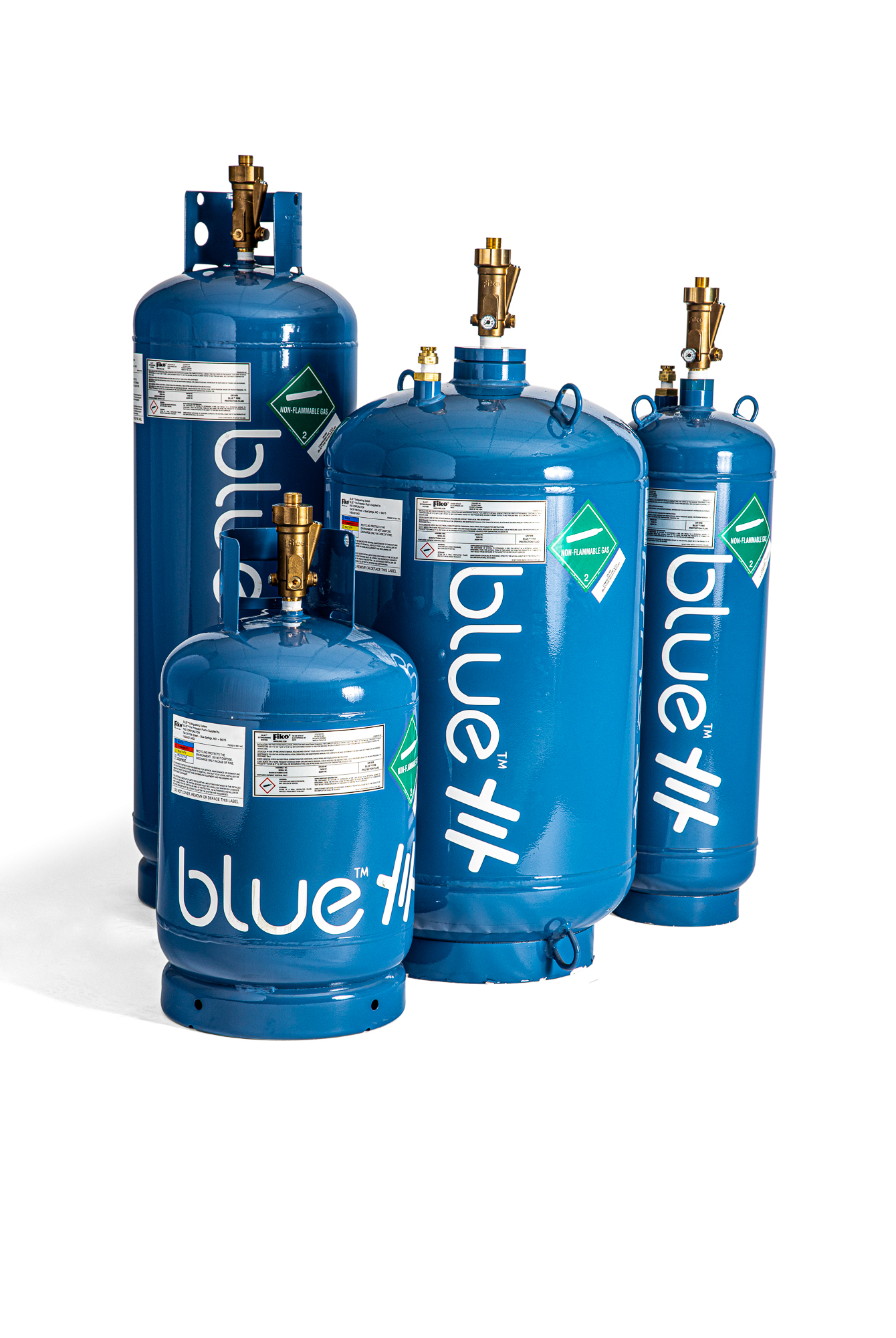
Fike Blue is a liquid, directly injected into the module and intended to manage the thermal event by absorbing the heat. It has a very high boiling point, much higher than water, and immerses the module until the event is over. It doesn’t dissipate like gases would in a typical fire suppression system.
During the testing, Farrell’s team only used about 26 gallons of Fike Blue as opposed to the thousands of water that would be required with traditional sprinkler systems or from a fire hose. Also, it’s completely non-toxic, biodegradable, and because so much less of it is used, the concerns about contaminating groundwater or having an issue with environmental authorities is significantly less.
Finally, Fike Blue opens up a very real possibility that ESSs may be safely deployed into various urban environments. In Fike’s opinion, this makes the ‘let it burn’ strategy adopted by various industry professionals and decision makers a strategy that is non-sustainable and ultimately unsafe, particularly when a better solution exists.
‘Letting it burn is a strategy I find to be irresponsible at best and dangerous in typical scenarios for two main reasons,’ Farrell said. ‘One, is the incredible thermal load you subject other structures to and other batteries to, and the other being the immediate danger to the environment and life in occupied spaces. If you let a battery burn, you generate fire obviously but also an enormous amount of toxic gases. Letting it burn takes care of the flammable gases just fine if things are on fire, but all those toxic gases have to go somewhere. If you have 1,000 cells inside a battery, and you let all those burn, you generate 1,000 cells worth of toxic gas that is going into occupied spaces and render them unoccupiable for some time.
‘If this is in an urban setting, this can have disastrous consequences. If you’re able to suppress it and stop propagating thermal runaway, instead of losing 1,000 cells, you may only lose 50. Which means that can be dispersed and get to levels which are not quite so toxic to people in the immediate vicinity.’
For more information: www.fikeblue.com
About the Author

Fike Corporation
Life Safety & Critical Asset Protection
Fike protects industrial processes around the world from explosions, fires and pressure-related hazards to safeguard critical assets and business continuity, and most importantly, to ensure workers return home every day to their families.

You must be logged in to post a comment.