
It has been widely reported that multi-sensors can help to reduce false fire alarms, when compared with standard optical smoke detectors, while still providing early warning of fire. A research study to investigate variations in the types of multi-sensor available, their abilities to detect different forms of fire and their resistance to common false alarms has now been completed.
Summary of previous work
Previous studies have proposed that the greater use of multi-sensors could significantly reduce false alarms. These detectors potentially offer significant advantages over single-sensor smoke detectors, as they use at least two different sensors to more reliably detect the signatures of a fire. The most recent study, a summary of which can be found in Issue 2 of UK Fire, identified that potentially up to 38.1% of reported false alarms could have been avoided had multi-sensors been present. The study proposed 35 recommendations to reduce false alarms, one of which recognised that further research work was required to identify the variabilities and capabilities of multi-sensors.
The Fire Industry Association, the BRE Trust and 12 detector manufacturers agreed to support the study to investigate multi-sensors that is reported here.
Types of multi-sensor
At one extreme of multi-sensor design are the most basic types, in which there is little more than a rudimentary enhancement in the response to smoke when a heat signature is detected. At the other end of the scale there are very sophisticated devices that perform a multitude of intelligent functions, sometimes using multiple sensors to identify and ignore false alarms. Clearly, with such variations in performance capabilities, their ability to detect fires and reject false-alarm sources will also vary, depending on the level of sophistication incorporated.
Although there are many types of multi-sensor in the marketplace, optical heat multi-sensors using an optical smoke chamber plus one or more heat sensors are prevalent. Proper guidance on their selection and use is much needed, so this study focused on optical heat multi-sensors that contain at least one smoke sensor and at least one heat sensor.
Thirty-five multi-sensors from 12 detector manufacturers were categorised as basic, intermediate or advanced according to their complexity, with 12 basic, 12 intermediate and 11 advanced samples being used in this study. The majority of the selected samples were commercial multi-sensors, with a few being domestic multi-sensor alarms. Whilst these multi-sensors were compliant with relevant standards, they were not necessarily claiming to be compliant with the latest EN 54-29 standard.
Fire tests
A good multi-sensor would be expected to respond to a broad range of fires that are more challenging than the TF2, TF3, TF4 and TF5 test fires used in the EN 54-7 test standard for smoke detectors. Therefore, two additional test fires from the EN 54-29 test standard for multi-sensors, and four additional test fires developed by BRE, were also used to challenge the technology.
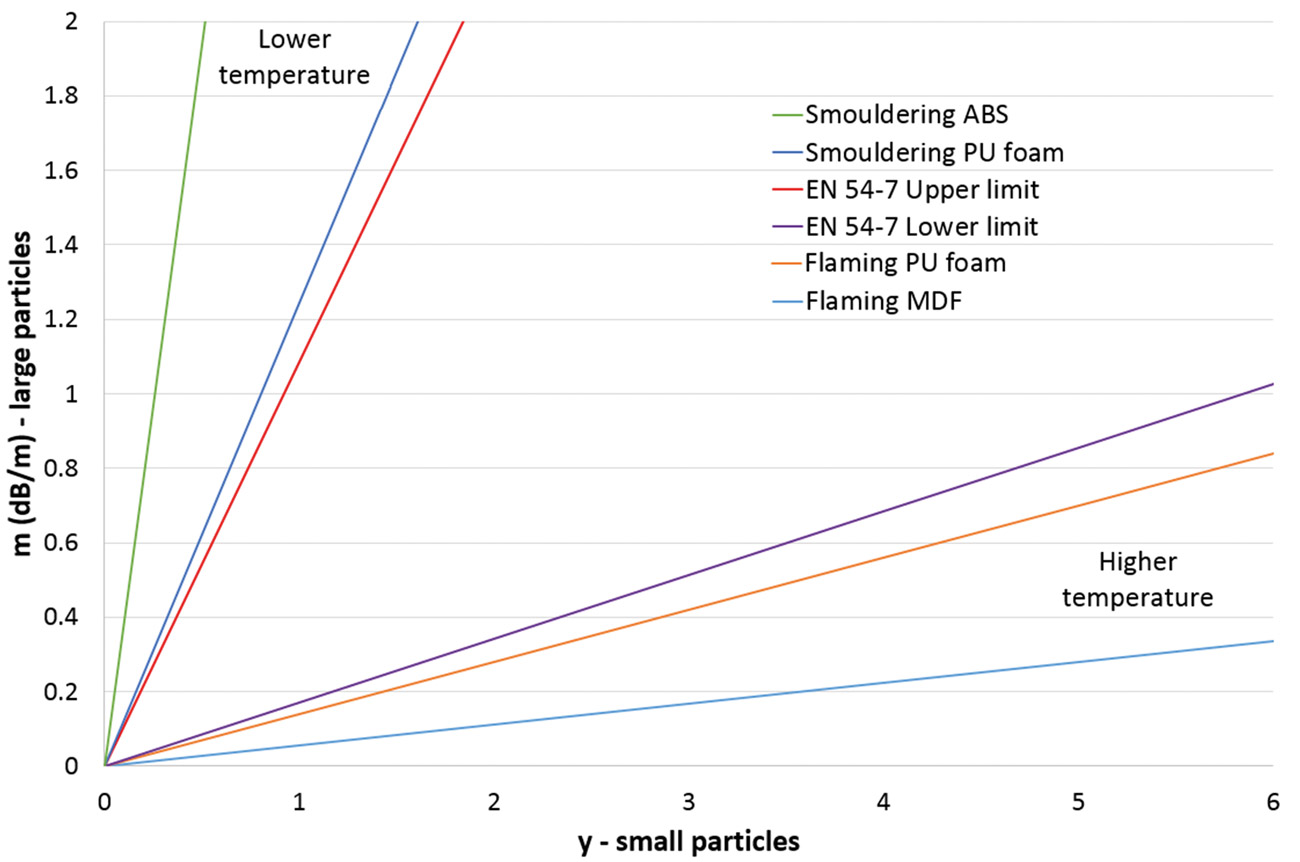
The new fires created for the tests included flaming fires, using MDF and flame-retardant polyurethane (PU) foam, which produce heat without much smoke, and smouldering fires using flame retardant polyurethane foam and ABS, which produce more smoke without much heat. These fires result in a low signal being generated at one of the sensors to demonstrate the multi-sensor’s ability to recognise a fire – and differentiate it from a false alarm, such as burning toast that may also produce a low signal for the heat sensor.
As can be seen from Figure 1, test fires were achieved that were beyond the limits of the existing EN 54-7 test fires.

False-alarm tests
Ten false-alarm types were explored in detail with a view to developing or using existing methods to test products to these common false-alarm types. One of the challenges of the study was to determine whether the false-alarm tests should exactly replicate reality or whether the focus should be on test repeatability. Trying to replicate what happens in the service environment introduces an element of variability and lack of control. Such a methodology is likely to produce broad responses for the same detector when tested multiple times and therefore cannot be used for a comparative study of different detectors.
Test methods for all ten false-alarm types were considered and the development of five false-alarm tests – namely the long-term dust build up, condensation, cigarette smoke, synthetic smoke and insect ingress tests – were explored but abandoned due to difficulties with developing repeatable tests. Developing suitable false-alarm test methods differed somewhat from real life, such as using water mist instead of steam. However, these were more repeatable tests that most accurately replicated the false-alarm phenomena. The five false-alarm tests used during this study were aerosol, short-term dust and water-mist tests developed by Duisburg University and cooking chips and toast tests developed by BRE Global Ltd. The fire tests as well as burning toast and cooking tests were performed in the BRE EN 54-7 fire-test room.
Fire-test performance
A broad range of responses had been observed for devices with the same sensitivity and in the same category, which may be due to the different approaches that manufacturers had taken during the development of the detectors. For example, some manufacturers would have taken the approach of lowering detection sensitivity to reduce false alarms, whilst others will have incorporated sophisticated algorithms to analyse the heat and smoke signatures. It would be expected that high-sensitivity detectors would, on average, respond sooner than medium-sensitivity detectors, which would in turn respond sooner than those of low sensitivity.
Multi-sensors defined as ‘basic’ category devices demonstrated the widest response on seven out of the ten fire-sensitivity tests, indicating that the variabilities of ‘basic’ devices is significantly higher than those categorised as ‘intermediate’ or ‘advanced’.
The end of test fire limits of y=6 and m=2 dB/m from the EN 54 series of standards were applied for the additional fire tests and when a device alarm response was reached that exceeded these it was considered a failure. Multi-sensors and optical smoke detectors had similar pass rates of around 90% for all detectors over all test fires. In general, the reference domestic optical smoke alarms operated first in the test fires and the multi-sensors and reference commercial optical smoke detectors operated much later in mixed orders. In terms of multi-sensor pass rates across categories the basic, intermediate and advanced devices were 90%, 85% and 92% respectively.
Whilst the performance of multi-sensors during the fire tests had been found to be similar to the single-sensor smoke detectors the false-alarm tests were expected to demonstrate the benefits of multi-sensors.

False-alarm test performance
The multi-sensors on average responded after the reference optical smoke devices for all five false-alarm tests performed. Whilst this is a great result for demonstrating the delayed response of multi-sensors to false alarms, the toast false-alarm test further demonstrates the benefits of the multi-sensor. During the toast test the multi-sensors typically operated around 40 seconds after the smoke detectors, but around 60 seconds before the toast ignited. This result shows that the delayed multi-sensor response allows more time for someone to intervene before a fire is present, yet it responds in good time before a fire is present.
The responses of individual devices as well as the average category responses were plotted. Figure 2 shows, as an example, the results from the water-mist test for all multi-sensors and the reference smoke devices.
The domestic smoke alarm responded first demonstrating poor resistance to the water-mist false alarm. The basic multi-sensors and commercial smoke detector had a similar performance but intermediate and advanced categories on average demonstrated increasing resistance during this false-alarm test. Overall for the false-alarm tests the responses starting with the quickest was domestic smoke detectors, commercial smoke detectors, basic, intermediate and then advanced multi-sensors. The improved resistance to false-alarm phenomena observed for the multi-sensors in the ‘advanced’ category indicates that the product design features intended to improve false-alarm resistance were effective.
In Figure 3 the mean response of the multi-sensors has been normalised to the mean response of the optical smoke devices for each of the false-alarm tests. During each of the five false-alarm tests the multi-sensors, on average, operated when a greater concentration of smoke was present when compared with the single-technology reference smoke devices.
Conclusions
Before exploring the benefits of multi-sensors demonstrated in this study, it is worth noting the following general observations:
- The sources of false alarms, in the majority of circumstances, tend to be present for a limited period of time before dispersing, e.g. steam from a shower room.
- Fires, in contrast, will typically tend to develop with increasing concentrations of smoke and heat and continue to grow over time.
During the false-alarm tests it was observed that the multi-sensors responded, on average, much later than the single-technology optical smoke detectors. This delay in operation gives time for transient false-alarm sources to disappear before the multi-sensor fire threshold is reached, thereby avoiding an unwanted alarm. There is also more time for building occupants to discover and respond to the false-alarm source before a fire alarm is triggered.
The use of multi-sensors would be unlikely to eliminate all of the 38.1% of false alarms reported earlier, but the additional delay in response may have prevented a significant number of those events from developing into false alarms.
Similar pass rates were observed for multi-sensors and optical smoke detectors to the ten test fires, but in all five of the false-alarm tests the multi-sensors typically operated after the reference smoke devices. On average, the false-alarm resistance increased with the greater sophistication of the detector, with the ‘advanced’ category detectors demonstrating the most resistance. As expected, multi-sensors set at lower sensitivities operated later in test fires and to false alarms. The basic multi-sensors were found to have the greatest variabilities in response to fire tests, with some being the first to operate and others operating towards the end of the test.
To conclude, this research has shown that the use of multi-sensor technology has the potential to reduce certain types of commonly encountered false alarms. However, the extent to which this can be realised depends on the particular implementation of features designed to improve false-alarm immunity. It cannot be assumed that use of just any multi-sensor detector will impact significantly on the occurrence of false alarms from every fire-like phenomenon.
Further work
This research has shown that it should be possible, and relatively simple, to produce a product standard that would enable multi-sensors to be graded according to their resistance to specific, commonly encountered phenomena that result in unwanted alarms. On that basis, codes of practice, such as BS 5839-1 (or a supporting Published Document), could give advice to users on the selection of multi-sensors for specific applications.
For more information, go to www.bre.co.uk/firedetectionresearch
About the Author

Principal Consultant (Fire Safety) at BRE.

You must be logged in to post a comment.