
Circumstances vary from country to country, but every member of GESA’s Global South Advisory Council agrees: a fundamental challenge facing the future of Emergency Services throughout the Global South lies in measurement. How exactly can we measure success in ways that are simple enough to share with the public and robust enough to drive policy and procurement toward better service?
‘Especially in developing countries with limited legislative and policy frameworks, how can the Emergency Services sector measure progress?’ – GESA Advisory Council Member, Francis Ndeleva – Chief of Fire Services, Kenya Airports Authority
International standards for data collection exist across different parts of the sector – for example, data collected by CTIF. But data-collection systems designed for the Global North can be technically or politically hard – or simply too expensive – to consistently implement on the ground across the developing world. Understanding the state of Emergency Services often requires data gathering across multiple ministries and agencies. Data gathering takes time and budget, which are often lacking. And, as we saw in work done by GESA’s Founding Members and the World Bank in 2018–19, there isn’t any real template for measuring success that is available to practitioners and ministries the world over.
The result is a situation where practitioners struggle to capture the data they need to make their case for essential budgets, where planners struggle to prioritize Emergency Services, and where donors and the public lack the ability to see progress, limiting crucial public support. What is left is a vicious cycle – a public often poorly served by a mostly under-resourced Emergency Services community that doesn’t have the tools to deliver the service they know is needed.
Starting from the old adage ‘what’s not measured isn’t valued’, GESA’s Advisory Council has been hard at work on this issue, looking in practical terms at what should be – and realistically can be – measured in a time- and resource-constrained environment, like many parts of the Global South. To look at the issue, the Advisory Council, which includes leading practitioners from across Africa, Latin America and Asia, focused on the practical questions: What can be measured quickly, simply, regularly? What can countries that wish to improve their ES environment do for themselves to measure and communicate progress to different stakeholders?
Based on recommendations from these star practitioners, we settled on a few different possible measures of success that any tool might want to take into account. These include metrics around:
- Investments in hard assets and personnel, such as number of firefighters per population
- Annual per capita ES budgets as a marker for commitment and success
- Training delivered and standards implemented as a measure of professionalism
- Issues with direct impact on citizens, such as firefighter and EMT response time
- Public perceptions of ES and community engagement
- Efficiency in the system, such as quick and transparent procurements, and the amount of time it takes to get gear into the hands of first responders
The Advisory Council then went a level deeper to rank different categories of metrics based on the level of importance, ease of measurement and what government decision makers care about most.
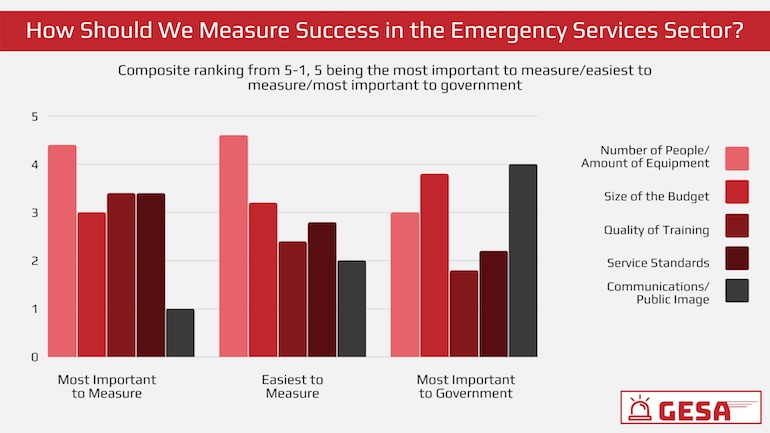 The results were both unsurprising and illustrative. Practitioners emphasized the need to measure better equipment and training. They saw personnel, equipment and budget as easiest to capture. But they realized that capturing the connection to the public/public image is one of the most important leverage points to government. Simply put, different audiences value different metrics. To communicate with everyone and build the national coalition needed for consistent improvement of Emergency Services across the Global South, we will need metrics that speak to many stakeholders.
The feedback from many conversations with AC members was clear: we need to build the tools to help practitioners track the success metrics that are important to them and the communities they serve – and we need to do it today. But we can’t do it alone.
With inputs and leadership from our Advisory Council, GESA is launching a six-month global effort to unpack the issue of metrics, to help us get the questions and approaches right. Please join the conversation. Share your insights and expertise as we work to build tools to measure and improve Emergency Services around the world.
Our work in this area has only just begun! We know that much is needed to build approaches that can create the data necessary to show the advances being made – and the work that needs to be done – across the developing world. Please contribute your insights as we begin a six-month-long effort to explore the kinds of tools that can help us measure and improve Emergency Services around the world. Please join the conversation on our GESA LinkedIn Group or submit an application for membership.
For more information, please visit: www.gesaction.org

You must be logged in to post a comment.