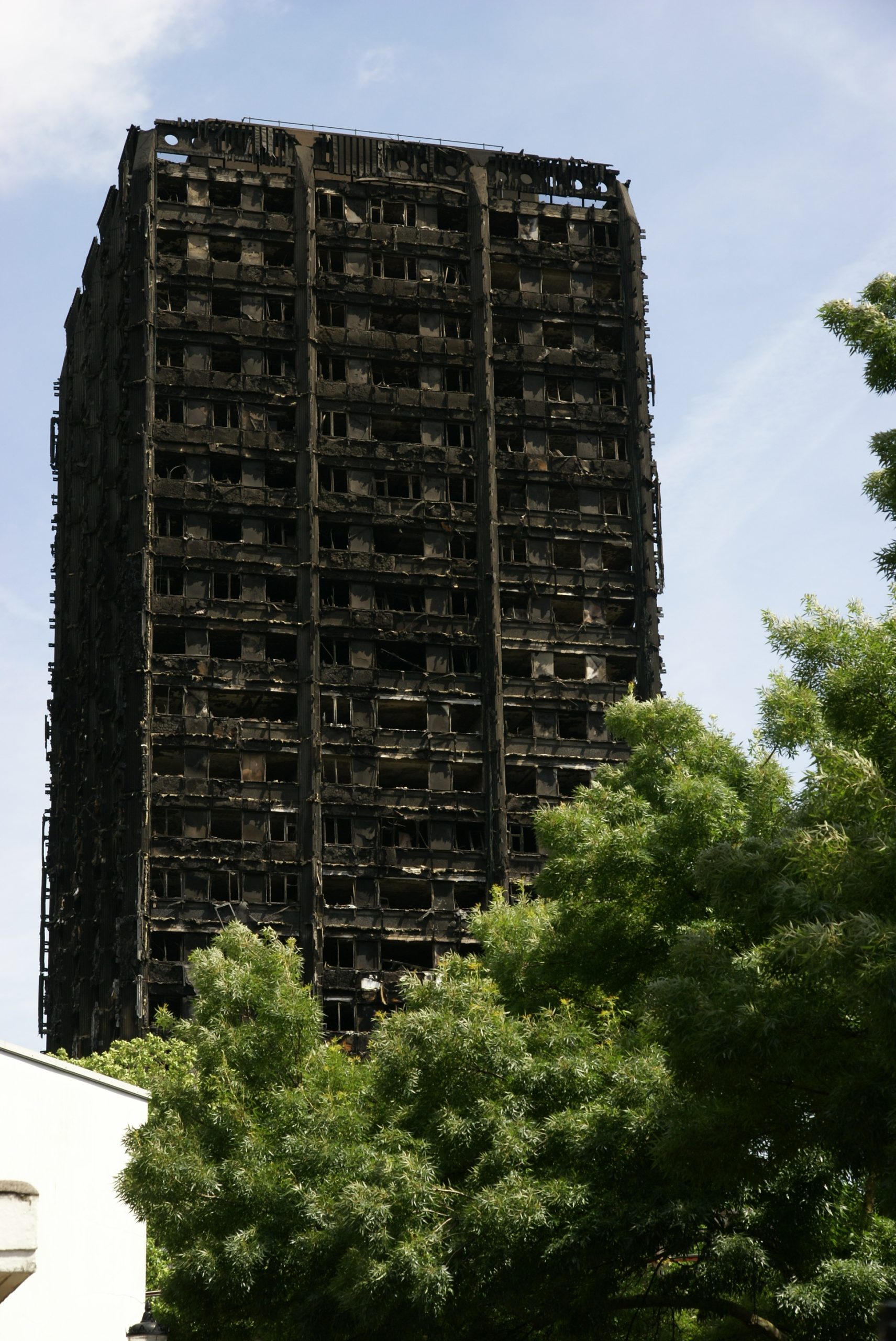
I have always felt that only lazy journalists and broadcasters relied on anniversaries for inspiration but in the case of the Grenfell Tower fire, the second anniversary of this horrific incident is probably a good time to reflect on what has – and more importantly, hasn’t – been achieved.
So, what has emerged from all the committees, meetings and enquiry sessions? Are we actually any surer that the deficiencies and hazards disclosed so disastrously have been eliminated? Are people who live in high-rise homes safer than they were on the morning of 13 June 2017?
I’m fairly sure that the most significant outcome so far is that there is considerably more public awareness of the dangers of what I used to call ‘external sandwich panels’ but have learnt now to refer to as ACM cladding but at the same time, it’s hard to accept that even the most basic improvements have been made, especially given the more than 470 towers that are thought still to be affected by non-compliant cladding. For example, there appears to have been no formal review of the ‘stay put policy’, nor the issue of fire-alarm systems.
Even more disappointing (at least to me) have been the outcomes of the Independent Expert Advisory Panel and the Hackett Enquiry. It’s my view that both of these well-intentioned groups missed major opportunities to promote early change in the way in which tower blocks are constructed and managed. In particular, while no one will disagree with Dame Judith’s wider recommendations, I cannot help feeling that imposing a new, complex structure to oversee the design and construction of a particular class of buildings is doomed to failure, not least because the skill sets demanded of the new organisation are in short supply and thus will command high salaries – which will have to be directly funded by the customers of the new body.
More disappointing still is the time being taken to deliver the Judicial Enquiry. While no one would welcome a less-than-comprehensive review of the circumstances that led to the fatal fire, the enquiry will probably not report before the end of 2021. Of course, this means that ‘Justice for Grenfell’ will be delayed until it does, as matters relating to criminal prosecutions cannot start. (I note in passing that the nearest thing to a Royal Commission on the fire service, the 1970 Holroyd Report, only took three years to deliver).
There are, however, clear signs that at least someone in government is listening. The agreement that central funds will be found to remove and replace cladding in social housing blocks is a hugely welcome. What a pity the same generosity was not extended to private developments where many first-time buyers now find they are living in a property with zero value and are still expected to pay for palliative measures such as ‘walking patrols’ and then also meet huge bills for cladding replacement.
If the government had adopted a more generous approach, it might have gone some way to exculpating their liability for ignoring the coroner’s recommendations in respect of the installation of sprinklers after the Shirley Towers and Lakanal House fires. The then communities secretary wrote to social-housing landlords affirming that he had a ‘commitment to ensuring that the safety of residents in high-rise buildings continues to be a priority’ and asking them to consider sprinklers.
Inside Housing have disclosed evidence that the Tenant Management Organisation responsible for the Grenfell refit were actually considering the installation of sprinklers as part of that refurbishment. This was not, of course, proceeded with because officials at the TMO were reportedly informed that ‘initial indications from CLG are that these recommendations (i.e. the installation of sprinklers) are unlikely to be taken up’.
Of course, had the TMO ignored the ‘indications’ from CLG and included sprinklers in the £10 million refurbishment, the outcome of the June 2017 fire would have been very different. The cost, by the way, of such an installation would have been in the region of £200,000.
The recent news that some Grenfell tenants have initiated civil proceedings against three US companies in Philadelphia brings a new dimension to the story. It would be ironic if the US courts decided on the liability of the manufacturer of the refrigerator thought to be the cause of the fire and that of the companies which manufactured the ACM panels and the insulation which backed them before the English Judicial Enquiry reports.
So where does that leave us, two years on? There are still many hundreds of residential towers with non-compliant cladding. Many of these structures also have single staircases and no common alarms and most still maintain a ‘stay put’ policy. In addition, we have now the problem of fires in combustible balconies. The fact that the Ministry of Housing only reminded authorities of the stipulations of Requirement B4 in July 2019 is more than a little worrying.
The Grenfell mantra ‘Never Again’ sounds, to me at least, a little hollow.
About the Author

Stewart Kidd MA, MSc, FIFireE, FIFSM, FSyI, FSA (Scot), CPP is a Chartered Security Professional. He has worked in security and fire protection since 1974 and now combines consultancy with expert witness assignments. He has a particular interest in the protection of national patrimony and built heritage, and he lectures and writes extensively on this subject. He is the author of eight books on fire and security topics including the Historic Environment Scotland’s Guide for Practitioners No 7, the Scottish Building Standards ACOP.