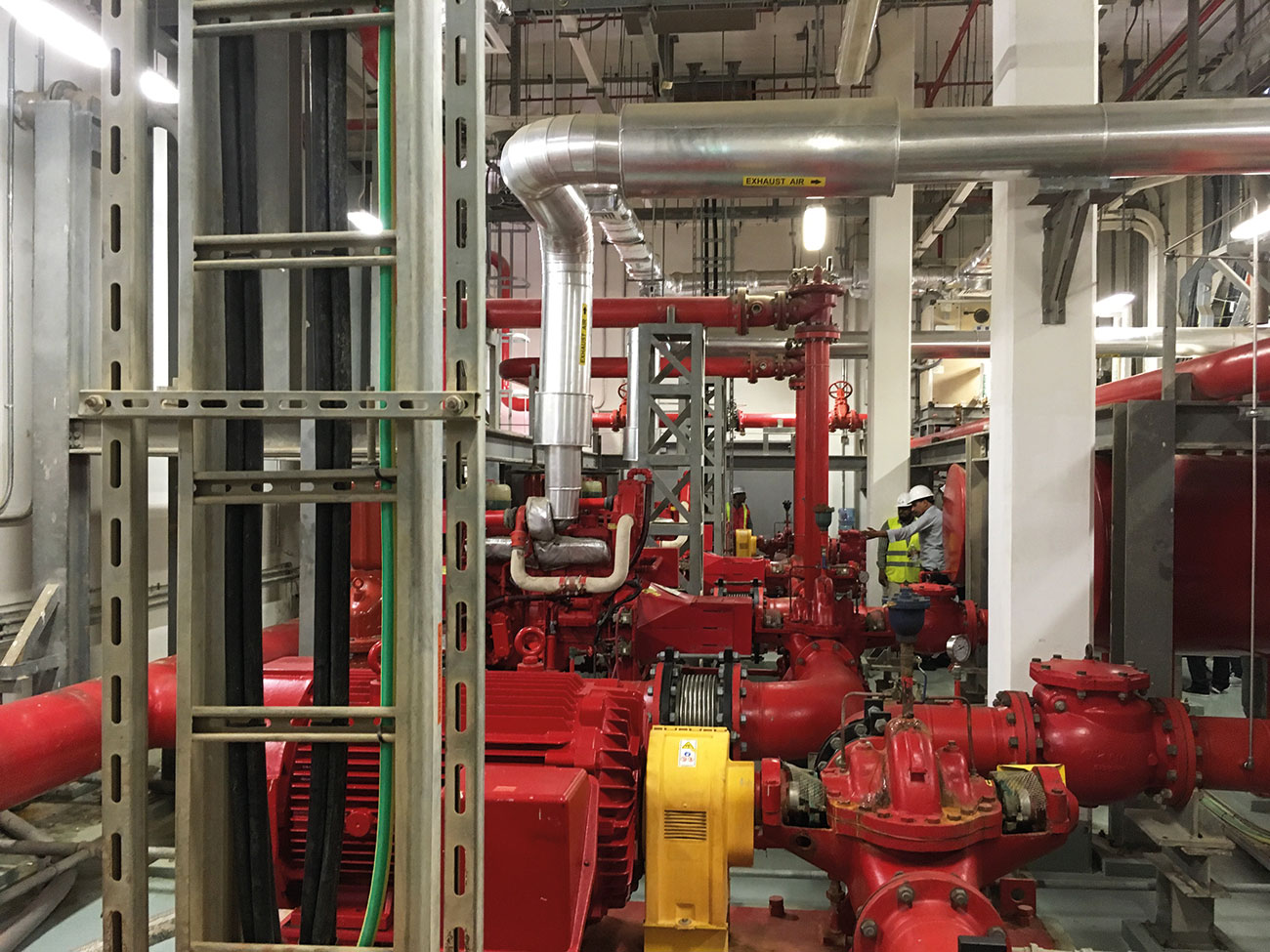
The motivation for this article arose from an observation overheard in a meeting when a consultant working for a social-housing provider questioned the need for BS 9251 to be specified for a sprinkler installation in a block of flats. His argument was that since BS 9251 had the subtitle ‘Code of Practice’ it did not need to be complied with as it was not a standard!
The revised BS 5306-2 and the Technical Bulletins (TBs) would appear to have satisfied the needs of the UK until a CEN group developed the first consensus European sprinkler standard, published in 2004. This standard, with a new set of TBs remained in use (with a couple of interim amendments) until they were superseded in 2015. Within CEN, the responsible committee, TC191/WG5 appears to have formed a view that the 2016 version was no longer fit for purpose. Comments such as ‘12845 is not being used for warehouse protection’ and ‘the lack of suitable guidance on emerging technology’ such as ESFR (early suppression, fast response) sprinkler heads has led to attempts to force the standard into new directions. Described by one member of the WG as being ‘revolutionary rather than evolutionary’, a radical change in the way hazard classifications are reached has also been criticised.
At the same time, according to some commentators, other standards are being widely used in Europe rather than EN 12845. Given that this standard is not harmonised under the Construction Product Regulations (that is, it is not listed as a hEN) it is perfectly acceptable to use other codes and standards. It would appear that these include:
- NFPA 13
- FM Datasheets
- CEA 4001
The last may surprise some who are not aware of this European Insurers’ document. However, it is a valid standard and is, for example, reportedly being called up in a major UK rail project.
Obviously, FM Global as an insurer promotes its own standards to its insured and given the expertise of FM-G’s engineers this approach ensures a widespread degree of compliance and high level of system availability. The same is true of some other insurers who take exceptional steps to promote standards compliance – including maintenance and annual hazard reviews. However, it is a reflection of the changing nature of the insurance market that much of the expertise that was once present in-house may be no longer available and underwriters are no longer able to rely on regular hazard reviews and sprinkler-system condition reports.
In the same vein, some insurers through RISC-A and the FPA have expressed concerns that the maintenance and inspection requirements in EN 12845 and the LPC Rules are not being complied with. Despite showing some evidence of issues with suboptimal pump installation and maintenance, and skimpy alarm valve servicing, it would appear that these concerns are essentially minor and are not reflected in large-scale system failures. Whether this is a factor of systems being over-engineered (and hence able to compensate for minor impairments) or good luck is not clear.
One result of the concerns expressed in some quarters has led to a toughening of the annual inspection clause in EN 12845. This now requires (Clause 27.1) periodic inspection annually by qualified personnel. The clause recommends (but does not mandate) that:
system inspections are undertaken by an independent body, e.g. not the system owner, building occupier, system installer (or competing installer) or service and maintenance provider (or competing service and maintenance provider)
This is a change from the original wording which made the ‘independent body’ inspection mandatory and actually excluded the insurer from doing this work! As far as can be determined, no independent data has been adduced to prove that inspections undertaken by installers or maintenance companies are in any way inferior to others doing this work. A cynical observer might reflect on the fact that in some countries there are technical bureaux associated with standards bodies and national fire-safety organisations that undertake such work. A UK observer could be forgiven for asking who will do this in the UK?
Relevant case law
It’s clear that in cases decided before the Sony DADC trial, judges were unwilling to impose duties on property owners to fit sprinklers where these were not required by law.
In J Sainsbury PLC v Broadway Malyan [1999] PNLR.286, HHJ Humphrey Lloyd QC ruled that Sainsbury had not been contributorily negligent in failing to put in sprinklers. He said:
‘Sainsbury was in my judgment free to decide whether it was in its own commercial interest to install sprinklers. Others might have done so, but I do not consider Sainsbury was at fault in not doing so. BM knew that there would be no sprinklers, as did EGP. They must be taken to have accepted the risk that any damage caused by negligence might therefore be greater than it would have been. I see no ground for holding that there was contributory negligence in not having sprinklers.’
As to the absence of fire barriers in the ceiling void, the judge reached the same conclusion, pointing out that no one from the relevant professionals had suggested that there was anything wrong in omitting cavity barriers. However, the judge did go on to make a finding of contributory negligence on the part of Sainsbury in relation to one of the fire walls, which had been built to a defective design and which the Sainsbury representative had failed to pick up.
In Fosse Motor Engineers Limited v Conde Nast and National Magazine Distributors Limited [2008] EWHC 2037 (TCC) Akenhead J dismissed the claim against the defendants for reasons concerned with causation. His findings in relation to contributory negligence where therefore obiter. However, on the topics of compartmentation and sprinklers, he said:
‘111(a) It was asserted that much of the fire damage was attributable to the absence both of a suitable system of sprinklers and of compartmentation at the warehouse.
(b) There was no statutory requirement (such as Building Regulations) for a building of this size built in 1976 to have sprinklers or compartmentation. (c) None of the literature at the time of the fire makes it clear that for an existing building of this age these are required. (d) There are numerous warehouses which do not have such systems in. Put another way, there seems to be a respectable body of opinion among warehouse owners that they are not necessary. e) Fosse was not required by the Fire Brigade who checked the building over some time before the fire or their insurers to install sprinklers or compartmentation. Fosse had taken some steps to provide an expensive new fire alarm system and other safety measures. f) The evidence on compartmentation was not satisfactory. There was no attempt to explain what compartmentation was needed as a reasonable minimum or the extent to which it would have limited fire damage. If it was extensively compartmentalised the damage would have been much less; if it was limited to means of escape for people little of the building would have been saved.’
In Trebor Bassett Holdings Ltd & Anor v ADT Fire & Security Plc [2011] EWHC 1936 (TCC) Coulson J said:
‘During the course of the evidence, I pointed out that I have never tried a fire case in which it was not suggested by the defendant that the claimants should, long before the fire, have put in sprinklers. Nor have I ever tried a fire case in which the claimant’s claim for the cost of rebuilding did not include the cost of a full sprinkler system. Both of those elements feature in this case. But what is unique, in my experience, is that here the claimants’ management at Monkhill were advised, not once, but twice (and by their own Group Risk Department, on whom they said they always relied) to put in a full sprinkler system and, on both occasions, they failed to follow those recommendations.
‘That is the most significant reason to distinguish this case from Sainsbury v Broadway Malyan and Fosse Motors. Unlike there, these claimants were positively advised that sprinklers should be put in; that sprinklers were the only certain way of eliminating the risk of fire. It is therefore necessary to look at the reasons why they were not installed, to see whether or not the conduct of the claimants can properly be criticised in refusing to follow the recommendations and, if so, what the casual significance of this default might be.’
Commenting on the failure of the claimant to follow the advice of their Group Risk Department, the Judge also said: ‘The extent and scope of the claimants’ failure to take on board the recommendations of the Group Risk Department were exacerbated by the events in the summer of 2004 when, for the second time in a year, there was a clear recommendation to Monkhill to put in sprinklers. This time, the report even spelt out the financial advantages of sprinklers; for a spend of £500,000, a projected loss of just under £30 million would be reduced to just under £1 million (see paragraph 357 above). The advantages are not therefore only apparent in hindsight; they were, or should have been, clear at the time.’
For more information, go to www.risk-consultant.com
About the Author

Stewart Kidd MA, MSc, FIFireE, FIFSM, FSyI, FSA (Scot), CPP is a Chartered Security Professional. He has worked in security and fire protection since 1974 and now combines consultancy with expert witness assignments. He has a particular interest in the protection of national patrimony and built heritage, and he lectures and writes extensively on this subject. He is the author of eight books on fire and security topics including the Historic Environment Scotland’s Guide for Practitioners No 7, the Scottish Building Standards ACOP.