
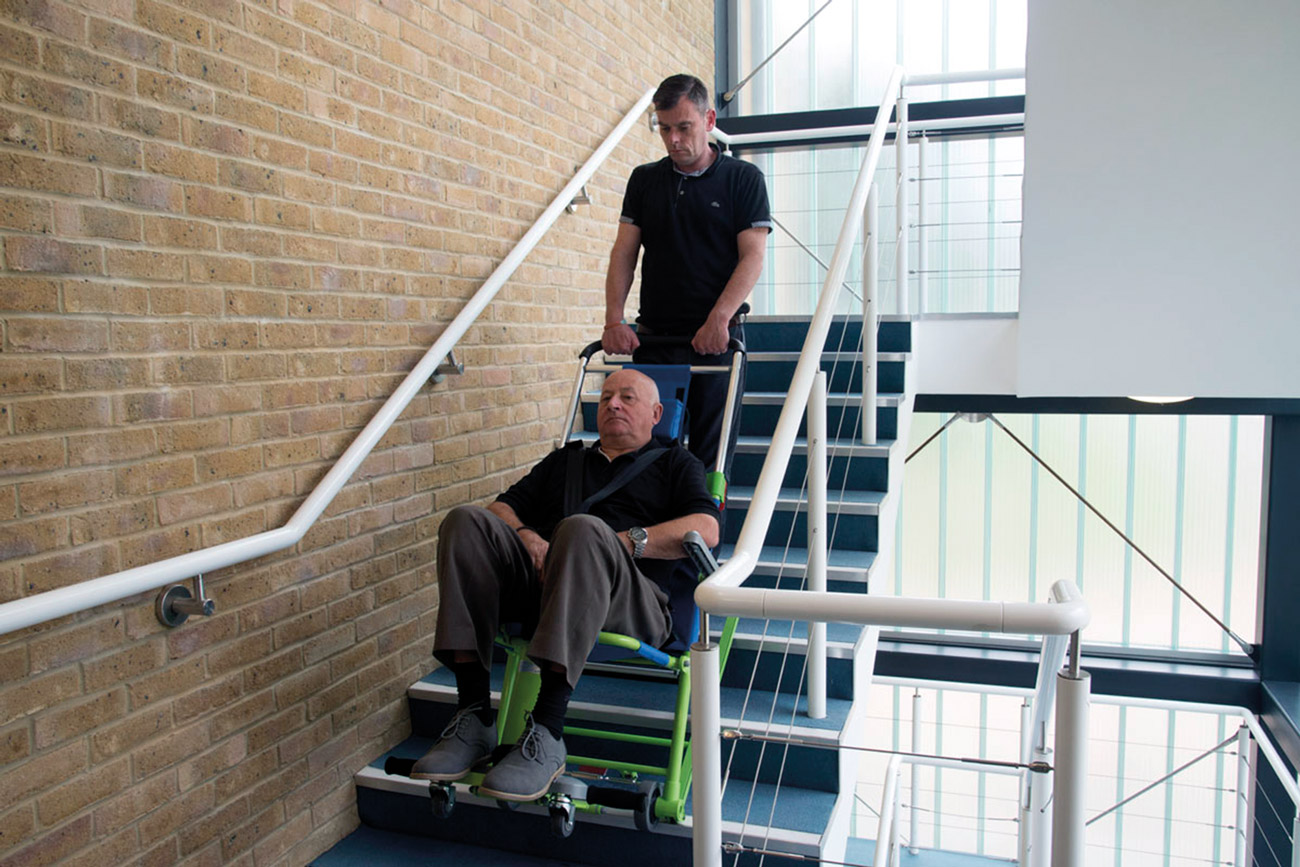
The importance of businesses having access to an evacuation chair, and the right training to be able to use it, cannot be underestimated. The Regulatory Reform (Fire Safety) Order 2005 states that business owners have a duty, by law, to ensure the safety of all people who are on their premises.
Emergencies can happen anywhere, at any time, and business owners need to make sure that they are always prepared to evacuate everyone out of their building safely and quickly.
What are evacuation chairs?
Evacuation chairs provide mobility-impaired people with a safe and comfortable way to evacuate a building in the event of an emergency, such as a fire.
The chairs can help a variety of different people who may be in your building. A person may be unable to be evacuated without assistance due to disability, an injury, mental health, pregnancy or other medical conditions. Evacuation chairs allow them to leave a building quickly and safely during an emergency.
Evacuation chairs are also known as disabled evacuation chairs, stairway evacuation chairs, fire evacuation chairs, or evac chairs.
How do they work?
The chairs are made out of materials that are lightweight but strong. While going down the stairs, the tracks attached to the chair create friction which slows down the descent and allows for a controlled journey. Once a person reaches ground level, the chair can then be used as a wheelchair to ensure the evacuee can get to safety. When not in use, evacuation chairs simply fold flat and are stored neatly on the wall.
As will be outlined in your fire-risk assessment and in section 21 of the Regulatory Reform Order, the installation of an evacuation chair requires the correct training of staff in their use and the chairs will also need a basic annual service.
It’s important to ensure that you have people in your building trained in evacuation-chair handling. This is so anyone assisting the evacuee is both confident and capable, and helps get everyone to safety in a quick and efficient way.

Do I need an evacuation chair?
Under current fire-safety legislation it states that it is the responsibility of the person in charge of a building to provide a fire-safety risk assessment. This assessment needs to include an emergency evacuation plan for all people likely to be in the premises, including disabled people. If your building is open to the public, you may have a wide range of visitors or customers.
In the UK today, 7.6 million people between the ages of 16 and 64 have some form of disability, which equates to approximately 1 in 8 people. There is a high chance that one of your visitors, or employees, would need assistance from an evacuation chair if an emergency were to occur.
Although neither the Disability Discrimination Act 1995 nor the Equality Act 2010 mentions evacuation chairs specifically, if a business owner or service supplier does not take action to provide a safe evacuation plan for disabled people, or limits access to parts of the building, this could be viewed as discrimination.
Don’t take the risk
Evacuation chairs play a vital role in the fire-safety and evacuation plan of a building. It’s so important to ensure that all employers, customers and visitors can safely leave a building in the event of an emergency. Evacuation chairs can save lives, and as a business owner, you have a responsibility to ensure that you are fully prepared for an emergency.
For more information, go to www.evacusafe.co.uk

You must be logged in to post a comment.