
I have spent nearly 60 years in the fire and safety profession and in this article we look at some of my experiences and lessons learnt. We consider how we can learn from other countries, the black art of fire safety in the UK, fire risk assessments, what can go wrong and problems in the fire-engineering profession.
During my time in the fire and safety profession I have seen many changes – some good, but many not so good. When I joined the fire service in the 1960s I was led to believe that I was part of the best fire service in the world and I did believe that until I went to work and study fire safety in the US and that really opened my eyes to another approach that was certainly different but more open, honest and transparent. Whilst the USA had many other different ways of working, I felt that we could learn a lot from our colleagues both in the USA and around the world.
Having brought and introduced some of those experiences into the UK I could see how we could learn a lot from ‘collaborative working’ with colleagues in other countries and so in recent years I have been trying to influence what happens in Europe by representing the ‘consumer interest’ on fire and safety matters. This is not an easy task when you have so many interested parties from organisations and countries of the EU around the table with so many different ideas and approaches, but of course that is one of the benefits.
The HSBC ‘We are not an island’ campaign is quite thought provoking in many ways and, when you consider fire safety and recent events, one that is very important. It is interesting to me because I previously worked for HSBC and know that they had some very good approaches to ‘collaborative working around the world’ and one that in the fire-safety field is extremely important if we are to truly learn from the experiences of past events and other professionals.

Black art
If you think about how we learn about fire safety in the UK, you soon start to realise that it is something of a ‘black art’ with there being many different bodies and organisations that people can go to for answers and many varying solutions. Obviously, there are many sources of information, but mostly these are driven by vested interests and unfortunately, in my opinion, this also now includes fire and rescue services (FRS). In the US the NFPA provides an excellent service both to the public and professionals and they also have the NFPA Xchange Forum for people to ask questions and get informed answers. In the wake of the Grenfell Fire the EC has set up the Fire Information Exchange Platform (FIEP) that aims to share information and experiences of other member states, and whilst I would like the information to be more used and referenced in the UK, it is at least a start, but how many people in the UK are aware of this initiative or the outcomes and why did the UK not take the initiative? Why was the European Fire Safety Week not really promoted in the UK because there is some interesting work that comes from it?
https://www.europeanfiresafetyalliance.org/european-fire-safety-week/ The topic for this year is LET´S PLACE CITIZEN SAFETY AT THE HEART OF THE ENERGY TRANSITION! – a topic that is so relevant to the UK.

Fire-risk assessment
This is a keystone part of the equation and covers many areas from those individuals and organisations that assess the risks to those that design, install and maintain the fire-protection and life-safety equipment to the Responsible Person (RP) – because they all play a key role in how the fire safety of the nation is managed.
I recently stayed in a hotel in Cumbria that I feel highlights some of the problems with the current system and the difficulties for the Responsible Person.
Whenever I stay in a hotel, I always look around the hotel both for my own safety and for my own professional interest. Obviously, I am only able to inspect the public areas, but this usually gives me enough information to form a good judgement about how the hotel management approaches fire safety.
My initial inspection of this hotel caused me some concern as I noted fire-resisting doors wedged open and with no intumescent or smoke strips, some high-risk areas not protected with fire-resisting construction, some escape routes not protected with fire-resisting construction and poorly defined, overgrown vegetation outside one fire exit and poor coverage in some areas with automatic fire detection. As I was concerned about the standard of fire safety, I decided to discuss the problems with the hotel owner.
When I tried to discuss these problems with the hotel owner he very quickly informed me that I did not know what I was talking about because he had a Fire Risk Assessment (FRA) that had been carried out by a local company and that the person that had carried out the assessment was a retired senior officer of the local fire and rescue service and that they had also inspected the hotel – he then turned his back on me and walked out of the hotel saying he did not wish to discuss it any further.
During my stay the fire alarm activated and it was noted that one of the fire-resisting doors that was held open on magnetic hold-open devices failed to close and that before the hotel had been fully searched, the alarm was silenced and a member of staff went around the hotel resetting the automatic hold-open devices. As I was concerned about the level of fire safety in this hotel, I sent a copy of my findings to the owner and as I was certain that he was not going to action any of the items in my 12-page report, I also sent a copy to the fire and rescue service. I did check on the company that the owner claimed had carried the fire risk assessment and this was what their website claimed: ‘We are all members of the professional body of the Institute of Fire Engineers (IFE) and our staff have completed a Fire Safety Diploma through the Fire Protection Association.’
Shortly after receiving my report the FRS inspected the hotel and issued a 13-page Enforcement Notice covering all the items that I had covered together with many more that had been discovered in areas that I did not have access to. It was also interesting that at about the same time I received a phone call from the MD of the hotel group that was quite threatening and telling me that I did not know what I was talking about and that he now knew where I lived. He also indicated that he was going to get my TripAdvisor Review removed, which he did, but I was able to get it reinstated thanks to the BBC.
Note 1. I did send a Freedom of Information (FOI) request to the FRS to confirm that the person that carried out the FRS was a retired member of their service and they replied, ‘Data not held’. In the same FOI I asked about their policy on the provision of intumescent fire and smoke seals on fire-resisting doors that do not comply with the current standards and the reply was ‘Data not held’. I was able to confirm by a phone call that this person had been employed by this FRS.
So, what does this incident say about competency, honesty and fire safety? From the hotel owner’s perspective they probably did all that they could to ensure that they were getting a professional FRA by a competent company, but as it turned out they were unlucky to get me as a guest and I certainly understand why they were upset.
From the FRS point of view, they acted quickly on my findings, and I now believe the hotel is up to current fire-safety standards, but what about the company that did the FRA and the Responsible Person? Clearly, there is a problem here, but is it with the assessor, the FRA company or the Responsible Person?
Note 2. I did ask the IFE to confirm that the company/persons referred to were on their register, but I have not yet received a response.

Fire-engineering profession
Another key area is the Fire Engineering Profession and one important lesson that I have learnt is to not take it for granted that systems that comply with relevant standards will work as stated by the manufacturer or installer and here is just one example of many that also include fire suppression and detection.
During my career I have overseen the installation of many large, fixed firefighting/suppression/detection systems and I always require that during commissioning the system is actuated and should be shown to extinguish/control/detect a typical fire. This is done to prove the system works as intended and to show the client that the system works as intended.
This incident involved the installation of a watermist fire-suppression system to large diesel generators in a data centre. The installation company was chosen for their experience, knowledge and manufacturer’s accreditation and I was taken to see several of their previous installations.
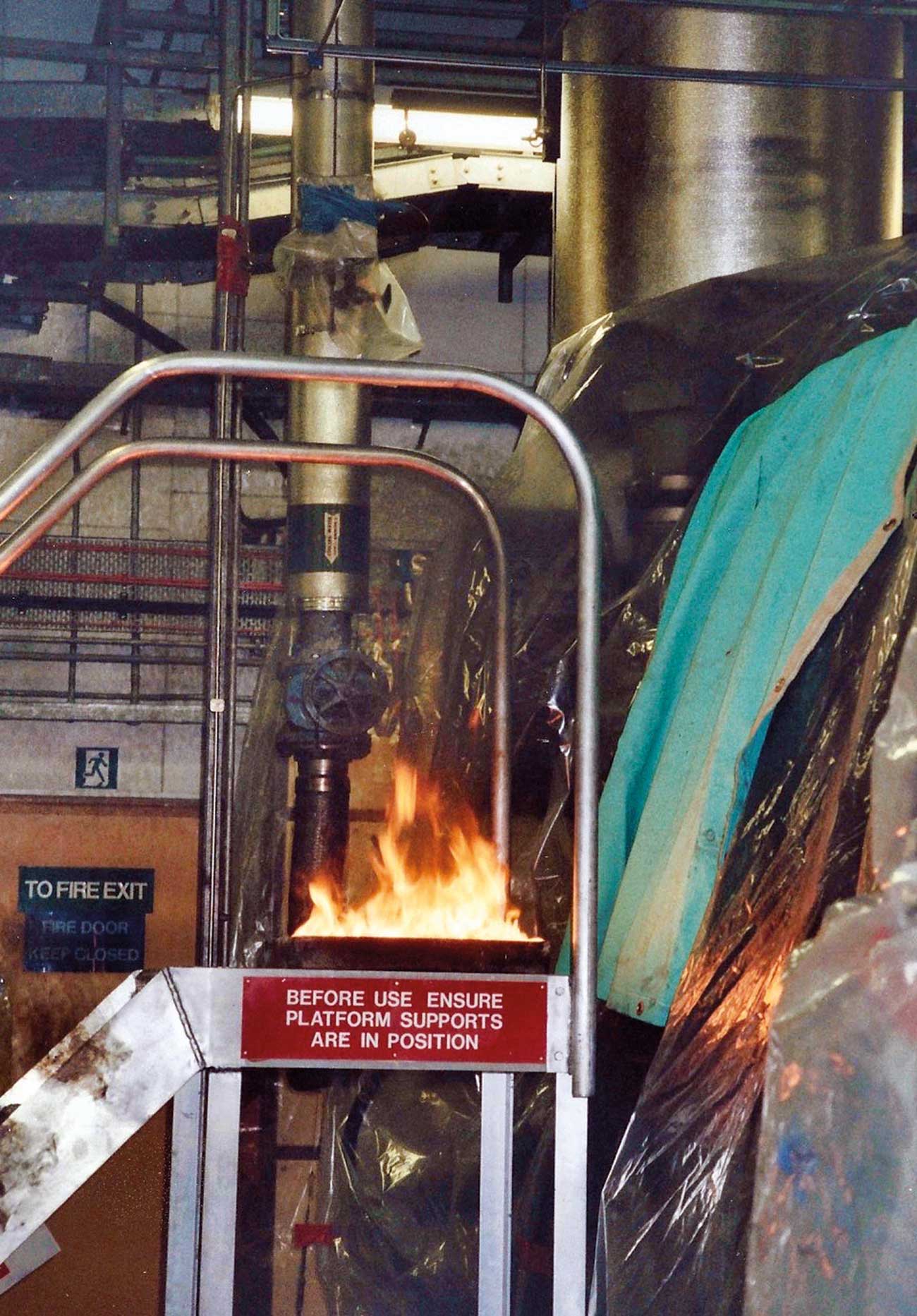
The installation went well and when it came to the commissioning rather than simply setting off the detectors, I informed them that I wanted to see it extinguish a fire to which the installation engineers expressed surprise and asked me what type of fire and I indicated that some rags and diesel in a bucket would be sufficient. One of the generators was wrapped in plastic sheeting, the fire started and the system actuated, but it did not extinguish the fire – the engineers were surprised and concluded that it did not work because the air conditioning unit was still running so this was switched off and the test repeated but with the same result. There was complete surprise by the installation engineers, and they went back to their office to discuss the problem.
Several weeks later they came back with a solution that ‘it was the wrong type of fire’ and that it needed a large open tray fire to work and as before the test was undertaken with both AC on and off, but it still did not work. The engineers went back to their office and built a similar installation to carry out tests and found that the installation piping and number of discharge heads were not sufficient to extinguish the fire and when this was rectified the system worked as was required.
I often wonder if they revisited their past installations and amended their design manual with this new knowledge.
In Part 2 of this feature I will look at fire and rescue services, law enforcement, serious fire investigations and the need for change
For more information, email alanfcox@gmail.com
About the Author

Alan Cox started his career in the fire and rescue service in both operational and fire-safety roles, before moving to the NHS where he was responsible for a large district health authority. His current role is offering pro bono advice to consumer organisations and individuals that feel the explanations/advice that they are given by enforcing authorities may not be correct and requires an independent view.

You must be logged in to post a comment.