
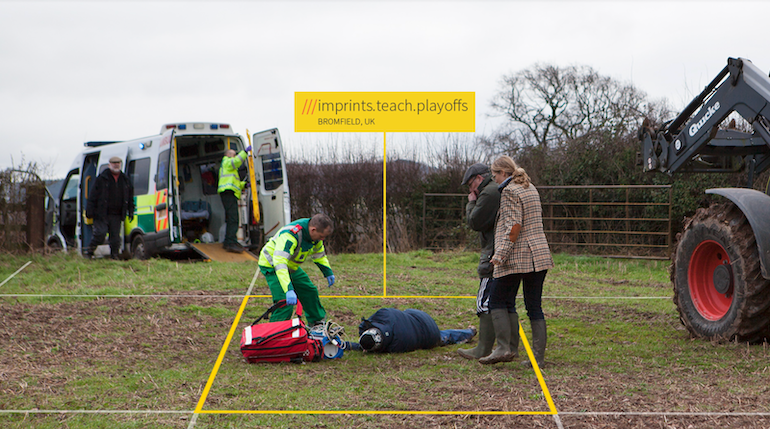
This week, emergency services across the UK are joining together to encourage the public to download the free what3words app, as a simple way to keep friends and family safe this summer. Over half (56%) of emergency services receive daily calls from people who don’t know exactly where they are or struggle to describe the location of an incident. And this summer, 65% of Brits are planning to go on a trip, holiday or to an event in a destination that they have never been to before, and 57% agreed that they find themselves lost or losing track of directions when they are away.
‘Where’s the emergency?’ is one of the first questions you are asked when calling 999 but describing exactly where help is needed can be challenging and stressful – particularly if you’re in an unfamiliar or unaddressed area. Call handlers and dispatch teams often can’t detect where you are automatically and can’t receive dropped pins. In fact, the Ordnance Survey found that three-quarters of UK adults can’t read a map – making it even more challenging to explain or describe exactly where you are.
what3words solves these issues by providing a simple way to communicate precise locations. It has divided the world into a grid of 3m x 3m squares and given each square a unique combination of three words. For example, ///laptop.processes.works will take you to the best view over Durdle Door in Devon. The innovative location technology is used by over 85% of the UK’s Police, Ambulance and Fire services, and has become a valuable and trusted tool in the emergency response toolkit.
The app is free to download for both iOS and Android devices, and works offline, making it ideal for use in areas with unreliable data connection, such as beaches, national parks and campsites. what3words can also be used via the online map at what3words.com. It’s available in 51 languages to date, including Welsh, and can be used anywhere in the world.
The technology has been used for everything from reporting fires and rescuing pets to locating callers mid-heart-attack with pinpoint accuracy. Last year, Joe Mason called the ambulance from the side of the motorway while his dad was having a heart attack in the car. After providing his what3words address, the ambulance arrived in a matter of minutes, saving his dad’s life from what could have been a fatal heart attack. In April, Mikey Hutton from Fife said what3words saved his life after he fell 15ft down a cliff. The emergency services used what3words to pinpoint exactly where he’d fallen. Mikey said: ‘It’s amazing that such a simple thing saved me from almost certain death.’
Peter Bromley, Crew Commander at Cambridge Fire & Rescue Service adds: ‘At Cambridgeshire Fire & Rescue Service, along with emergency services across the country and the world, we are encouraging everybody to download what3words on your mobile phone. This app is helping us to save lives and can bring the emergency services to your location much faster than ever before, helping us to help those in need.
‘what3words has already helped us to locate people stuck in flood water, animals trapped in wire, bonfires out of control, forest fires as well as people on motorways, side roads and unnamed roads with car fires, medical emergencies and a whole range of other issues. This app can help us find you anywhere.’
Gill Pleming, Service Manager (EMS Coordination), at the Welsh Ambulance Service adds: ‘what3words has proved to be an invaluable addition to our emergency response toolkit. It saves us time and resources in time critical situations. Our call handlers are trained to gather as much information as possible to identify where help is needed. This could include the area name, nearest road, landmarks and more. The additional layer of accuracy that what3words provides saves us time when it matters most. We, like many emergency response teams across the UK, have worked closely with what3words to ensure that the technology is utilised effectively and accurately and to avoid any issues that may arise from human error when it comes to relaying words.’
Around the world, emergency call centres are embracing what3words at a rapid pace, with control rooms in the UK, US, Australia, France, Germany, Belgium, Austria, Singapore, Canada, India and South Africa all utilising the innovative technology, and urging the public to download the app. Call takers are always trained to collect as much location information as possible from callers, and what3words has proven to be useful when identifying exactly where to send help. As well as using the app for emergencies, people are using what3words every day to meet up with friends at parks and on beaches, to share great running and hiking locations, and to share sports match locations with their teams.
In a recent voluntary survey of nine emergency services across the UK:
- 44% of emergency services surveyed use what3words to locate callers every day, and a third use the technology on a weekly basis. In fact, one service reported that they’ve used what3words almost 2,000 times (1,944) to locate callers so far this year.
- Over half (56%) of emergency services surveyed receive daily calls from people who don’t know exactly where they are or struggle to describe the location of an incident
- 100% of emergency services are expecting incidents with addressing issues in the countryside, 89% at hiking and walking trails, 78% on the roadside, 67% at the coast, 56% in parks, and a third at festivals, sporting events and stadiums
- 78% of emergency services agree with the statement ‘what3words saves us time’
- 22% of services surveyed say that what3words saves them over ten minutes per call, and 44% say it saves them between 1 and 10 minutes
- 100% of emergency services surveyed consider what3words ‘a reliable tool to have as part of the emergency toolkit’.
- 78% of those surveyed agree that festivals, sporting events and travel returning to normal are likely to increase the volume of incidents at hard to describe locations this summer – i.e. beaches, event sites and rural areas
- 89% of emergency services agree that what3words makes it easier for people to communicate their location during times of emergency
