
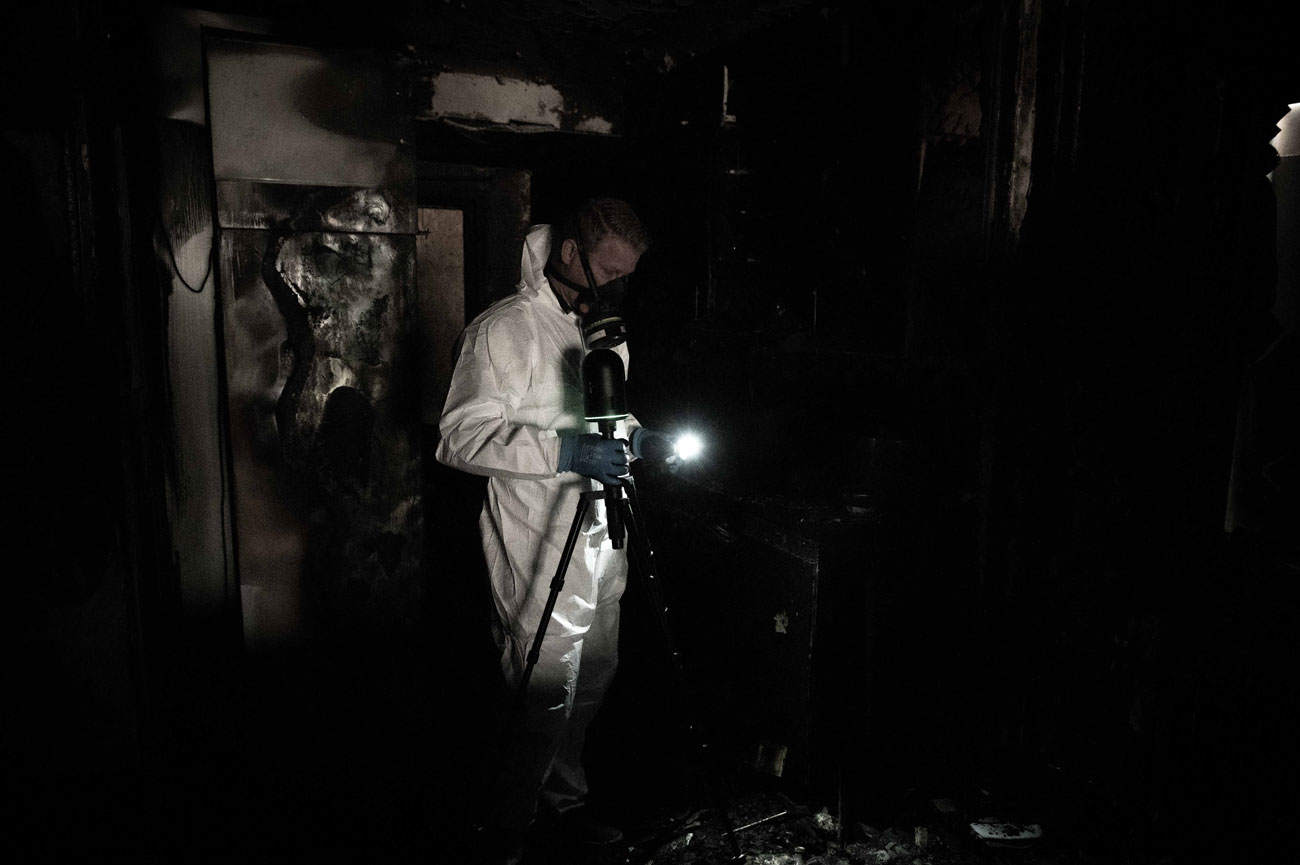
Malgorzata Krol, Director of Marketing Communications at Hexagon’s Geosystems Division – Global Public Safety & Forensics, in conversation with Richard Jacobsson, Fire Investigator and Forensic Expert
Fire and arson investigation, in the not-so-very-distant past, was once a profession of cameras, tape measures, chalk and hand drawings. 3D laser scanning technology has risen in importance in the fire investigator’s toolbox in recent years, owing to its ability to capture the minute details of a scene enabling multiple stakeholders to return to the place of the incident without the risk to life or contamination of the location.
Investigators can capture the fire or arson scene much more quickly and safely than a team of responders with tape measures and cameras. In these scenes where there are lots of people, lots of debris and lots of movement, and traditional methods are too slow and inefficient to ensure the scene investigators have documented every important piece of evidence. If there is a lot of smoke and falling debris, meaning the investigator must wear full protective gear, there is only so long they can wear this cumbersome clothing to measure and capture the scene. 3D laser scanning allows the investigator to move seamlessly between capturing the fire scene up close and from a safe distance, as modern 3D laser scanners can be operated by the user at 60m with millimetre-level accuracy.
In the same way that we moved away from the fax machine and the landline, tape measures, cameras and sketch boards are becoming increasingly outdated in the face of laser scanners and digital twins, which provide public safety professionals with a multi-dimensional reproduction of the collected evidence, accessible to all stakeholders to explore and analyse time and again after the fact.
Fire investigators are critical in helping public-safety authorities, insurance companies, architects and planners understand and prevent fires. They are involved not only after the event but also use insights gleaned from fire scenes to play an important role in preventing fires by, for example, advising on infrastructure planning and development.
One fire or arson investigation can differ radically in scope and circumstance from the next. Common to every fire scene is a fine line between evidence collection and analysis and tampering and contamination; the onsite team must try hard not to cross this line. Fortunately, in recent years, fire investigators have more tools and technologies to help them accurately ascertain the particulars of a fire or arson scene, safely and efficiently.
The making of a Swedish fire investigator
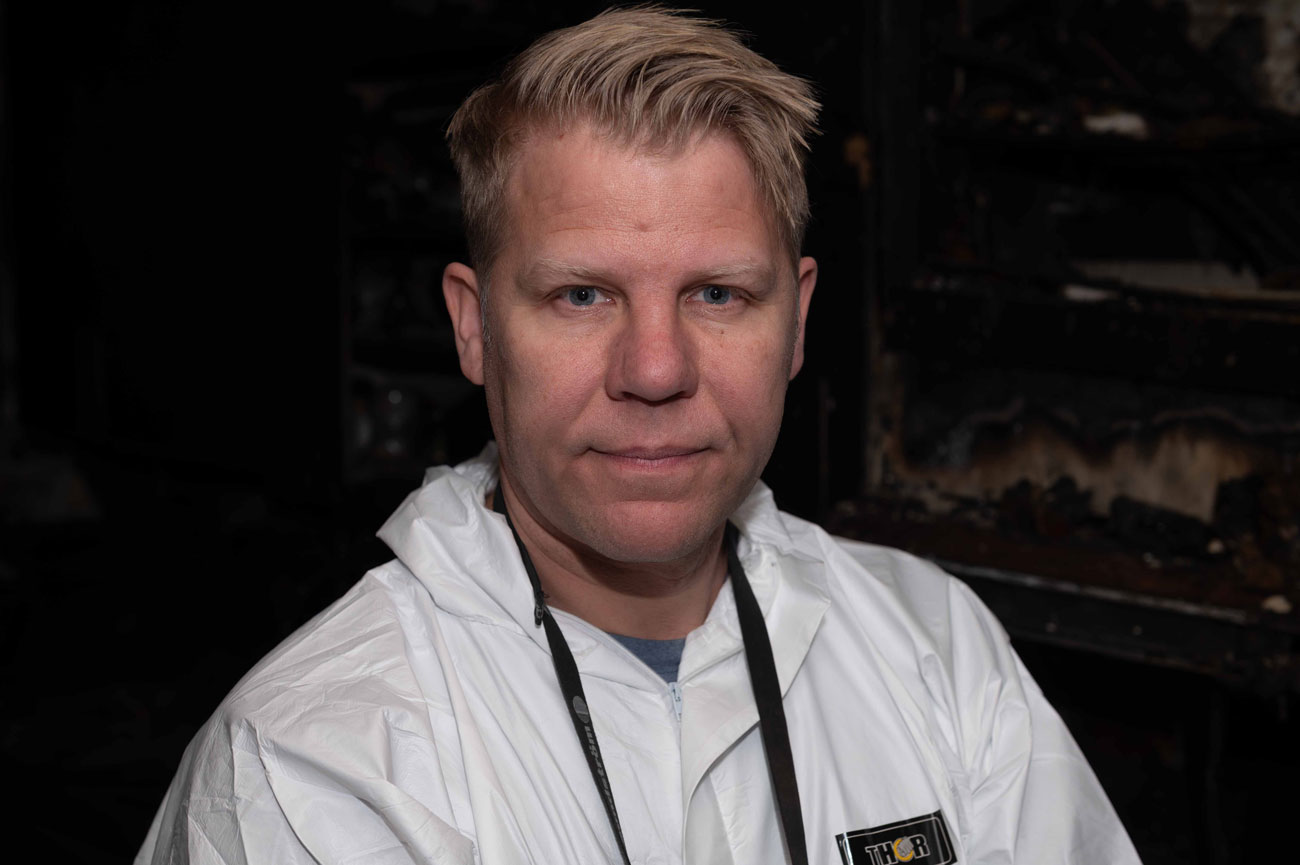
We spoke to independent fire investigator Richard Jacobsson about how he uses cutting-edge scanning technologies to assist him in his work. Richard is not only experienced in the field, operating as an investigator in Västerås, Sweden, but he also quite literally wrote the book on fire-scene investigation, being the co-author of the ‘Nordisk brandmanual’, a practical guide to fire-scene investigations, taught at the Swedish National Forensic Centre (NFC).
Richard explained that early in his career he worked ‘as an R&D manager at a CNC company when I saw that the National Forensic Centre was offering training in technical fire investigation. I had always loved TV crime series and the idea of being involved in detective work, so that is how I ended up training as a fire investigator and working for the National Forensic Centre.’
During the two-year training, Richard learnt all about the dynamics of fires: what causes them, how they spread and how you recognise what happened by looking at the evidence after the fire. He explained: ‘Approximately 30% of fires are caused by electrical equipment or faults in electrical installation, so being an electrical engineer helped me get the training position. And it still helps my business. Criminal investigators like to have an electrical engineer on site to check for electrical fire cause. There might also be some bare live cables lying around. That is why I have to check electrical safety and deliver an electrical report, where we determine if an electrical fault caused the fire.’
A lot of fire training focuses on conducting investigations scientifically. It is about developing a hypothesis and then evaluating it. That means there is the investigative mode (generating your hypothesis) and the evaluative method (testing it).
‘In forensic lab work, these phases are distinct, whereas, during fire-scene investigation, they overlap because you are collecting evidence and documenting your hypothesis simultaneously. That means, while you work intuitively, you need a robust methodology and a means of documenting everything; otherwise, you won’t be able to present the hypothesis and lead non-experts to a decisive conclusion.’
Integrating 3D laser scanning into the workflow
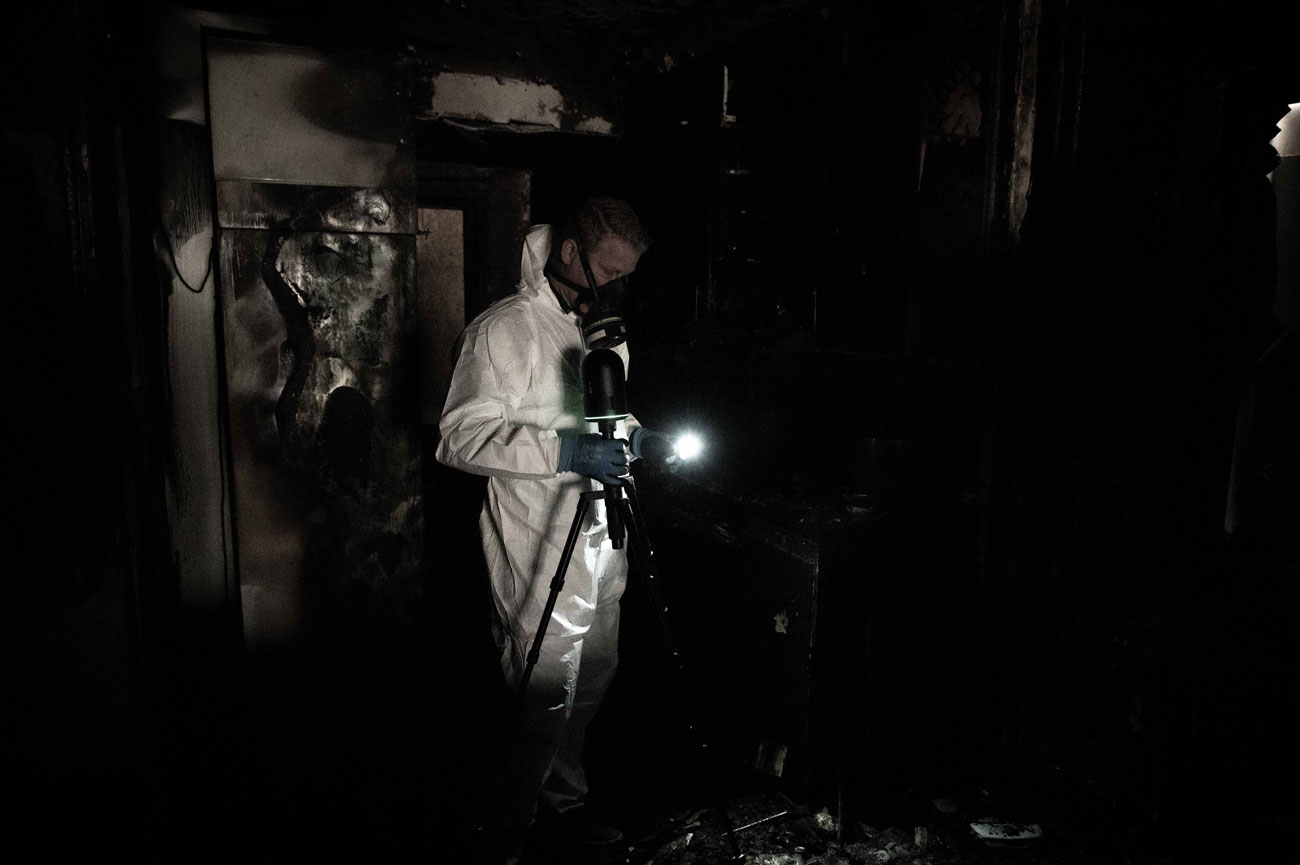
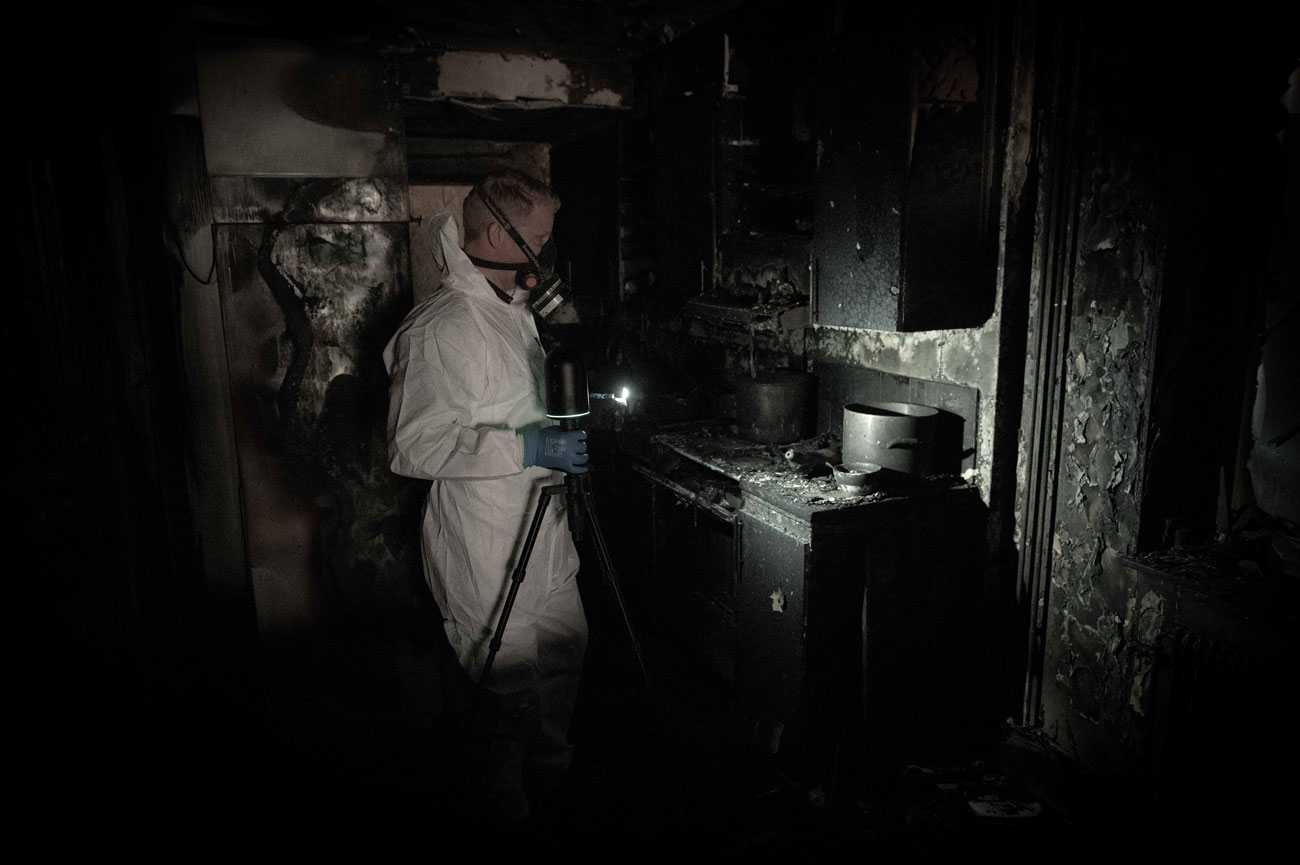
This is where imaging laser scanner technologies and software come into play. Jacobsson uses the Leica BLK360 laser scanner and Leica Cyclone REGISTER 360 software.
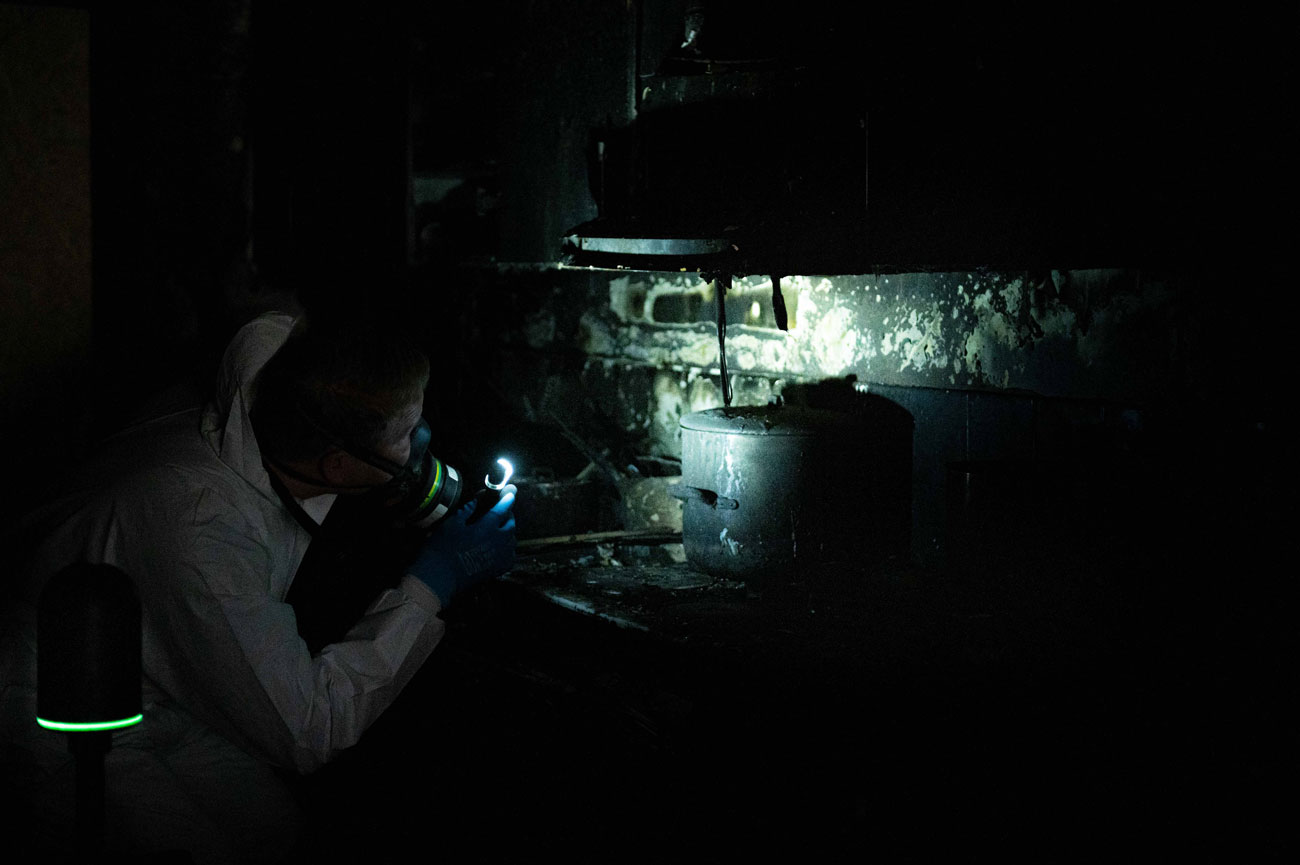
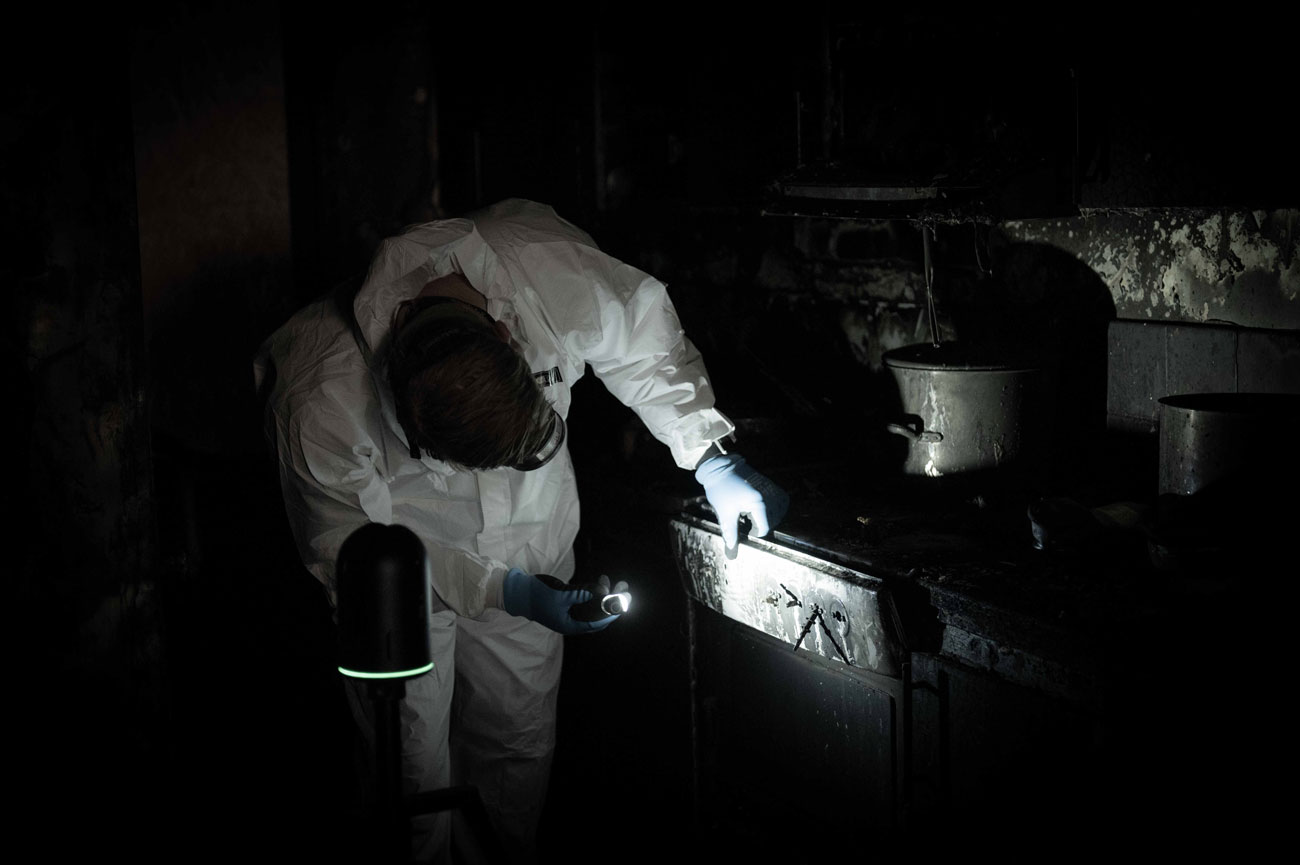
‘Most of the fire scenes I go to, the first and last thing I do is to capture a few scans and images. That gives me a reliable record of how everything was when we started investigating the scene.’ He uses 3D laser scans to visualise the scene and evaluate a variety of different hypotheses during the course of the investigation.
‘Before I purchased a 3D laser scanner, I had to rely on sketches, photos and a tape measure. That is a much slower and less flexible way of working, and because of time constraints, there is always a risk that you might not capture some information that turns out to be important later. But with modern technological solutions for fire investigation, you can leave the fire scene confident that you have all the information you need.’
It is essential to have a structured approach to investigating fires and documenting the findings. For example, always working from outside inwards – from the non-burnt area to the burnt area. ‘We follow the process defined in the Nordic Fire Manual (Nordisk brandmanual), which I helped develop and teach at the NFC. Following this method is the best way to deliver a strong report.’



Thinking in 3D
Unless the circumstances of the scene are total fire damage, a trained fire investigator can see from the burn pattern where the fire began. A natural fire usually spreads from a single point. If the fire seems to have started in several places, that is a strong indication of arson. The presence of accelerants also points to arson. Sniffer dogs can be trained to smell these flammable liquids in the ruins of a fire, but for court cases you need a material sample. So rather than waiting for a specialist accelerant sniffer dog to arrive from far away, a trained fire investigator can deduce the source of the fire based on visual patterns. These patterns can be modelled and visualised with a level of accuracy by modern technologies.
‘From my work in CNC machining, I was already quite used to thinking in 3D and working with modelling software, so it was very easy for me to get used to the REGISTER 360 software, which I use mainly for visualisation. I use it to revisit the site and see what things might have looked like, to extract any necessary measurements and finally, to present my hypothesis and findings in a way that someone who is not so technical can understand.’
Registration software for point clouds offers simple, guided workflows that empower users of any skill level to go from scans to deliverables quickly and intuitively. Richard explained the benefit: ‘Hands-free scanning technology means I can concentrate on my fire investigation rather than on handling the scans.’
The work of fire investigators goes beyond settling specific cases. It impacts planning too. If in a housing estate where all the houses are built the same way, some homes get destroyed in a fire, the obvious question is if the houses were designed adequately for fire protection.
‘An expert can probably tell that fairly quickly, but we need to be able to explain the problem to a non-expert, judges or lawyers or planners. In one case, I scanned an entire intact house and a burnt house and laid these scans on top of each other in REGISTER 360. From that data, I could visualise the firewall design’s impact on the fire’s development.’
Investigators can use this information to order remedial measures on the remaining houses. The differences and similarities in those scans can also advise an insurance company on whether to tear everything down and start again or use parts of a building that survived the fire. ‘My 3D scans show the insurance engineers what structural elements were deformed during the fire and by how much.’
Telling the story
Modern technologies are useful for accurately scanning a scene of fire or explosion, but they are also integral for telling the story of the scene after the fact to the relevant audiences and stakeholders. Taking a complete spherical image and 3D point cloud takes only a little over one minute after which the investigator can view, inspect, ‘fly through’ the 3D point cloud and deliver an immersive and interactive forensic digital twin, which is accessible and meaningful to experts and non-experts alike. 3D scanners also have integrated 360 imaging systems and thermography panorama sensor systems, allowing the fire investigator to capture the thermal information and view and adjust HDR photospheres. This can prove crucial in reconstructing the story of the fire decisively.
The capabilities of the technology have now given way to a new emerging trend in the public-safety arena: ‘scene to courtroom’. The data from a fire scene can be captured and transformed into a visual and audible model, image, video or written document, leveraging the point cloud, footage from the scene and expert opinions, which is immediately accessible to a legal team, jury or insurance company.
When employed together, 3D laser scanning hardware technologies and custom software packages have the potential to help the public-safety sector streamline dataflows, and increase the efficiency and accuracy of forensic investigation, all while maintaining rigorous data-security standards.
About the Author

Malgorzata Krol
Malgorzata Krol works at Hexagon’s Geosystems division as Director of Marketing Communications – Global Public Safety & Forensics, leading the worldwide public-safety marketing activities and programmes. Her role includes strategic industry marketing, communications, managing and developing customer relationships, commercialisation, business intelligence analysis and strategic market development within the global public-safety segment.

You must be logged in to post a comment.