

On 18 September 2017, the Scottish government started a consultation process seeking to obtain views on possible changes to the minimum standards for fire alarms in Scottish homes.
One area the consultation focused upon was the different requirements for fire alarms depending on the tenure or age of the property. New build or existing, rented or owner occupied, all required different levels of fire protection. The consultation questioned why those in rented or new build properties had higher levels of protection than those in owner-occupied premises.
The results of the consultation strongly favoured support for a new common minimum standard, across all housing, regardless of tenure or age. The clear opinion was that all properties should be safe for occupants and that tenure or age was not relevant. There was also strong support for the new standard to be based on the current standards required in private rented properties (Scottish Repairing Standard). Many respondents felt that this was a good minimum standard and adequately covers fire safety risks.
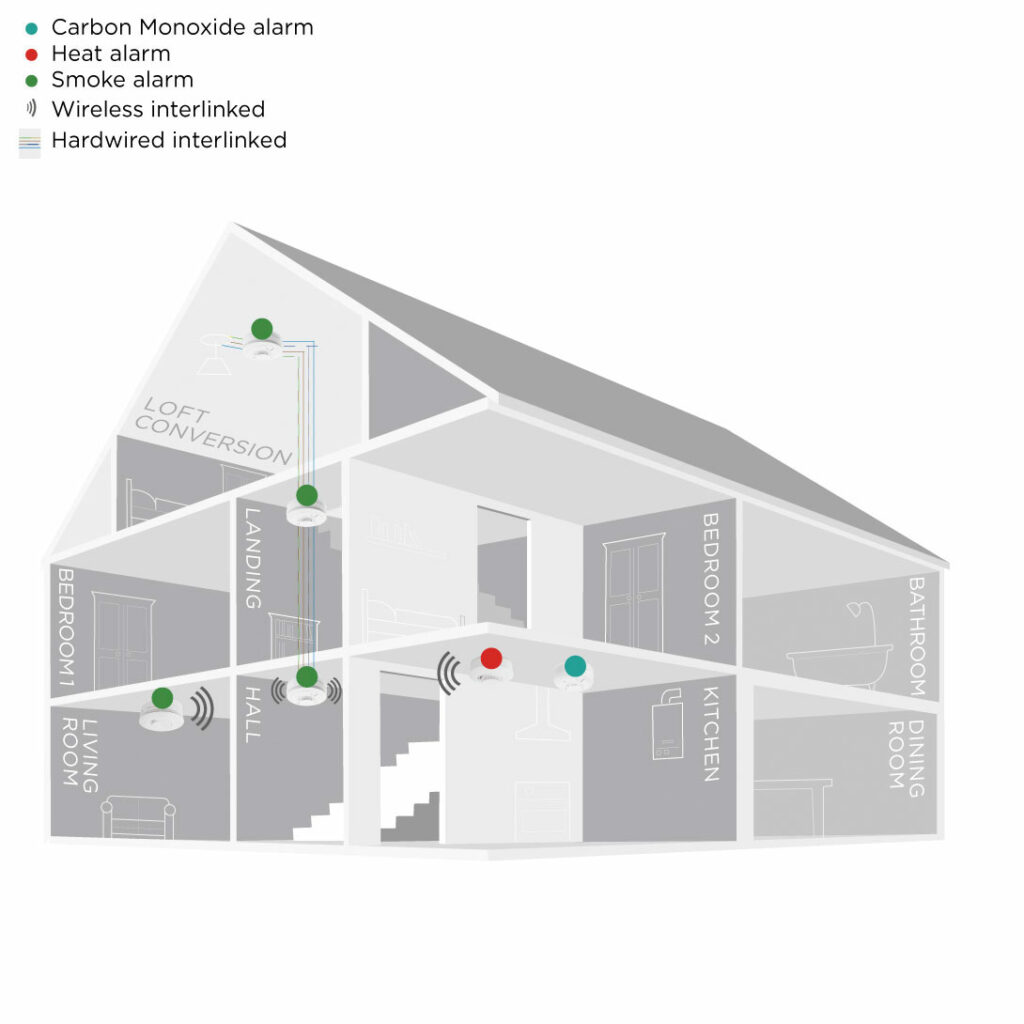
In February 2019, the new legislation was published and will come into force by February 2021.
The new minimum standard requires the following:
- Smoke alarms in every circulation space on each storey, such as hallways and landings.
- Smoke alarms installed in the room most frequently used for general daytime living purposes.
- Heat alarms installed in every kitchen.
- All alarms to be interlinked.
- Carbon Monoxide alarms to be fitted in rooms containing a fuel-burning appliance or flue.
- Alarms could be sealed long-life battery alarms or mains-powered alarms with a maximum lifespan of 10 years.
For anybody familiar with the British Standard 5839-6:2019, this is very similar to a Category LD2 installation.
The change has been welcomed by all and will dramatically improve fire safety across Scotland. The decision to allow long-life battery alarms to be used also made it easier for homeowners and landlords to comply with the new legislation within the two-year timescale.
This move by Scotland leaves the rest of the UK well behind when it comes to fire-safety legislation. Although the whole of the UK shares the British Standard 5839-6:2019, which recommends high levels of fire protection in domestic properties, compliance with the standard is not a legislative requirement.
In England there is legislation for private landlords, and Building Regulations for new build properties, but in some cases, these require far lower levels of protection than the British Standard suggests and only still affect rented or new-build properties.
Over 65% of properties within the UK are owner occupied with social and private rented making up the remainder. This leaves a lot of properties that potentially may not have any fire alarms installed and no legal requirement to do so. The risk is for the most vulnerable occupants still living in accommodation that has no fire-detection and alarm system installed.
Recent figures show that 9% of properties in England do not have a working smoke alarm. This is over 2 million properties which is a worrying statistic.
The recent changes introduced will massively improve fire safety for over 5 million people living in Scotland. The question remaining is when will the rest of the UK catch up?
For more information, go to www.aico.co.uk/scottish-legislation

You must be logged in to post a comment.