
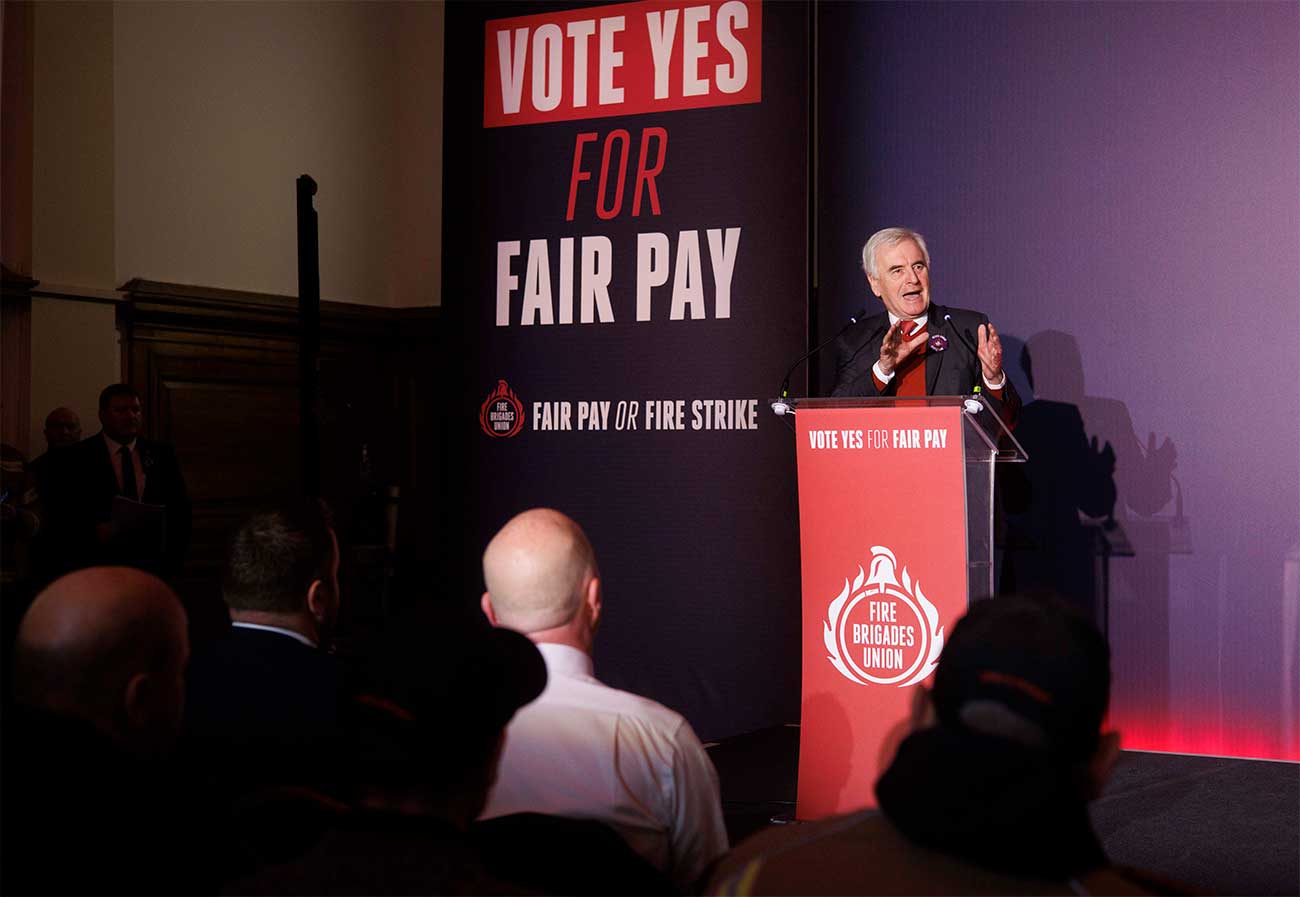
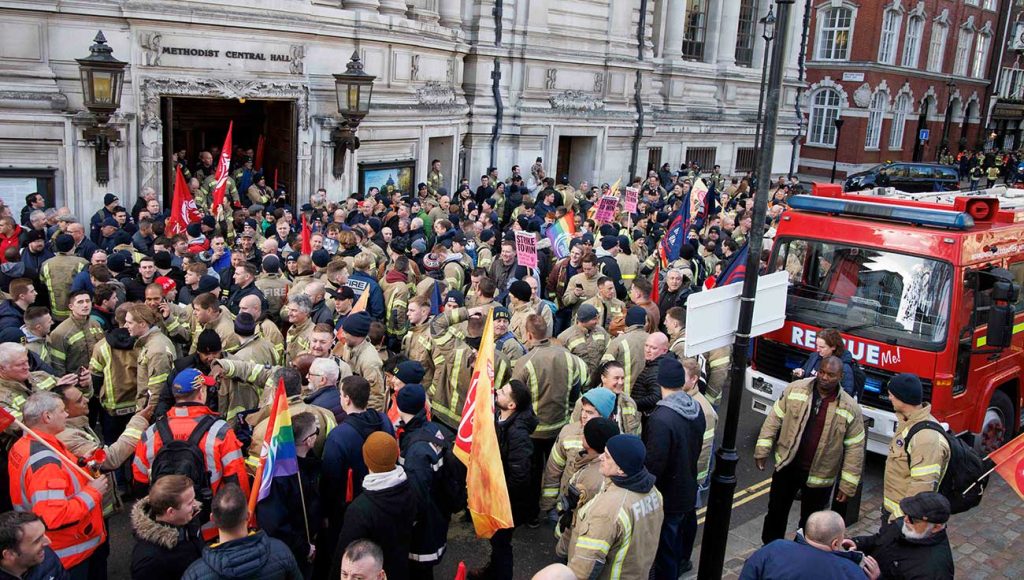
Yesterday (6 December) over 2,000 firefighters and control staff from across the UK assembled in Westminster to protest low pay after their strike ballot opened yesterday.
Extraordinary scenes saw speechmakers including MPs speaking to a packed Methodist Central Hall and hundreds of firefighters and control staff gathered outside in an overflow area.
MPs including Zarah Sultana and Jeremy Corbyn addressed the crowds, as well as FBU general secretary Matt Wrack and several FBU officials and members.
After the rally firefighters and control staff marched to Parliament to lobby their MPs on the issue of pay.
Firefighters and control staff received a 5% pay offer, which would constitute a significant real-terms pay cut with annual CPI inflation currently at 11.1%. Fire Brigades Union members voted to rejected this pay offer, with 79% voting against it in a consultative ballot.
The strike ballot opened on Monday 5 December and will close on Monday 30 January.
Speaking to the crowds, FBU general secretary Matt Wrack said:
“You’ve turned out in your hundreds and hundreds and hundreds… I think that demonstrates the anger that is out there… they’ve found 45 billion in tax cuts to give away to millionaires, but they will tell you that there’s no money for pay, that there’s no money for the fire and rescue service. Corporations enjoy record profits, some people get richer and richer and richer, and they tell us there’s no money.”
If a national strike were to take place, it would be the first national strike since pension action between 2013 and 2015 (which did not include control), and the first on pay since 2002-2003.
Firefighters and firefighters control pay dispute timeline
Firefighters and firefighters control are vital emergency service workers who served on the frontline throughout the entire Covid period. During this period, firefighters provided additional services to communities and undertook additional areas of work, with the agreement of the union, to help the country through one of the worst crises in living memory.
Despite this on 27 June 2022 fire service employers made an insulting pay offer of just 2%.
The offer was an insult to firefighters and firefighters control. It came after 12 years of government- imposed austerity and pay policy which has led to falling real wages. Furthermore, the offer was utterly inadequate in the face of the emerging cost of living crisis where FBU members are increasingly struggling to make ends meet. Inflation is expected to hit over 18% in January 2023 (source: Financial Times) as well as dramatic increases in energy bills.
Following a period of national consultation with members, this offer was rejected unanimously by the Executive Council on 18 July 2022 and the result relayed to fire service employers on the same day.
Fire service employers wrote to the Home Office requesting additional funding to improve pay on 2 August 2022. The Home Office unequivocally declined this request.
Throughout August and September 2022, the union ran a substantial campaign of membership engagement, branch meetings and mass meetings. Entitled ‘Fair Pay or Fire Strike’ the campaign publicly displayed the anger of FBU members at the 2% pay insult and the determination to move to strike action in the fight for fair pay.
On 4 October 2022 fire service employers at the National Joint Council (NJC) made a revised pay offer of a 5% increase on all Grey Book rates of pay, including CPD, from 1 July 2022.
On 14 November 2022, after a two week consultative ballot, FBU members delivered a clear verdict with a 79% vote to reject the 5% offer and 78% of eligible members voting in the ballot.

You must be logged in to post a comment.