
Impeller is about to announce dates for its new heavy-lifting course, but how did the Heavy Road Traffic Collision course come about? What problems had to be overcome, and which partners had to be involved in order to overcome the problems?
Impeller is a social enterprise based in the UK who work in close collaboration with Tyne and Wear Fire and Rescue Service (TWFRS) to help clients, both nationally and internationally, by delivering expert training and compliance services. Our work generates ‘profit for good’, which is reinvested in local community fire-safety projects via our charity, the Impeller Foundation
Impeller is always striving to improve its courses and have recently gained Skills for Justice accreditation for our Heavy Rescue Instructor course. This will ensure we always deliver to a nationally recognised standard. HGVs account for 13% of all traffic licensed to use the UK’s roads today, the current figure being approximately half a million vehicles. Whilst the percentage of goods vehicles may appear to be small, it must be remembered that, as opposed to private motor cars, commercial vehicles are used intensively and spend little time immobile. The current maximum weight of an unescorted HGV is 44 tonnes and the maximum length is 16.5m although there is a definite possibility that this limit will be increased in the future.

History of the HRTC course
Twenty years ago, TWFRS identified, during operational incidents, a need to develop training to meet the increasing numbers of road traffic collisions involving large vehicles, and particularly the initial problems of stabilising and gaining entry into such vehicles. Out of this training need evolved the Heavy Road Traffic Collison Operators course and subsequently the Heavy Road Traffic Collision Instructors course.
The trainers at the time were given a series of problems that the service had identified as specific training requirements:
1. Stabilisation.
2. The problems with height and how to gain access to cabs to extricate drivers.
3. Under-runs and (the biggest conundrum) how to stabilise and lift an HGV that has trapped another vehicle under its trailer unit on its side.
4. What new equipment would be required both to undertake the training and subsequently for operational deployment.
The trainers were faced with overcoming these basic problems and developing techniques that were already present in standard car-extrication procedures.
Before the training could begin, a supplier had to be found who could provide HGVs in the local area at a cost that wasn’t prohibitive.
A local scrap merchant who deals with HGV cabs was approached, and he was more than happy to pass his knowledge regarding HGVs and the problems he had when recovering crash-damaged vehicles. To this day, he still supplies TWFRS and Impeller and is still available for advice when required.
Stabilisation
The equipment available at the time to stabilise and gain entry into HGVs was in its early development and not widely known to the fire and rescue services.
The trainers worked closely with the HGV supplier and local mechanics to create a safe and effective system to stabilise a vehicle and its load, gain entry into the cab and create maximum space around the occupants to allow for quick medical intervention and casualty extrication.
It was identified at an early stage that stability would fall into two categories: Ground to chassis and chassis to cab. As the course progressed, this developed into three categories to include the driver’s seat. Each category presented its own unique problems.
Ground to chassis
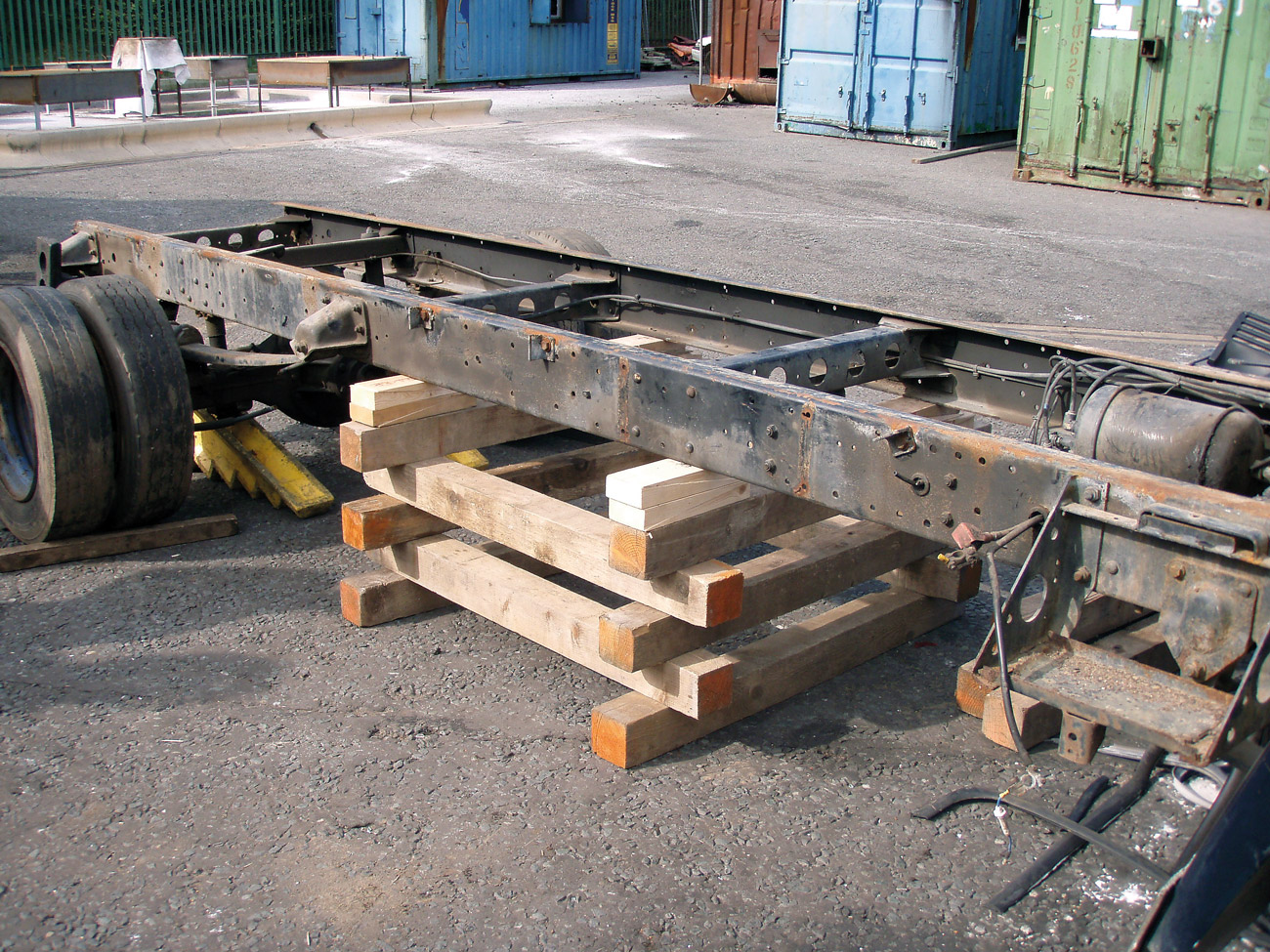
The configuration of HGVs means there are large spaces between the ground and the truck chassis. This presented the first stabilisation problem. Equipment such as step blocks, blocks and wedges were used in great numbers to achieve the best stabilisation possible. Through a series of trials, other equipment such as bottle jacks used in conjunction with the blocks and chocks were found to have their uses. Stability developed over the years from blocks and chocks to struts, supports and cribbing.
Chassis to cab
Through trial and error, the trainers identified that the most advantageous way to stabilise the cab was to secure it to the chassis by means of a strap passed through or over the cab, with any dead space taken up by the trusty blocks and chocks.
Gaining access
In order to bridge the height from the road to the cab it was necessary to find a way to work safely. Various options were considered, but the use of a collapsible, adjustable working platform became the favoured option to safely facilitate the work of rescue personnel and enable the extrication to be carried out. This also required a set of protocols to be worked out in order to work safely on the platforms.
The risk of musculoskeletal injuries was always at the forefront in the minds of the trainers. The weight of the door on an HGV door can be 80kg and so, to try and obviate any injury, it was decided to secure it with a line to prevent it from falling. Once the door was detached from the cab, it could be lowered using the line and moved away to the designated debris area.

Safety cell
As well as casualty entrapment within HGV cabs, there was also the need to develop a safety cell, which would stop any further movement of the load during operations.
Rear and side under-run were a common occurrence and the trainers identified that, before any lift could take place, a form of safety cell should be devised in case anything happened during the lift that could cause the load to descend uncontrollably, thereby exacerbating the situation. A further complication was that the safety cell also needed to move with the load as it was being lifted.
The early use of equipment involved working with Zumro (now NT) airbags for the lift with Holmatro power shores providing the safety cell, but this has developed over the years to include other manufacturers such as Stabfast and Paratech.
Working with manufacturers meant we had access to equipment and expert knowledge, while working with mechanics gave us the practical know-how to put together a course dealing with any casualty entrapment and covering all the objectives set by the service.
As part of Impeller’s constant drive for improvement, we have developed a two-day CPD course to demonstrate primary and secondary lifts whilst providing a safety cell using a wide range of market-leading tools such as airbag lifts, hydraulic and pneumatic struts and cribbing.
Further scenarios will include rear-axle lift, box van on its side cab lift, tanker side lift and advanced lifting of a train on railway tracks as well as demonstrating the new driver-extricating technique using the Paratech Bipod and hauling system.
For further information about the course contact Mick Cowans on 0191 444 2002 or mick.cowans@impeller.co.uk
For more information, go to www.impeller.co.uk
About the Author

Vince O’Neill is Operations Manager for Impeller. He worked previously for TWFRS as an operational firefighter, finishing his career as Deputy Training Centre Manager at the Barmston Mere Training Centre.

You must be logged in to post a comment.