
Head of International Business Development at Kentec Electronics
With a career starting in the pharmaceutical, chemical and energy industries, and his subsequent appointment as a Fellow of the Institution of Chemical Engineers and a Chartered Engineer of the Engineering Council UK, Costas brings considerable multi-disciplinary, technical expertise to Kentec’s international operation.
Responsible for the leadership of an international team of Business Development Managers (BDMs) in EMEA and AsiaPac, Costas’ role is to expand and optimise Kentec’s global partnerships and operations, and to galvanise their strong and growing market position across multiple nations and regions.

What has your experience of the fire industry, and more specifically the fire-detection industry, been so far?
My first experience with the fire industry came in 2009 when I was Head of Business Development at FirePro, a Cypriot-based manufacturer of Condensed Aerosol Fire Suppression systems. With previous working experience revolving around operations and engineering, it was a chance to work in a new, life-saving market, with an opportunity to develop and build partnerships across the globe for the first time. It was in this role that I first encountered Kentec, a supplier of FirePro.
Following this, almost two years were spent in an international business development consultancy role, primarily involved with life safety, fire alarm detection and fire suppression. My work with Kentec, however, left an impression, and the team’s forward-thinking approach towards life-safety was one that resonated with me, and one in which I could see an avenue for mutual development, not only in relation to the markets Kentec works with but also the products that it manufactures and sells. The opportunity to lead a culture-centric approach in Kentec’s international business development team is one I jumped at, and the team have supported my mission since day one – onboarding a world-class group of people to understand the specific wants, needs and working habits of overseas customers – beyond simply making a sale.
Shared culture and experiences drive meaningful and lasting relationships, and it is this approach that Kentec has adopted, and one that has borne significant fruit. We’re currently overseeing a market that’s growing year-on-year, and capitalising on this is crucial for a manufacturer such as Kentec.

What are the existing trends and developments in fire detection?
The fire industry has come on leaps and bounds since the first days of fire detection and suppression. Kentec originated as a panel manufacturer and has since evolved into being a provider of full system solutions. This is a development we’ve seen with many manufacturers across the industry, but the ability to manufacture and own all component parts of a life-safety system under one roof, from sensors to fire panels to the wireless technology housed within them, is a key selling point, and one which Kentec is proud to hold. Specifiers, consultants and end-users directly benefit from all-inclusive packages and support services, and have the confidence that all products are compatible, reliable and operate within the same fire-detection and life-safety system loop.
Where life-safety systems are already installed in a residential or commercial property, they are often a combination of products from a host of different manufacturers. Replacing these systems is a costly operation, but as Kentec’s technology is open protocol, it can easily integrate with what’s already there, without having to rip it all out and start again with all the associated costs and disruption.
Not only must products be compatible with one another but they must also communicate. The rise of wireless detection, and its huge popularity, shows that this is a priority for professionals in the industry. We’ve recognised this for some time and have invested accordingly, and wireless solutions are increasingly being specified to enhance or upgrade existing fire-detection systems as part of a wider life-safety solution.
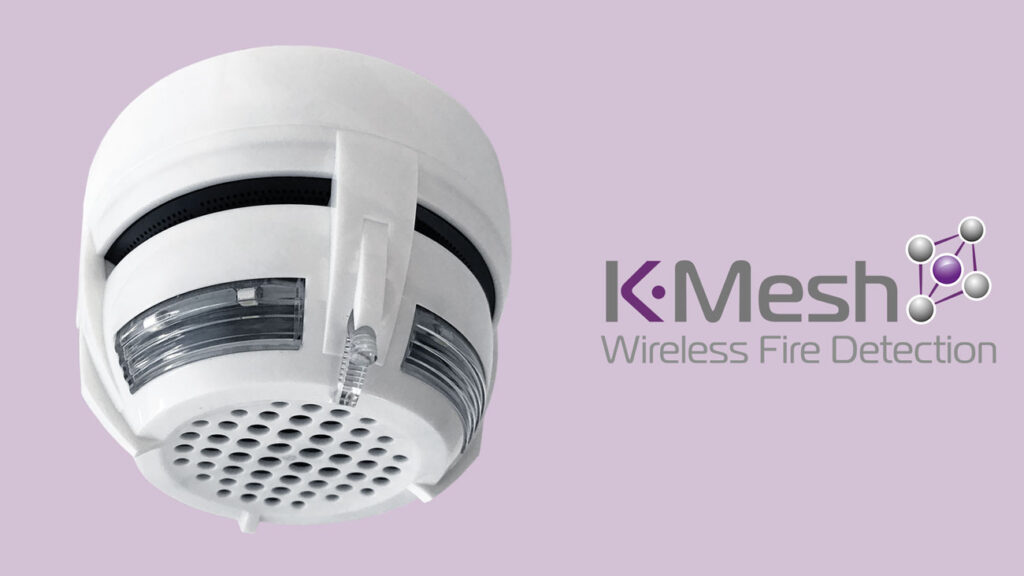
Making systems expandable, and able to accommodate future developments, are key towards protecting residents and staff across all types of sites. This is where Kentec’s K-Mesh technology truly thrives. With self-healing mesh technology, K-Mesh can configure anything from two to 2,000 devices across a communication range of up to 1,200m, with the same functionality and reliability that more ‘traditional’ hard-wired systems are renowned for. However, this is just the start for wireless technology, and we expect wireless to develop further as its use becomes more common.
What challenges does the industry face, and how do we fix them?
Professionalising the industry is of critical importance if we are to provide products and services that protect and save lives. The global life-safety and fire-safety industries are worth an estimated USD 77.88bn as of 2022.1 In the year prior, in the US alone, fires caused a property loss of around USD 15.95bn,2 and that is without mentioning the cost of life also associated with fire damage, smoke inhalation and structural failure outside of the North American region.
If we are to save lives and save money, we must ensure that the systems specified are installed, monitored and serviced by professionally trained and qualified staff, and that products are robust enough to stay in operation for as long as possible.
Another challenge is how to reduce or even put out a fire before it fully takes hold. This is being addressed by a new generation of targeted extinguishant technologies. Early-warning fire-extinguishant systems and detection technology, such as the Sigma ZXT, can detect a fire and automatically release a fire-suppression agent to eliminate fire within a matter of seconds. These critical moments can make the difference between small-scale damage and large-scale issues to the structural integrity of an entire facility.
By introducing and enhancing targeted extinguishant systems such as the ZXT, extinguishant agents are only released on specific targets within conventional, configurable detection zones, with an alarm trigger being required to activate its release, according to an alerted response from one or multiple zones. This also acts to reduce false activation, and the unnecessary damage that results.

What does the future of fire detection look like to you? What can the industry do to improve?
In the future, we should see further application of wireless communication and technology within the fire-detection industry to create all-encompassing life-safety solutions. Linking wirelessly communicating devices, sensors, alarm and alert panels, and others together will be commonplace, and if they can be combined effectively with building management and security systems, residents would benefit from a holistic personal safety package.
Inspecting, replacing and/or testing panels and detection systems remotely is another trend we expect to develop further. Through notification, end-users will benefit from an accurate, constant monitoring solution wherein the status of a system, or components of a system loop, can be analysed off-site from a remote location. This would not only save on labour costs and time spent on manual checks but also minimise the element of human error, ensuring that all life-safety systems are consistently maintained to the highest level possible.
A big area of improvement in recent times has focused on Public Address and Voice Activation (PAVA) systems. These have increasingly become a priority within our industry, and certainly for Kentec. These systems allow for safe and controlled building evacuation and management – and can often be managed or monitored remotely. When coupled with Evac-Point evacuation alert panels, fire crews assume control over evacuation protocol, benefitting from knowing the precise location of the fire and being able to assess the situation prior to their arrival on-site. This means they already know the risks in advance prior entering a potentially dangerous environment and makes the safe evacuation of people trapped inside a building more likely. This is all achieved through an integrated approach to technology and thinking, and will be a developing trend in the years ahead.
References
1. https://www.grandviewresearch.com/industry-analysis/fire-protection-systems-market
2. https://www.statista.com/statistics/203776/property-loss-in-the-us-due-to-fires/

You must be logged in to post a comment.