
Today, Bristol Uniforms is a global leader in the design and manufacture of PPE for firefighters, providing cutting-edge protective garments to fire services in 110 countries across the world. But the company also boasts a rich history stretching back more than 200 years.
At Bristol Uniforms, we’ve been looking back on our history and have created a timeline marking the company’s operations throughout the industrial revolution and two world wars to the global enterprise it is today.
The 19th century – origins as a clothing manufacturer
Bristol Uniforms started life in 1801 as Gardiner & Sons, at a time when the city of Bristol boasted a thriving clothing industry based around the woollen mills of Gloucestershire. Its founder, John Gardiner, was a small retail clothier based in the city centre, who grew the company by securing lucrative colonial trade deals. In the 1830s the company began exporting ready-made clothing to the West Indies in large barrels or ‘puncheons’, usually used to transport rum. By the early 1850s, new export opportunities had been identified in Australasia.
In 1862, Sir Charles Wathen joined the business and the company became Wathen Gardiner & Co. For the next 25 years, Sir Charles vigorously pursued export markets across the British Empire, reportedly buying wool landed early in the morning from Australia and New Zealand, to transform into ready-to-wear clothes by the end of the day! Sir Charles prided himself on providing consistently high-quality clothing from his Bristol factory. He was knighted by Queen Victoria for services to the public, and was appointed as mayor of Bristol on six separate occasions.
On Sir Charles, death in 1887, William J. Hill took the helm, and by 1899 had moved the company out of the city to a brand new factory built on a greenfield site at Staple Hill. But after a disastrous fire in 1910, the entire factory had to be rebuilt, finally reopening in 1917. The factory remains the headquarters of Bristol Uniforms to this day, but had a significantly different outlook in 1917 when it was by green fields!
The 20th century – the birth of specialist firefighter PPE
By 1921 a considerable volume of business was being done in South America and South Africa, in particular in sales of overcoats. This, however, incurred substantial bad debts and saw the beginnings of a difficult financial period for the company.
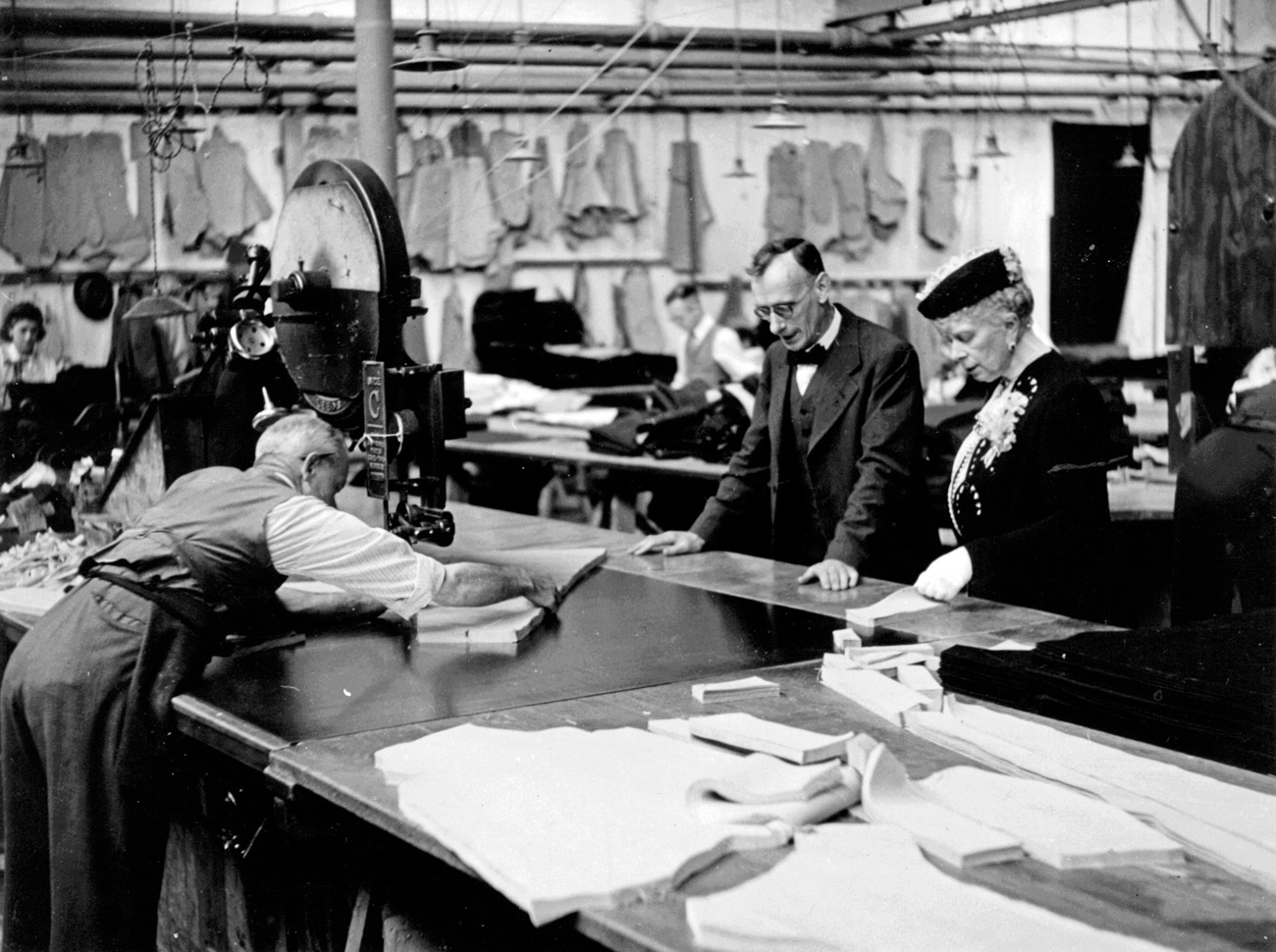
As a result, by the mid-1930s, the company had begun to diversify into manufacturing civilian uniforms for both the public and private sectors. Customers during this period included the Board of Trade, water companies, bus operators and Customs and Excise. The company also continued to sell its products across the world through a network of agents who were paid on commission. In 1937, tunics for the air force were made for the first time and the company continued to make them throughout the war. These wartime efforts prompted a visit from Queen Mary in 1943.

Close links with the military remained until the 1960s, when the company was asked to develop PPE for firefighters working at RAF airfields. In 1961 Bristol Uniforms was created as an arm of Wathen Gardiner & Co to focus on this side of the business. Bristol created the first aluminised suits, which were loosely designed around the buoyancy suits the company had developed for pilots during the Second World War.
By the late 1960s, new specialist materials emerged onto the market, including the first Nomex® fabrics from DuPont. This enabled the development of a new generation of fire clothing, replacing the longstanding T9B woollen fire tunic with the T63: a forerunner of the modern fire suit, incorporating a serge material with a fire-retardant finish.
Throughout the 1970s and 1980s, Bristol pioneered product development for firefighter PPE, working with the London Fire Brigade and the Home Office to develop the A19 Home Office specification: a Nomex® outershell short tunic with yellow PVC wet legs. This was followed by the A26, which became the first bunker-style fire coat.
During this time, Bristol also began developing significant trading relationships, exporting its firefighter PPE around the world. In 1976 it appointed Concorde in Abu Dhabi, one of Bristol’s longest-standing international distributors.
Bristol’s technical staff also formed part of the working party for the first European Standard for firefighter protective clothing (EN469). Introduced in 1995, it became the first standard to cover all countries in the European Union.
The 21st century – managed services and revolutionary design
The year 2000 saw the launch of Bristol’s managed care service for cleaning and repair, which has grown significantly over the years, now operating out of two sites in London and Bristol and playing a crucial role in the business today.
The turn of the century also marked considerable advances in fabric technology, with the introduction of revolutionary new outer shell fabrics such as PBI Matrix®, and there were consequently rapid developments in firefighter PPE design. These new specialist lightweight fabrics, along with WL Gore’s high-performance moisture barriers, paved the way for a new generation in lightweight PPE, which began with Bristol’s Ergotech ranges in 2003. The Ergotech design was selected following groundbreaking human physiology trials commissioned by Bristol to determine the impact of different designs on heat stress – a significant health risk for firefighters which was just coming to light.

Over the past decade, Bristol has remained at the forefront of PPE design with the launch of innovative products including the ergonomic XFlex structural range, RescueFlex for USAR crews, and LayerFlex, which offers varying levels of protection to suit the diverse roles of today’s firefighters across the globe. We have also been awarded contracts for two national procurement frameworks for firefighter PPE in the UK: the Integrated Clothing Project (now the Central PPE and Clothing Contract) in 2007, and the Collaborative Procurement Framework in 2017.
To accommodate rising demand from the UK and overseas, the last decade has also seen a period of considerable expansion, with the establishment of a Central Cutting Unit and new International Distribution Centre in Yate, a custom-designed studio for our Product Innovation Department, and the expansion and reorganisation of both Managed Service Centres to increase capacity.
Looking to the future, Bristol will continue to innovate to help protect emergency crews from the many dangers they face, be that heat stress, chemical contamination or carcinogenic smoke particles. We look forward to maintaining our position as a world-leader in our field, helping to promote best practice both at home and beyond.
For more information, go to www.bristoluniforms.com/our-history

You must be logged in to post a comment.