
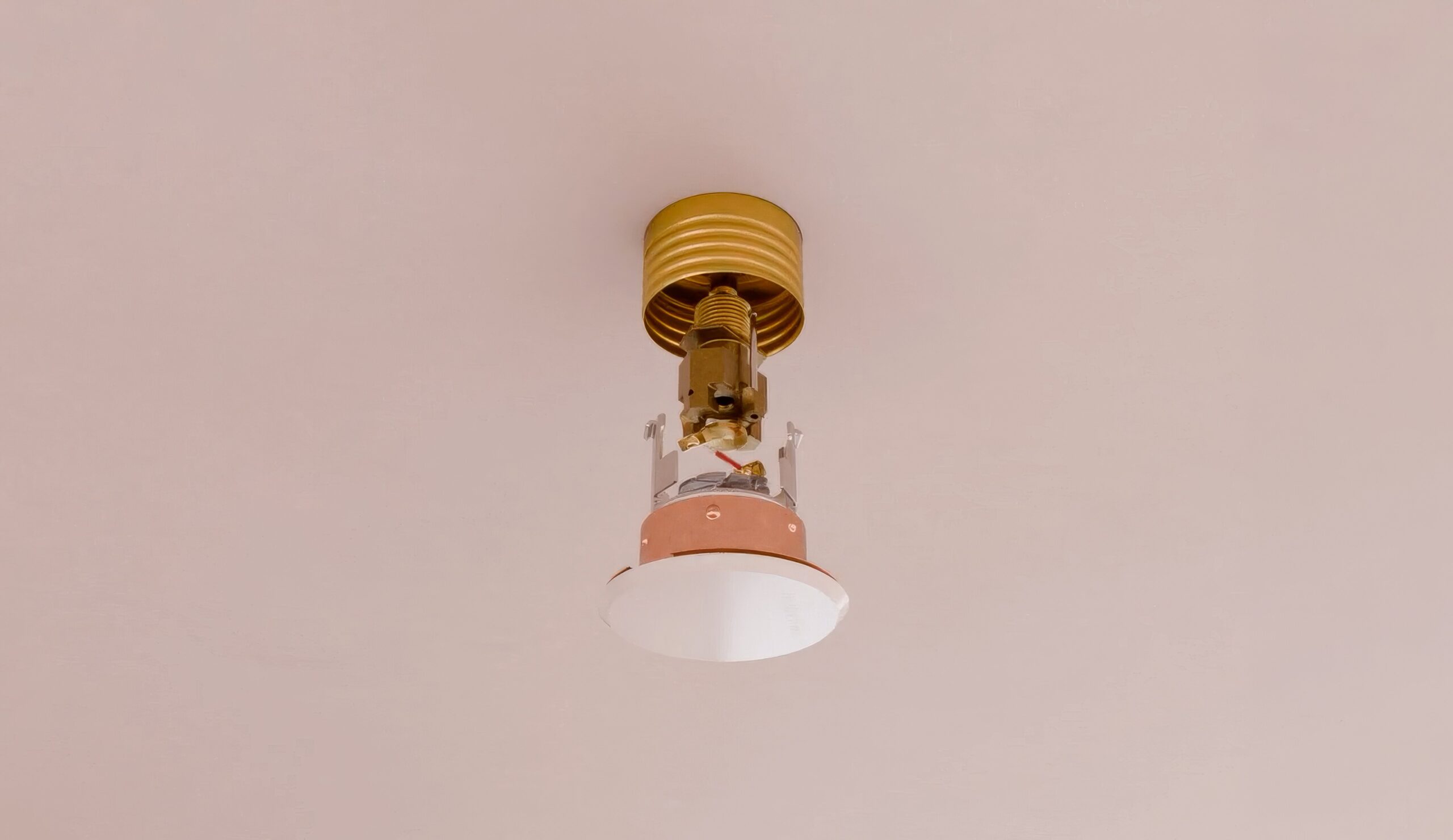
Lifting the lid on the first concealed low-pressure nozzle independently tested to BS EN 14972-17.
iCO Products Ltd, a leading UK manufacturer of residential water mist fire suppression products, recently announced a first for water mist: the successful independent testing of its new concealed low-pressure nozzle in accordance with BS EN 14972-17:2025, the fire-test protocol for water mist systems protecting residential occupancies using automatic nozzles.
As the first in the UK water mist industry to independently fire test a concealed low-pressure nozzle to BS EN 14972-17, iCO has reached an important milestone, providing architects and fire safety professionals with independent evidence of the nozzle’s performance. Highlighting the importance of the news, iCO spokesperson Greg Farmer said: “We know water mist can face more questions than sprinklers when it comes to specification and sign-off. We’ve always believed in what low-pressure water mist can do, but now we have independent BS EN 14972-17 test evidence to support that conversation.”
Pullout:
A first for water mist: a concealed low-pressure water mist nozzle independently fire-tested in accordance with BS EN 14972-17:2025.
Transitioning to the new standard
BS EN 14972-17:2025 is the new European fire-test protocol for water mist systems protecting residential occupancies using automatic nozzles. It works alongside BS EN 14972-1:2020+A1:2025, which sets out requirements for the design, installation, inspection and maintenance of water mist systems.
BS EN 14972-17:2025 supersedes BS 8458:2015, which has now been withdrawn by BSI. Withdrawal of a British Standard does not in itself make existing systems designed or installed to the earlier standard non-compliant. However, for new projects, the BS EN 14972 series now provides the current British Standards framework for residential water mist systems within its scope.
As the industry transitions from BS 8458:2015 to the BS EN 14972 framework, specifiers, installers and approvers need to understand what the new standards require and the evidence available to support system design. The successful independent fire testing provides clear evidence of the performance achieved by iCO’s low-pressure nozzle under the conditions defined by BS EN 14972-17. The iCO low-pressure nozzle is suitable for:
- Applicable residential buildings up to 45 metres high
- Ceiling heights up to 3.5 metres
The 3.5 metre ceiling height is supported by the BS EN 14972-17 fire testing, while the application to residential buildings up to 45 metres is established through the design and application framework of BS EN 14972-1.

Pullout:
The iCO low-pressure nozzle can be specified for applicable residential buildings up to 45 metres high and ceiling heights up to 3.5 metres.
A viable new alternative to conventional sprinklers
Sprinkler systems have traditionally been the more established fire suppression solution for multi-occupancy residential buildings. This includes applications such as apartment blocks, care homes, sheltered and extra-care housing, HMOs and student accommodation. Factors such as higher occupant densities, shared escape routes and, in some occupancies, vulnerable residents can increase fire risk and the potential consequences of a fire, making fire suppression an important consideration within the overall fire safety design.
Despite its practical advantages, low-pressure water mist has sometimes been overlooked in favour of more familiar sprinkler solutions.
With the performance of iCO’s low-pressure nozzle now independently demonstrated through BS EN 14972-17 fire testing, it provides a credible alternative to conventional sprinklers for applicable residential projects.
How low-pressure water mist works
Water mist suppresses fire using fine water droplets to absorb heat and cool the fire and surrounding gases. iCO’s low-pressure nozzle achieves this at a minimum operating pressure of 6 bar, with a flow rate of approximately 29 L/min per operating nozzle.
The concealed automatic nozzle uses a heat-sensitive frangible bulb, activating individually in response to heat in a similar manner to a conventional sprinkler head. Its lower water demand can reduce the water supply and storage requirements of a correctly designed system, helping to reduce the space required for pumps and tanks.
Depending on the system design, this can represent a reduction in water demand of up to 50% compared with a conventional residential sprinkler solution.
How sprinklers and mist measure up:
| Sprinklers | Water mist |
| Fire sprinklers respond to heat and discharge water into the area of the fire to control or suppress its development. Each sprinkler operates individually when exposed to sufficient heat, rather than all sprinklers operating simultaneously. The water cools the burning materials, reduces heat within the room and can help to prevent flashover – the stage where a fire rapidly spreads throughout a compartment. | Water mist uses fine water droplets to absorb heat and cool the fire and surrounding gases. Evaporation of the droplets can also contribute to local oxygen displacement, reducing the oxygen available to sustain combustion. iCO’s automatic nozzles use heat-sensitive bulbs and activate individually in response to heat, in a similar manner to conventional sprinkler heads. |
| Traditional sprinklers primarily control fire by applying water to burning and surrounding materials, providing cooling that can limit fire growth and help prevent flashover. | Water mist systems discharge fine droplets, with BS EN 14972-1 defining water mist as a spray in which 90% of the total volume of liquid is in droplets with a diameter of less than 1 mm. The small droplets provide a high surface-area-to-volume ratio, promoting heat transfer, evaporation and cooling of the fire and surrounding gases. |
| A conventional residential sprinkler head typically discharges around 50 L/min, although actual flow will depend on the sprinkler and system design. | Water mist uses significantly less water than conventional sprinklers, making it particularly suited to applications where space for water storage is limited. The iCO low-pressure nozzle delivers approximately 29 L/min at its minimum operating pressure of 6 bar, with performance independently fire tested to BS EN 14972-17:2025 |
Passing the test
Independent fire testing to BS EN 14972-17 was carried out at Baltic Fire Laboratory, an ISO/IEC 17025 accredited fire testing laboratory with accreditation covering the BS EN 14972-17 test method.
The testing programme verified the performance of iCO’s low-pressure nozzle at ceiling heights up to 3.5 metres under the domestic and residential fire-test conditions defined by BS EN 14972-17. The standard establishes repeatable, scenario-based fire tests designed to represent a range of conditions relevant to residential fire scenarios.
iCO’s Greg Farmer reinforced the rigorous nature of the testing, adding: “Passing tests A–E of BS EN 14972-17 was no easy achievement. The test programme puts the nozzle through a range of challenging fire scenarios, including different fire positions and ventilation conditions. Seeing our low-pressure nozzle perform successfully at both 2.5 and 3.5 metre ceiling heights gives us really strong evidence of what it can do.”
Pullout:
“Installers and approvers now have solid independent evidence of our low-pressure nozzle’s performance, helping to support a smoother route through approval and sign-off.”
Greg Farmer, Business Development and Partnerships Manager, iCO.
Low-pressure nozzle technical specification
- Dimensions (Without Cover Plate): 59.5mm x 55.3mm
- Ceiling Hole Diameter: 60mm
- Weight: 0.27kg
- K-Factor: 12.0
- Temperature Rating (Cover Plate): 57℃
- Temperature Rating (Frangible Bulb): 68℃
- Minimum Operating Pressure: 6.0 bar
- Maximum Pressure: 12.0 bar (limited by pipework)
- Flow Rate: 29.4 L/min
- Pipe Connection Size: BSPT 1/2”
- Colour (Cover Plate): White (RAL 9010)
- Material: Naval Brass CZ112, Stainless Steel 316
The benefits for designers and installers
Low-pressure water mist can offer a range of practical benefits for designers, specifiers and installers, including lower water demand, reduced plant space requirements and discreet integration into residential interiors.
For specifiers and architects, iCO’s concealed nozzles provide a discreet finish, helping to minimise their visual impact and reduce exposure to accidental damage or tampering. Lower water demand can also reduce pump and water-storage requirements, helping to free up valuable plant space.
For installers, compact equipment and lower water-storage requirements can make systems easier to accommodate and install, particularly where plant space or access is constrained. Familiar pipework techniques and screw-fit nozzle connections can also help simplify installation.
For approvers, independent BS EN 14972-17 fire-test evidence provides a clear basis for assessing the performance of iCO’s low-pressure nozzle when incorporated into a system designed and installed in accordance with the applicable requirements of BS EN 14972-1.
In summary
The water mist industry has reached a significant milestone, with the first concealed low-pressure nozzle independently fire tested to BS EN 14972-17 for residential applications. The result provides designers, fire engineers and approvers with independent evidence of performance, helping to provide greater confidence when specifying and assessing low-pressure water mist.
With independently tested fire performance, lower water demand and reduced space requirements for pumps and water storage, iCO’s low-pressure water mist nozzle provides a credible alternative to conventional sprinklers for applicable multi-occupancy residential buildings up to 45 metres high.
For more information please visit: https://ico-products.com/concealed-low-pressure-mist-nozzle/
