
You can’t build a great building on a weak foundation – a strong foundation is required for a strong structure. In the context of the Grenfell Tower tragedy, it is clear that the foundation of the UK’s built environment is not as strong as it once appeared – we’ve built on sand, rather than rock. Whilst the Grenfell Tower Fire tragedy cannot be blamed on one individual factor, the lack of clarity around basic issues of fire performance and safety appears to indicate that wider, systemic issues may have had a role to play.
To understand the complex issues and factors that may have contributed to the Grenfell Tower Fire, the Government established a Public Inquiry, whilst simultaneously ordering an Independent Review of Building Regulations and Fire Safety, led by Dame Judith Hackitt.
Whilst the public inquiry is still taking evidence, a range of factors have been highlighted as possibly contributing to the extensive damage to homes at the Grenfell Tower. These factors include:
- A lack of sprinkler protection within the tower block
- The compartmentation strategy that was bypassed and questions over items like fire doors and smoke ventilation systems performing to the required standards
- The use of a single stairway for egress and firefighter access
- The use of combustible construction materials in the form of aluminium composite material (ACM) cladding and insulation systems which was observed to spread fire up the facade of the building
Understandably, the use of ACM cladding on Grenfell Tower and other high-rise buildings has been a major area of concern following the fire. Many stakeholders have questioned why the cladding was installed, querying whether it passed fire-safety regulations and tests. Inherent in this discussion remain concerns around desktop studies – highlighted within Dame Judith Hackitt’s interim report – as well as concerns around combustible cladding.
The Interim Hackitt Report
The interim report from the Dame Judith Hackitt-led review was delivered in December 2017 and highlighted that the current system of regulation that was “not fit for purpose”1 due to a lack of clarity on fire-safety guidance. In particular, significant concerns were raised about the specification of construction materials, their performance in a fire, as well as the use of desktop studies.
This lack of clarity makes it significantly more difficult for manufacturers and constructors to understand whether the materials used will operate appropriately should a fire occur – something that has become increasingly clear over the past 12 months. Vague building regulations and a focus on cost rather than property and building safety is unfortunately demonstrated throughout much of the UK’s built environment – a culture that has certainly contributed to major fires in the past and will likely continue to do so.
Desktop studies
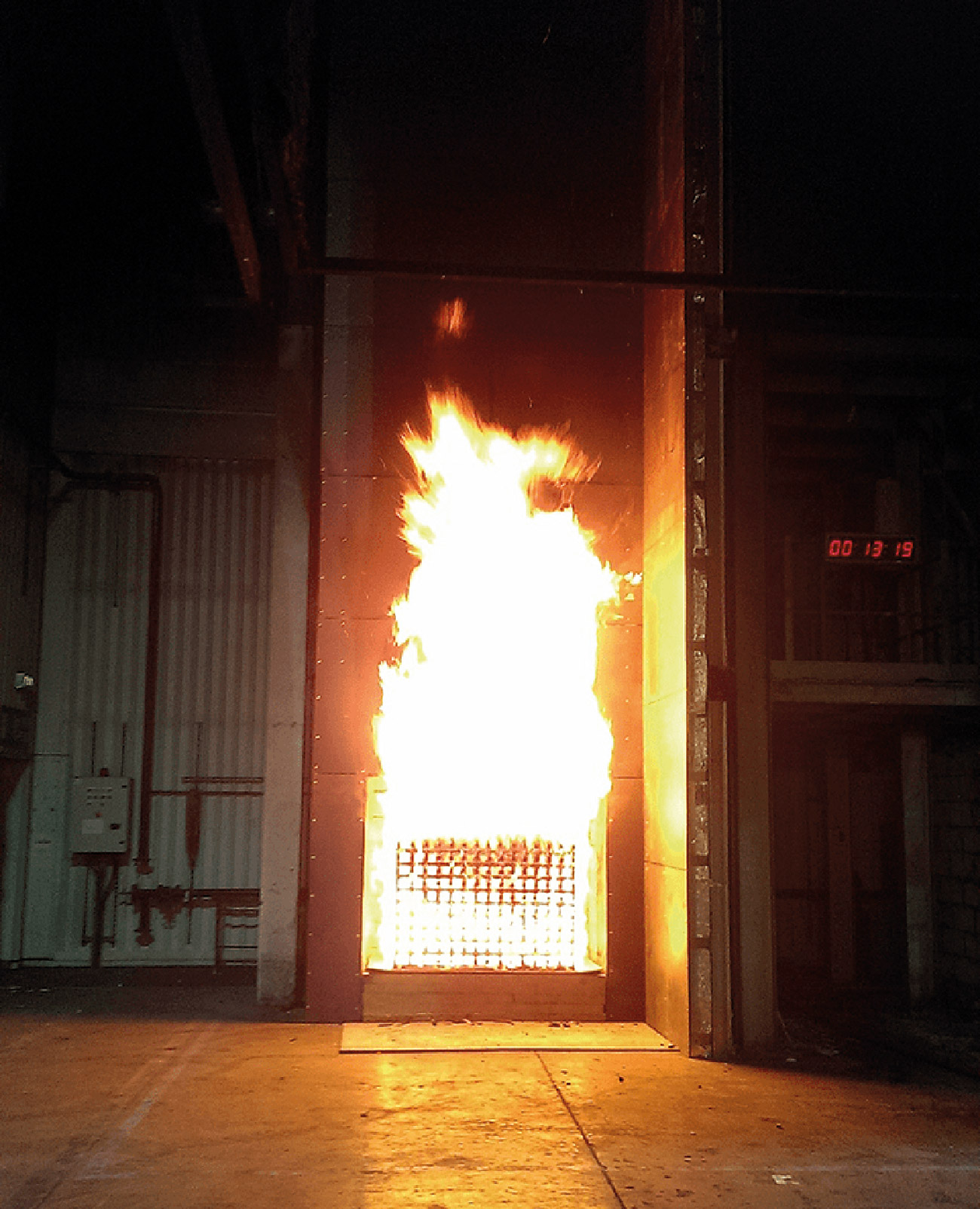
Desktop studies or more precisely ‘assessments in lieu of testing’ became a focus within the Interim Hackitt Report as it was clear that combinations of insulations and cladding had been used on buildings without going through full-scale physical fire tests. The assessments of these systems were used instead of full-scale fire testing as a cost-effective way of classifying the fire performance of differing building materials such as cladding. These assessments were meant to be carried out using previously available data, taken from real-life full-scale physical tests, to decide whether the materials in question would pass a physical test. Using desktop studies has been a way of sidestepping the more expensive, full-scale physical test of ACM cladding (BS 8414).
The Final Hackitt Report
The final report from the Independent Review of Building Regulations and Fire Safety was published in May 2018. It focused on high-rise residential buildings and a system of regulation to improve fire safety in those buildings, whilst also calling for a change in culture towards fire safety for these buildings. Given the various failings inherent within the UK’s regulatory regime, Dame Judith was certainly correct to draw significant attention to this issue of culture. Fundamentally, the culture needs to change to provide greater focus on property safety – something that will both protect buildings and promote safety in the future.
Whilst Dame Judith’s Final Report was welcomed by some stakeholders, the narrow focus and lack of detail in regard to definitive actions on construction materials gained all the headlines at its launch. In response, the Secretary of State announced a consultation on a ban for combustible materials in high-rise residential buildings on that very same day.
A ban solves it all?
For many stakeholders a ban on combustible cladding on high-rise buildings may appear to solve the issue – if all combustible cladding is banned then clarity for manufacturers and constructors is guaranteed. At the same time, the issues with desktop studies will be made redundant. Whilst FM Global welcome the intention of this ban – creating an environment where non-combustible cladding is used as the norm – it is vital that a focus on clarity of regulations and attention to detail is retained moving forward.
Given that the proposed ban on cladding would apply only to high-rise residential buildings over a certain height, questions remain for other building types and those buildings below the cut-off point.
Firstly, would desktop studies for combustible cladding still be permitted for buildings outside of the proposed ban? The devastating effects of fire on these buildings should surely result in this not being the case – at least in the short term. FM Global strongly believes that a moratorium on desktop studies, replaced by a period of time where physical tests have to be conducted for cladding materials, would greatly improve the available evidence base. Once the evidence base has suitably improved, this could allow manufacturers and constructors to use assessments for defined and limited alterations, in the confidence that the cladding used would perform and restrict the potential for external fire spread.
Once desktop studies are placed under a moratorium, the testing system for cladding would also need to be refined. For those developers who continue to choose a combustible option, rather than a lower-risk non-combustible option, a stricter testing regime needs to be developed. Developers would then need to adhere to this, keeping in mind the goal of protecting property and lives rather than focusing on purely meeting the bare minimum standards required by the tests.
Finally, a focus purely on non-combustible cladding is not enough. It is FM Global’s belief that the solution to building fire resilience is relatively straight forward. The use of non-combustible materials and appropriate fire-protection systems, such as sprinklers, will effectively stop a fire from spreading and causing damage. We must look to create an environment that facilitates this. Active fire-protection measures, such as sprinklers, need to be promoted within building regulations.
Building a culture around safety
The core finding of the Hackitt Report is right and there should be a shift in the current culture to make fire safety a priority. The Government and industry should not miss the opportunity to look carefully at and update the current regulations and regulatory guidance.
Reforming building regulations will take time, but this doesn’t mean we should shy away from it. Clarity and attention to detail are needed to ensure we are building fire safety on a solid foundation. The review of Regulatory Guidance is long overdue and needs to start now. The clock has been running for one year and actions are needed. That review needs to be open to ideas on using effective active protection like automatic sprinklers. In order to prevent another disaster like Grenfell Tower a change in the culture surrounding building regulations is also of paramount importance – government and industry bodies most work together to make a safer built environment for the future.
For more information, go to www.fmglobal.com/insights-and-impacts/2018/can-your-cladding-take-the-heat
References
- Building a Safer Future – Independent Review of Building Regulations and Fire Safety: Final Report, https://assets.publishing.service.gov.uk/government/uploads/system/uploads/attachment_data/file/707785/Building_a_Safer_Future_-_web.pdf pg.5
About the Author

Tom Roche is Senior Consultant, International Codes and Standards for FM Global.
