
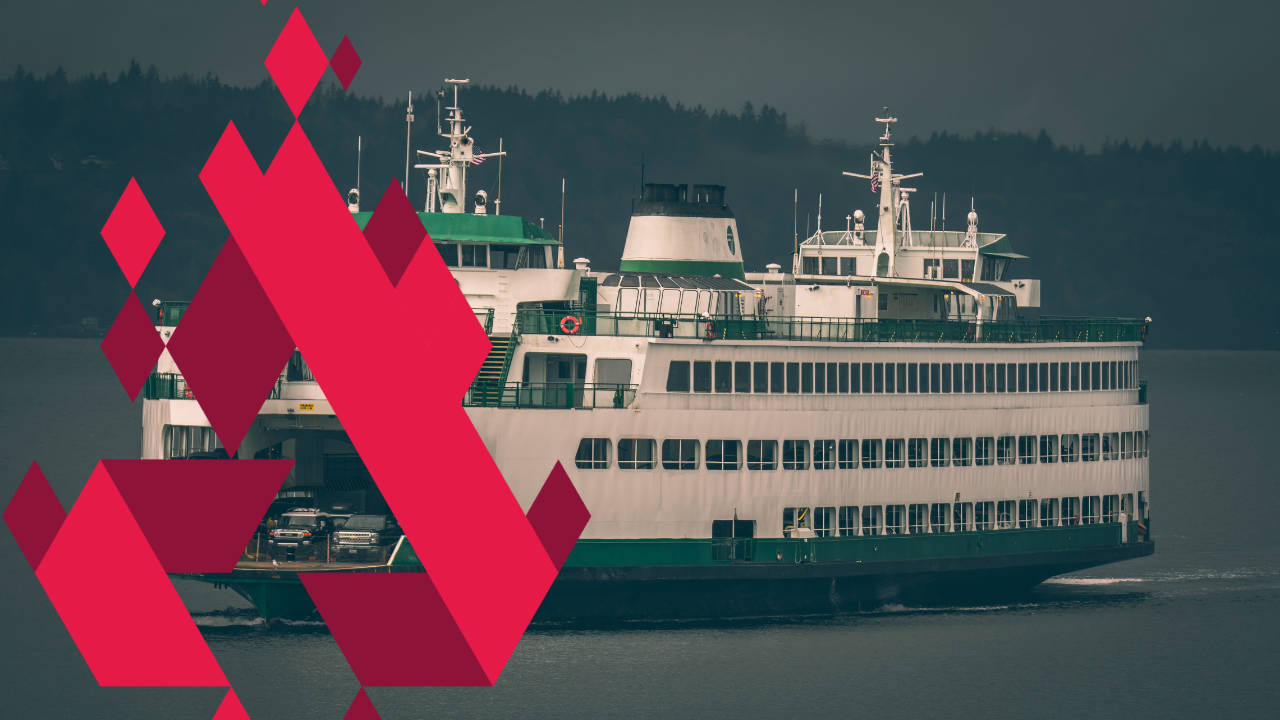
The observations below are intended to inform professional discussion of maritime fire safety and should not be interpreted as findings regarding the circumstances of the KMP Mutiara Sentosa 2 incident.
Following the fire aboard KMP Mutiara Sentosa 2 in the Java Sea, the Institution of Fire Engineers (IFE) Transport Special Interest Group (SIG) says some aspects of the public narrative around ferry fires are deeply misleading and that survivors who entered the water should be understood as responding rationally to the conditions they faced.
The SIG has reflected on the fire engineering realities behind the fire aboard the Indonesian passenger ferry KMP Mutiara Sentosa 2, which caught fire in the Java Sea on 2 August 2026 while sailing from Surabaya to Makassar with 271 people aboard, 232 passengers and 39 crew.
The IFE’s Transport SIG extends its condolences to the families of those killed and to those still awaiting news. It stresses that it has no regulatory or investigatory role in the incident, that Indonesia’s National Transportation Safety Committee (KNKT) has opened an investigation, and that it will make no inference as to the cause of the fire.
The SIG’s comments are limited to broader issues relating to fire development on roll-on roll-off passenger vessels and established understanding of human behaviour during maritime emergencies, including reports that survivors gathered at the bridge and bow before entering the sea.
Dr Mukesh Tomar, AIFireE, Founder and CEO, Tomaers and Marine lead of IFE’s Transport SIG explained:
“A ferry fire is not a large car fire and treating it as one is why the public account of these events is consistently wrong. A roll-on roll-off vehicle deck is a single long undivided volume, open end to end, because that is what loading vehicles efficiently requires.
Compartmentation, the principle almost all fire safety design ashore depends on, is largely absent by commercial necessity. Fire moves between vehicles by radiant heat with nothing to stop it. Significant fire exposure can place severe thermal loading on the structure above the vehicle deck and, if control measures are overwhelmed, may threaten adjacent occupied spaces.”
In further discussion, the SIG highlighted the operational condition it considers most widely misunderstood as Mukesh said: “Ashore, every building’s fire strategy assumes a professional fire service arrives within minutes.
“At sea, there is no fire service coming. The crew is the fire service, and the same people are fighting the fire, managing several hundred frightened passengers and working the ship simultaneously. No reinforcement, no relief, no second attempt. The reported timeline in this case, with the fire placed between 06:00 and 07:00 and search and rescue notified at 08:24, illustrates the arithmetic every passenger vessel operates under. At sea, help is measured in hours, not minutes.”
On the reported behaviour of survivors, Mukesh was direct: “Much of the coverage has called this panic.
“It was not panic. Fire safety design ashore rests on the idea that people move away from the fire towards a place of ultimate safety. On a ship at sea, that place does not exist until rescue arrives. Once the internal stairways are smoke-logged, the muster stations may already be unreachable, so people move to the furthest point from the fire, in this case the bow, and wait. When the heat reaches them there, entering the water is the last protective action available. Those were reasonable decisions taken by people from whom every alternative had been removed one by one, and the families reading these accounts deserve to know that.”
The sequence has precedent in the same waters. In January 1981, the ferry KMP Tampomas II burned in the Java Sea on passage from Jakarta to Makassar. Passengers gathered at the bow ahead of the smoke and entered the water while a rescuing vessel
struggled to come alongside. More than four hundred people died in the tragedy. The IFE’s Transport SIG stressed these are the important questions for the investigation and the wider sector, not findings:
- Whether the time taken to alert external rescue should be treated as a fire safety system in its own right, designed, drilled and audited accordingly. Where help arrives in hours, minutes lost at notification are minutes taken from everyone aboard.
- Whether passenger vessels should be designed for the refuge people use, rather than only the muster station shown on the plan. If survivors reliably migrate to the bow when the interior becomes untenable, the sector should establish how long that location remains survivable and whether rescue can physically reach it there.
- Whether the merchant and fishing vessels that are frequently the first assets on scene are adequately recognised in emergency planning. In this incident, a nearby cargo vessel reported the fire’s full extent but was limited in the assistance it could offer by the nature of its own cargo, a constraint that was foreseeable rather than a surprise.
- Whether an accurate passenger manifest is understood as a fire safety measure. Search and rescue cannot account for people who were never counted, and no family can be told the truth about a number that does not exist.
The IFE’s Transport SIG believes that learning from incidents such as the Java Sea ferry fire is essential if future tragedies are to be prevented. Through its extensive continuing professional development (CPD) resources, technical events and specialist communities, the IFE supports fire professionals in building the knowledge and understanding needed to improve fire safety across the transport sector and beyond and prevent such incidents. The SIG will continue to monitor the outcomes of the investigation and any subsequent policy or legislative developments and will keep members and stakeholders informed of lessons relevant to the profession.
It also calls on the media and wider commentators to reflect carefully on how maritime fire incidents are described. Simplified or inaccurate comparisons can undermine public understanding of the risks involved and inadvertently shape expectations, behaviours and future responses during emergencies. Accurate reporting is not simply a matter of commentary; it is an important part of public safety education. By improving understanding of how fires develop and how people respond in extreme conditions, the sector can help ensure that lessons are learned and lives are saved.
For more information, go to: www.ife.org.uk
