
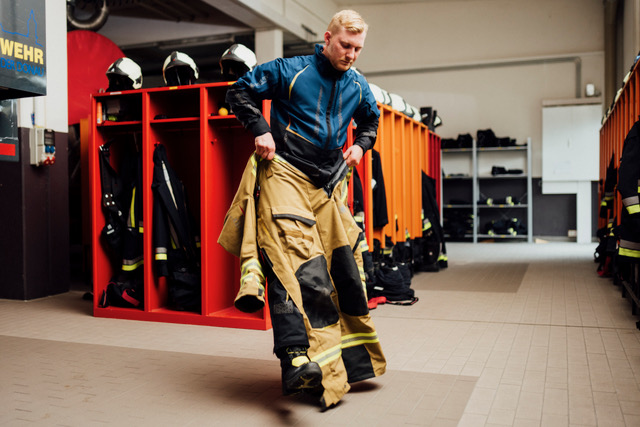
Delegates at INTERSCHUTZ 2026 will be the first to see a new modular firefighting garment concept from Gore-Tex® brand that uses adaptive layers to cover technical rescue, wildland fire and structural firefighting operations
Firefighters typically wear the same protective clothing for all operational responses, whether they are carrying out technical rescue or structural firefighting assignments. Their protection is designed to meet the most extreme conditions, such as a flashover in a structural fire.
But firefighters do not tackle structural fires daily. Most operational responses are for rescue operations, accidents or small fires. This means that they are often responding to incidents ‘over-protected’ by gear that was designed for more extreme conditions, potentially raising the risk of heat stress.
Added to this, their needs not only differ, but they can even be conflicting, compromising their operational effectiveness in one scenario for effective protection in another. Freedom of movement and high visibility are essential for technical rescue professionals. Wildland fire operations call for lightweight, heat-resistant garments. Firefighters tackling a building fire need maximum insulation and protection against exposure to heat and flame.
“The challenge is to reconcile conflicting needs to remove the compromise in operational effectiveness and mitigate the risks of overprotection. Freedom of movement, weather protection and thermal protection cannot be optimized in one garment. A garment that fulfils the requirements of all operational scenarios will always involve trade-offs,” says Christophe Didelot, the firefighting and technical rescue product specialist at GORE-TEX® Brand.
Two garment layers instead of a one-fits-all configuration
GORE-TEX® Brand is presenting an innovative new design concept for fire garments at INTERSCHUTZ 2026 that solves this paradox. Instead of combining multiple requirements in one garment, the concept presents two adaptable garment layers based on existing product technologies.
Each can be worn alone or in combination, depending on the mission:
- Layer 1 for technical rescue operations and other frequent call-outs is based on the GORE-TEX® CROSSTECH® PYRAD® Stretch Product Technology. It is lightweight and designed for freedom of movement and comfort.
- Layer 2 uses GORE-TEX® CROSSTECH® Product Technology and is a stand-alone solution for wildland fire call-outs and outside operations. It fulfils the performance requirements of EN 469 level 1 and EN ISO 15384.
- The two layers can be worn in combination so that together they provide EN 469 level 2 protection for structural firefighting.
Instead of incorporating the required protective features into the same garment, they are now integrated into two adaptable clothing layers. This means that the lighter Layer 1 is worn alone for technical rescue operations and Layer 2 for wildland fire call-outs. For structural firefighting operations, the two layers are worn together.
So, two garment layers now meet the needs of three operational scenarios. This also reduces the number of garments required, simplifying procurement and maintenance and saving time, effort and expense.
The decisive factor is not maximum performance at all times, but the appropriate garment for the specific purpose.
A proven principle from other sectors
GORE-TEX® Brand has been developing modular clothing systems and the underlying product technologies for multiple professional scenarios for many years. These solutions are focused around a layering principle, which interprets clothing as a system of fine-tuned, carefully coordinated layers rather than a standard uniform.
Examples of these are the Nordic Combat Uniform (NCU) of the Nordic Defence Cooperation and the Flexible Layering Systems of the German police. These concepts are based on a clearly defined layering construction. The individual garment layers are carefully chosen depending on the climate, physical demands and intervention type. Each layer may not meet all the requirements, and not all components will be worn together.
These layering systems are developed and tested by Gore in realistic situations. Durability testing and wet laboratories, a rain tower, as well as climate and environmental chambers, are used for this purpose. These are complemented by field tests conducted by end-users. The underlying motive is to analyze how heat, moisture, physical demands and protection influence each other during operations. The result is a garment system whose performance is achieved at the system level – through the coordinated interaction of the individual layers and not through isolated individual components.
For more information, go to: www.gore.com
