

When it comes to fire ventilation tactics, there isn’t a one-size-fits-all strategy. Every fire ground is different. Compound that with the ever-changing dynamics of the structures being protected – building size, room geometry, interior contents and construction materials – and it’s no wonder organizations like UL, NIST and others continue to devote resources to enhance firefighters’ ongoing understanding of fire ventilation. For that reason, this article isn’t about ventilation tactics but rather the tools that departments can consider when preparing for likely scenarios. So what ventilation tool(s) are right for your department?
Today, we’re going to take an in-depth look at PPV fans and some of the factors your crew may want to consider when selecting this equipment.
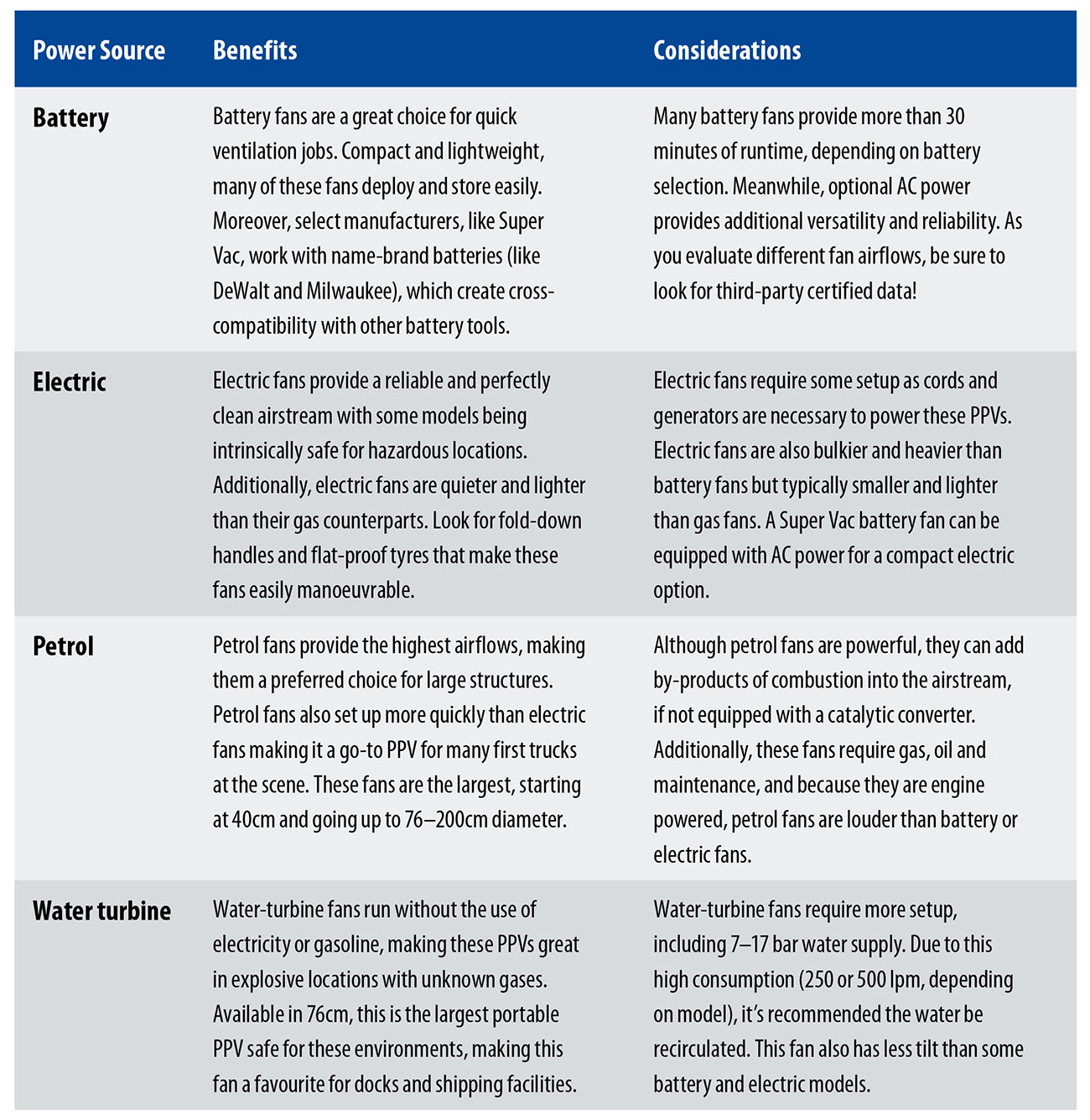
1. How do you plan on powering your fan?
The chart below provides some considerations:
2. Fan size is another key consideration, especially when space is limited on most fire apparatus
Large petrol blowers and high-capacity electric fans typically deliver more output but require considerable storage. These fans are often relegated to support apparatus. Meanwhile, modern battery PPVs are smaller. At just 21kg and 66cm x 66cm x 30cm, the Super Vac battery fan is so compact, it can be stored on its side in shelf-style compartments, making it perfect for first-response rigs. But fan sizing considerations don’t stop there. Super Vac offers the largest range of PPVs, spanning from the 20cm-diameter confined space Nano to the trailer-mounted 200cm diameter BFF, which produces approximately 1.25 million cubic meters of air per hour, ideal for ventilating tunnels, airports and other large structures. Overall, to narrow down your selection, consider storage space on your apparatus, evaluate the size and types of structures in your jurisdiction and decide how much fan output you need.
3. Once you’ve identified your power source and a general fan size, you can select your preferred motor or engine
Do you need single or variable-speed functionality? Need to spec an ATEX motor for hazardous locations? Pneumatic motors feature compressed air, also making these fans intrinsically safe for hazardous environments, and water-powered motors are another intrinsically safe power source.
4. Another consideration – noise pollution
Noise pollution can adversely affect fireground communication near the fan and within the structure. Simply put, noise is a major drawback to mechanical ventilation, especially petrol-powered fans. But that’s no longer the case with battery fans. The decibel reading for Super Vac’s V18-BD fan produces an 85dB reading at 1m in front of the fan, and 75dB from 3m, which is only slightly louder than the sound a showerhead makes. With these quieter fans comes improved communication. Plus, battery fans produce less airborne cancer-causing agents – a whole other type of pollution crews want to avoid.
5. Finally, consider PPV accessories to add more functionality
Select fans can be equipped with accessories that create light, foam, mist or even heat to aid in rescue and rehab efforts. Different fan-guard options give crews the ability to adjust fan-entryway setback, while a door bar/hanger kit allows the fan to be mounted in a doorway to elevate airflow. Meanwhile, smoke curtains can be used to help control oxygen while maintaining door control and mitigating smoke damage, and spiral ducts are perfect for helping move large quantities of air into hard-to-reach places, like confined spaces. For gas fans, consider spec’ing an exhaust hose extension to remove emissions away from the PPV intake, or a catalytic converter to significantly reduce emissions.
For more information, go to www.supervac.com

You must be logged in to post a comment.