
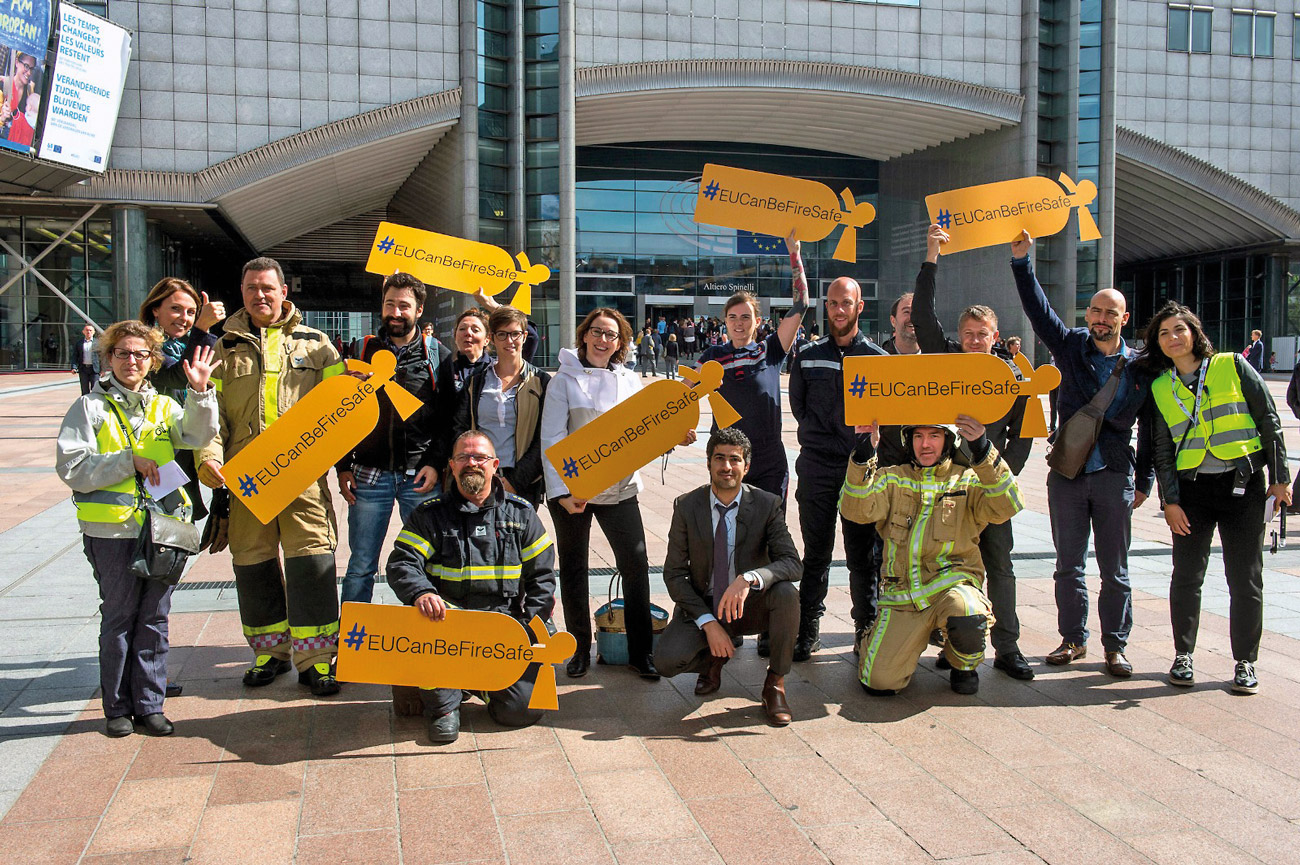
The start of October was marked by the announcement at the Conservative Party Conference 2018 that combustible materials will be banned from the facades of ‘all new high-rise residential buildings, hospitals, registered care homes, and student accommodations’ over 18m.
Although this may be a limited scope, it is an important step in the right direction. Fire Safe Europe (FSEU) had responded to the UK government consultation on ‘Banning the use of combustible materials in the external walls of high-rise residential buildings’ by emphasising that the facades of any building where escape and firefighting may be compromised by additional fire risks, regardless of height, should be made of non-combustible construction materials (euroclass A1/A2).
Allowing solely non-combustible materials to be put on high-rise and high-risk building facades is increasingly common in the EU, in spite of widely different regulations from country to country.
In June 2017, Fire Safe Europe (FSEU) had looked at facades regulations on high-rise buildings across 16 EU countries. At the time, Croatia, Czech Republic, Denmark, France, Germany, Hungary, Poland, Slovakia and Serbia already had strict requirements for the products used in facades to make ‘no significant contribution to fire at any stage of the fire’, corresponding to class A2 or higher in the European classification system.
For this research, FSEU had defined high-rise buildings as being 22m or higher, but it is worth noting that the very definition of a high-rise building is different from country to country, ranging from 18 to 28m. With the Conservative Party statement, the UK now enters the ranks of countries with non-combustibility requirements for high-rise buildings.
Interestingly, the UK is not the only country that has either introduced or revised their regulations regarding fire safety in the past year. Nine European countries have also been reviewing their laws and regulations.
For some of these countries, work had started even before 2017. Yet there is no denying that the UK tragedy has been a wake-up call on fire safety across the EU. The results of an increased awareness on fire safety are becoming visible, as this year new regulations came into force in three other European countries: Greece, Finland and Denmark. Bulgaria has also reviewed its existing regulation to allow only the use of non-combustible (A1 and A2) materials for fire barriers and for the facades of buildings over 28m.
Belgium, France and Ireland have all published reports to assess the state of the fire safety in their country. The Belgian Building Research Institute (BBRI) published a report which underlined the shortcomings of the current regulation and has triggered a legislative process foreseen to finish by the end of 2018.
Neighbouring France has also started with identifying issues with a report made by the Scientific and Technical Centre for Building (CSTB) before introducing a new law proposal encompassing all building aspects. This law aims at harmonising regulations for buildings between 28 and 50m irrespective of the type of building, professional or residential. Another significant improvement proposed would be the inclusion of fire-safety considerations when carrying out energy-efficiency renovation.
Ireland set up a task force which investigated the possible development of additional regulations for some large-scale or high-rise buildings and produced recommendations.
Despite the limited scope of the foreseen new regulation in the UK, which will address only new residential buildings over 18m, it is a great step for the UK to follow suit and ensure that UK citizens are at least as safe in their buildings as those in other countries within Europe. As Juliette Albiac, Managing Director of Fire Safe Europe (FSEU) stressed: ‘This is a great moment for fire safety all across Europe, as several countries have been revising their building regulations in the past year’, and there is hope that this trend inspires countries that have yet to guarantee sufficient levels of fire safety to their citizens. However, a critical factor for success lies in the effective enforcement of these new regulations.
For more information, go to www.firesafeeurope.eu
