
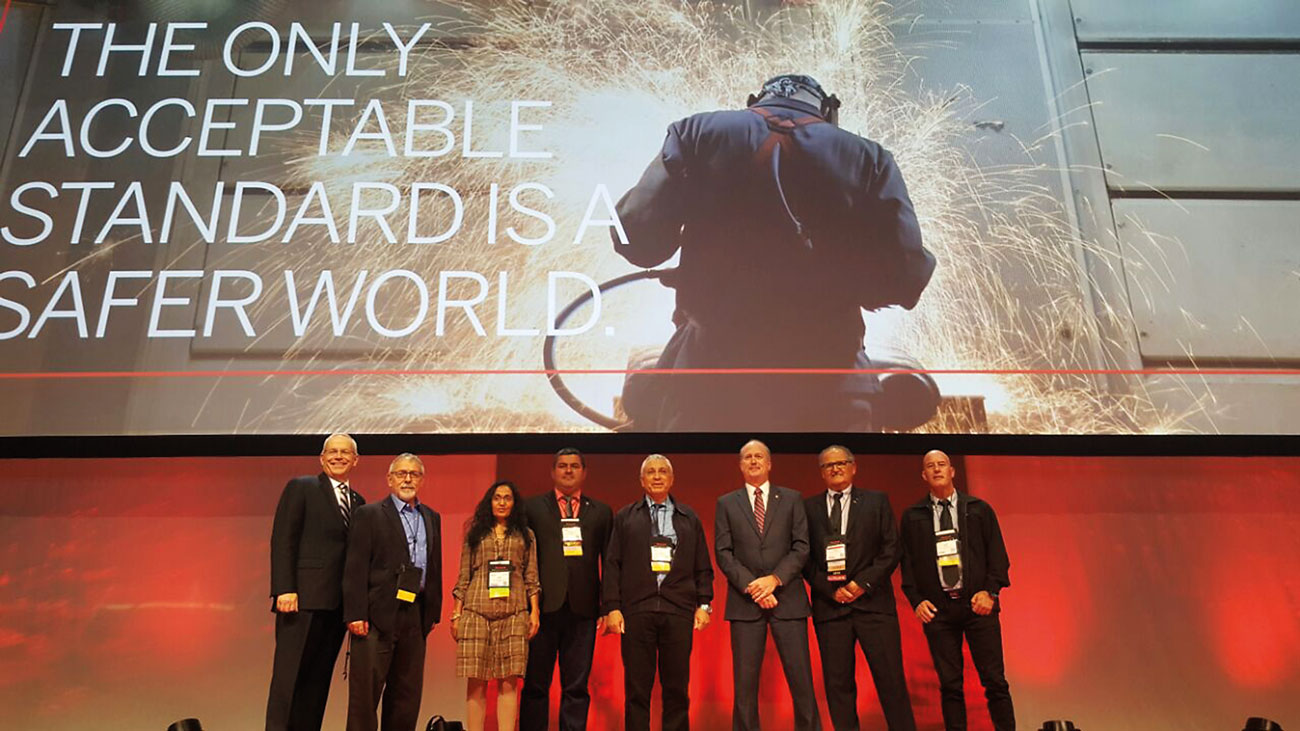
Earlier this year, National Fire Protection Association (NFPA) President and CEO Jim Pauley wrote a blog applauding an editorial titled, ‘The Joy of Standards – Life is a lot easier when you can plug in to any socket,’ published in the 26 February edition of The New York Times. Representing one of the world’s standards development organisations (SDO), Pauley reinforced one of the article’s main messages, which was that standards affect virtually everything around us. Contributors Andrew Russell and Lee Vinsel provided a relatable example about the average laptop being designed and developed in accordance with more than 250 standards.
By normalising the standards development process in one of the world’s most respected news outlets, the co-authors underscored what most private citizens or even policymakers may not know, fully appreciate or take for granted: standards keep us safe from harm. The creation of standards ensures reliability, interoperability and quality, while delivering economic, societal, and governmental savings benefits.
As an SDO, it goes without saying that NFPA takes the development and use of standards seriously. Our Association believes, and has believed since our inception in 1896, that safety is not something we can take for granted. Safeguarding people and property have been the cornerstone of NFPA for more than 120 years – and continues to be the foundation for all we do today.

The need for safety standards to address new technologies began to take shape back in 1893 when the United States was faced with a problem – and new solutions needed to be applied. At the time, the insurance firm for the World’s Fair balked when electrical workers could not agree on the best electricity and lighting approach. William Merrill, the leader for one of the major underwriting organisations at the time, was called upon to vet electrical safety. He did just that, and the insurance company agreed to insure the fair.
About a year later, visionaries in the world of fire-sprinkler systems began to explore the possibility of establishing consistent rules for the installation of sprinklers. The burgeoning success of fire sprinkler systems had resulted in several different systems and installation techniques so stakeholders came together to establish a set of rules. Their efforts resulted in NFPA 13 Standard for the Installation of Sprinkler Systems – the first standard that NFPA produced. The year was 1896.
Meanwhile, five electrical codes were being used in the US, making it difficult to manufacture products and provide uniform training for electricians. Electrical professionals began gathering in 1896 in an effort to cull the best of the US codes, as well as the guidance found in a German code, the code of the British Board of Trade, and the Phoenix Rules of England into one document. The committee created and printed a draft code, sent it to 1,200 interested individuals in North America and Europe for comment, reconvened in the spring of 1897, and established the ‘National Electrical Code’. For the next fourteen years, an independent organization was responsible for revising the code before it was transferred to the Electrical Committee of the National Fire Protection Association in 1911 for ongoing development. Today, the NEC is the most widely known and adopted standard produced by NFPA.
Keeping people and property safe requires a solid framework
In the United States, private-sector groups such as the NFPA develop standards, whereas in nearly every other country in the world, it is the responsibility of government agencies.
NFPA standards include insights from different interest groups – not one of which can make up more than one-third of any NFPA technical committee. Standards provide benchmarks for how safety measures are incorporated into the design, manufacturing, and use of products, as well as the minimum job performance requirements for using equipment or fulfilling roles. Plain and simple, standards are written to protect people and property from harm. Volunteers on NFPA technical committees represent manufacturers, users, applied research/testing laboratory, special experts, installers/maintainers, enforcers, insurance, labour, and consumers.
Technical committees employ a consensus approach so that all parties with a vested interest in a topic are invited and encouraged to weigh in. This process helps minimise second-guessing and conflict when the standard is released. It is up to jurisdictions to determine which standards will be adopted and enforced.
So why is it that today, more than a century after its birth, the NFPA standards development process predominantly features US based input and volunteers if we know that broader insights, different experiences, unique perspectives, and varied tactics ensure the development of the most well-rounded, far-reaching safety solutions?
Each country and culture has its own nuances. Therefore, it is essential that global stakeholders contribute to the standards development process. For example, when NFPA 58, Liquefied Petroleum Gas Code was being developed, international representatives made some important contributions that their counterparts in the United States were simply unaware of. They pointed out that while rooftop installations of propane containers are rare in the United States, they are common in Mexico and other parts of the world where piped natural gas is not available and space is limited. Additionally, stakeholders from Japan explained that they, too, had challenges that were being unaddressed. That corner of the world is prone to tsunamis and therefore containers could be damaged or displaced by a wave. They informed the NFPA 58 Technical Committee that, in such installations, natural gas containers are generally filled at ground level with qualified personnel at the rooftop container and at ground level. These invaluable international insights influenced elements of NFPA 58.

Not all countries have the same infrastructure and resources that exist in the US, thus the reason global authorities that may be aware of different considerations are encouraged to partake in the development process – not only for the benefit of their own constituents and citizens, but moreover for the sake of the public and practitioners everywhere.
Growing up as the son of a submarine vet who went on to become a firefighter, I strived to learn all I possibly could about fire dynamics and how it impacted different structures, building construction, and hydraulics. There seemed like an endless list of text and material on all the subjects, but most of it stemmed from US sources – with the exception of some fire-protection engineering guidelines. It made me wonder how firefighting was being addressed in other countries. Mustn’t they have their own ways of fighting fire in their jurisdictions? What do they do differently? How can we better assist them with their needs? It is critical that there is a global voice heard during the standards development process. It just makes sense to facilitate and ensure that well-rounded, worldly learnings are incorporated into NFPA standards. A diversity of knowledge and global insights benefits all.
Some may say that firefighting tactics and equipment vary from country to country – how can one set of codes and standards be of any help? There is no denying that protocol and resources may differ from place to place, but by working together we can identify challenges and develop the best infrastructure for reducing risk.
While there are more than 100 NFPA codes and standards that keep firefighters safe from harm, NFPA standards also factor significantly into the built environment. It is not uncommon for building projects in the Middle East and Asia markets to be designed and constructed using criteria from NFPA codes. International building efforts tend to involve design teams either lead by US based firms or featuring US professionals that are aligned with in-country architectural teams because they tend to possess standards knowledge. Workers in these positions typically use standards but may modify or revise procedures to accommodate the region’s preferred materials, construction techniques, and material delivery methods.
Designers and contractors familiar with countries outside of the US not only add value to NFPA technical committees but are perceived as valuable resources by global authorities because of their standards knowledge. Their understanding of best practices and use of standards can also help smooth the way for other multi-national organisations charged with developing projects in those same countries (i.e. Marriott, IBM, Apple). Essentially, individuals working in different countries can benefit from getting engaged in the standards development process and play a role in informing peers domestically and abroad.
There are several ways to get involved in the NFPA standards development process. One of the best ways is to submit Public Input (a suggested revision to a new or existing NFPA standard) or Public Comment (a suggested revision to the first draft of an NFPA standard) during their revision cycles. It’s 100% free, easy to do, and can all be done online.
Another option is to apply online to be a member of a technical committee. Organisational applicants have a better chance of getting appointed to a committee since it brings the views of many to the process rather than perspective from one individual or company. All principal applicants are encouraged to have an alternate apply at the same time, in the event that there are schedule conflicts. Individuals must be willing to actively participate in the work of the committee; be able to communicate by e-mail; have access to the NFPA website; and agree to discuss and disagree in a professional manner.
Technical committee appointments are decided by the NFPA Standards Council three times a year, and are based on the qualifications of the applicant; a balance of interest categories on the committee; maintaining a manageable working size committee; and the ability to attend and participate in all committee meetings. Technical committee members do not need to be active NFPA members.
When it comes to standards development, no matter where you work or live – your voice matters. NFPA purview extends the world over, and exchanges with international stakeholders are greatly valued.
It’s a Big World Let’s Protect it Together. This is not merely an NFPA slogan – it’s a call to action.
For more information, go to nfpa.org/Codes-and-Standards
About the Author

Curt Floyd is Technical Lead for First Responders at the National Fire Protection Association (NFPA).

You must be logged in to post a comment.