
With more lithium batteries in use than ever before, the risk of fires caused by them is also increasing. The London Fire Brigade recently stated that, on average, they attend 24 fires each week caused by chargers, batteries and cables. Another report produced by the Environmental Services Association (ESA) found that around 48% of all waste fires occurring in the UK each year were caused by lithium-ion batteries, costing £158 million.
Here we take an in-depth look at lithium battery fires, how they start and how special extinguishers work to put them out.
Lithium-ion batteries can be found in an increasing number of household electrical items including mobile phones, toothbrushes and even singing greeting cards.
One of their main design features is that they can be manufactured in very thin sizes, but this is also their biggest flaw. If the internal chambers become damaged either through impact, overheating or other misuses, it can cause the circuit to short and lead to an intense fire.
The misuse of lithium-ion batteries can quickly become very dangerous if they are stored improperly, charged too quickly, or sustain any structural damage. If a fire were to break out, it would get extremely hot in a very short space of time and cannot be put out with water or a standard fire extinguisher.
The batteries, or devices they are used in, often end up either thrown in the waste to landfill or with household recycling. As they pass through the sorting processes, they are prone to damage and high temperatures which significantly increases the risk of a fire outbreak.
Lithium-ion battery fires aren’t just an issue for waste management either, with the increasing number of mobile phones also creating a greater risk for consumers. Mobile phone manufacturers design and test the batteries they use as thoroughly as possible to minimise the risk of damage and overheating, but the temptation to use low-cost replacement batteries or poor-quality chargers means a greater chance of overheating and causing a fire. Lithium battery fires can become very hot in a short space of time (up to 800°C) and there are several sources of heat that can cause the thermal runaway of a battery to surge.
Thermal runaway is when overheating causes internal temperature and pressure to rise at a much faster rate than can be dissipated. This means that if one component of the cell ignites, it produces enough heat to cause adjacent battery cells to also catch fire.
Simply put, thermal runaway happens because lithium battery systems have a high energy density, so any small intrusion of a metal particle could have devastating consequences. These include heat-related battery failures, a chain reaction between cells and battery destruction – all these can ultimately lead to flames.
Other sources of heat within the lithium-ion cell that can cause the fire to escalate quickly include:
- Ohmic: caused by high current flow through short circuits
- Combustion: the burning of the packaging and electrolytes
- Chemical: the thermal decomposition of the metal (cobalt) oxide electrode
How are lithium battery fires put out?
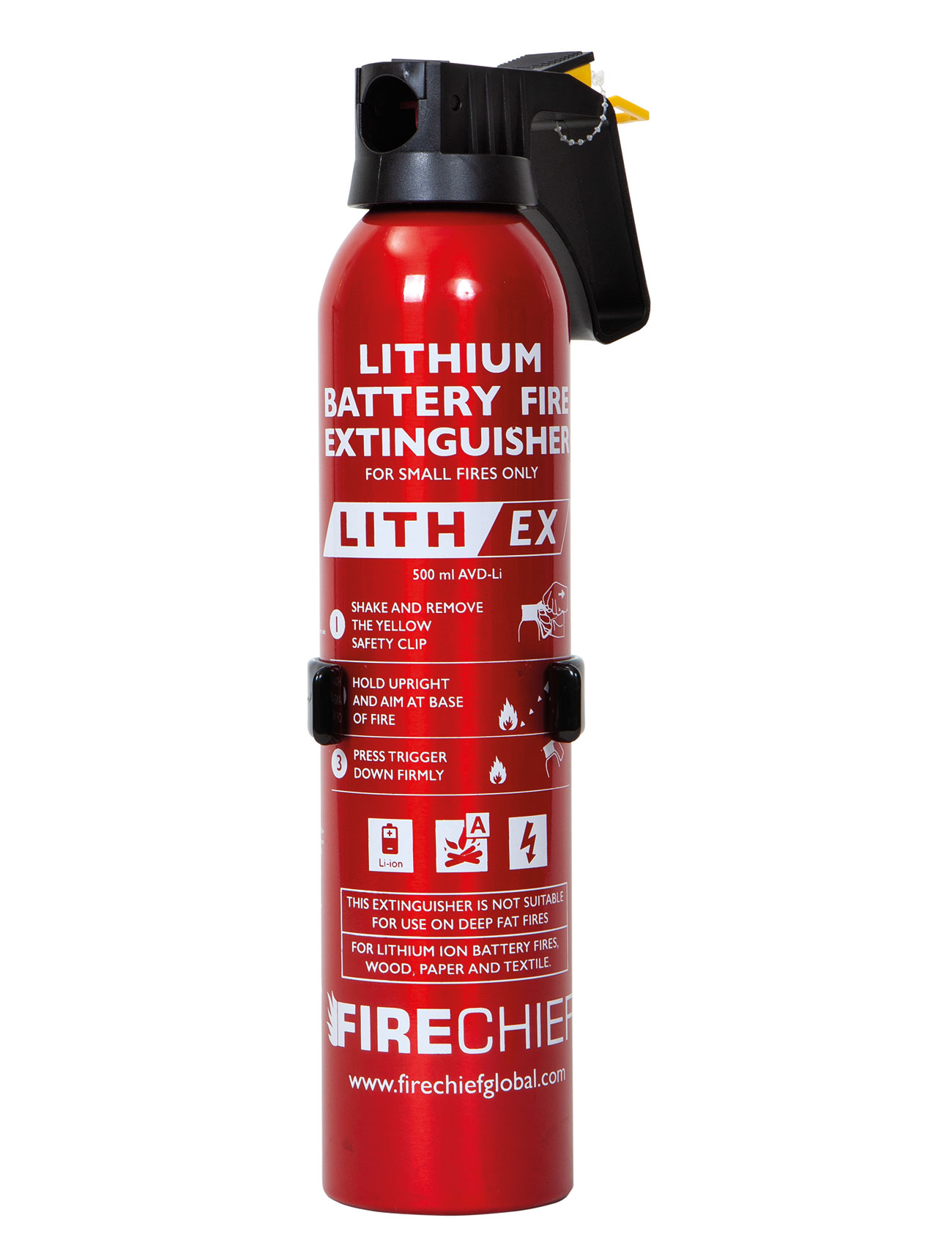
If you find yourself in a position where a lithium battery is on fire, then using a specially designed lithium battery fire extinguisher is the best and safest way to extinguish it.
These fire extinguishers work by spraying AVD (Aqueous Vermiculite Dispersion) compound in a fine water mist. AVD is a stable dispersion of refractory vermiculite platelets in water. When sprayed over a fire, the aqueous vermiculite dispersion quickly extinguishes it as the water cools the system, and the high-surface-area mineral platelets interrupt the radical chain reaction to starve the fire of oxygen.
Another advantage of AVD is that as it dries, it forms a thermally insulating film which helps to stop the fire from re-igniting. The film also coats the packaging of adjacent cells to further minimise the risk of the lithium battery catching fire again.
If you don’t have one of these fire extinguishers on hand, then a standard fire extinguisher that is designed for class B fires (Powder, Foam, CO2) will help, but be aware that reignition is more likely.

What causes the re-ignition of fires?
When it comes to lithium-ion cells, using a standard extinguisher is not always enough to guarantee safety. Due to the high runaway temperatures that a lithium-ion battery can reach when it catches fire, putting it with a standard fire extinguisher leaves the risk of the components not dropping below their auto-ignition temperature. This can quickly cause re-ignition of the fire, placing people and other flammable items around the battery in danger.
This process is known as a delayed reaction which is why using the correct fire extinguisher designed especially for lithium battery fires is ideal. The water and AVD work together to dramatically cool down the cell components, preventing the delayed reaction process from happening.
The problems faced by firefighters when faced with a battery fire
One of the main problems faced with lithium batteries is how volatile they are. Between the electrolyte, the positive-charged anode, and the negative-charged cathode which contains oxygen, a lithium battery contains all the components to self-sustain a fire.
This makes the threat of fire, especially in large waste organisations and warehouses, extremely high. In fact, most UK recycling centres report at least one battery fire outbreak every day.1
Fire departments up and down the country are having to deal with these types of outbreaks much more often than they used to. This poses a few problems, some of which include scalding heat conditions, poisonous fumes, collapsing structures and the potential for large battery explosions.
With that being said, fire and ambulance crews are becoming more resilient to lithium-ion battery fires. This is thanks to increased knowledge about these types of fires, advanced technology when it comes to specialised fire extinguishers and more thorough training.
What are the different types of lithium battery fire extinguishers?
All lithium battery fire extinguishers are similar in the sense that they are all compact, lightweight, easy to store, non-toxic and environmentally friendly. One of the main differences between the different types is size.
For example, a 500ml lithium battery fire extinguisher is one of the smaller sizes available, which makes it useful for keeping in compact spaces such as at home, in a small office, or in vehicles. These can be used to extinguish lithium-based battery fires from personal electronic devices such as mobile phones, tablets and laptops.
Larger models such as 9-litre lithium battery fire extinguishers are much more suited to industrial and commercial environments such as goods distribution, battery collection bin centres and battery recycling locations.
Midlands-based industrial suppliers, First Mats Ltd have recently expanded their range of fire extinguishers to include a brand-new class of lithium battery fire extinguishers. Certified according to the European standard EN3-7:2004 + A1:2007, the range of lithium battery fire extinguishers allow you to deal with fire emergencies quickly and effectively both in your workplace and at home.
‘Our company focuses on products that promote safety in the workplace, and our range of lithium battery fire extinguishers represent the ever-changing risks faced by workforces up and down the country,’ states First Mats Director Richard O’Connor. ‘Thanks to groundbreaking technology, a solution to the ever-increasing number of lithium-ion battery fires can always be found, and we are delighted to be a part of it.’
For more information, go to www.firstmats.co.uk
References
- https://www.bbc.co.uk/news/business-54634802
About the Author

Richard O’Connor is a Director for First Mats, using extensive knowledge from working within manufacturing environments to develop a range of products that improve safety, productivity and employee wellbeing. Richard also produces articles to share knowledge, tips and advice to help people make their workplaces safer for everyone.

You must be logged in to post a comment.