
Merseyside Fire & Rescue Service (MFRS) is leading the charge in raising awareness and championing mental health within the fire and rescue community. The mission of MFRS is to achieve ‘Safer Stronger Communities – Safe Effective Firefighters’. In order to achieve that mission, we have invested heavily in our people and, over several years, developed mental-health initiatives that are now embedded as part of our ‘normal’ business.
Whilst there is no such thing as a ‘typical’ firefighter, people often describe them using words like ‘hero’ and ‘strong’. This is, of course, true and whilst people clearly understand the physical toll that working as an operational firefighter brings, they often don’t think of the emotional impact it can have too. Firefighters do an extremely difficult job and will experience a lot of traumatic incidents during their tenure, but they are often the last to ask for help.
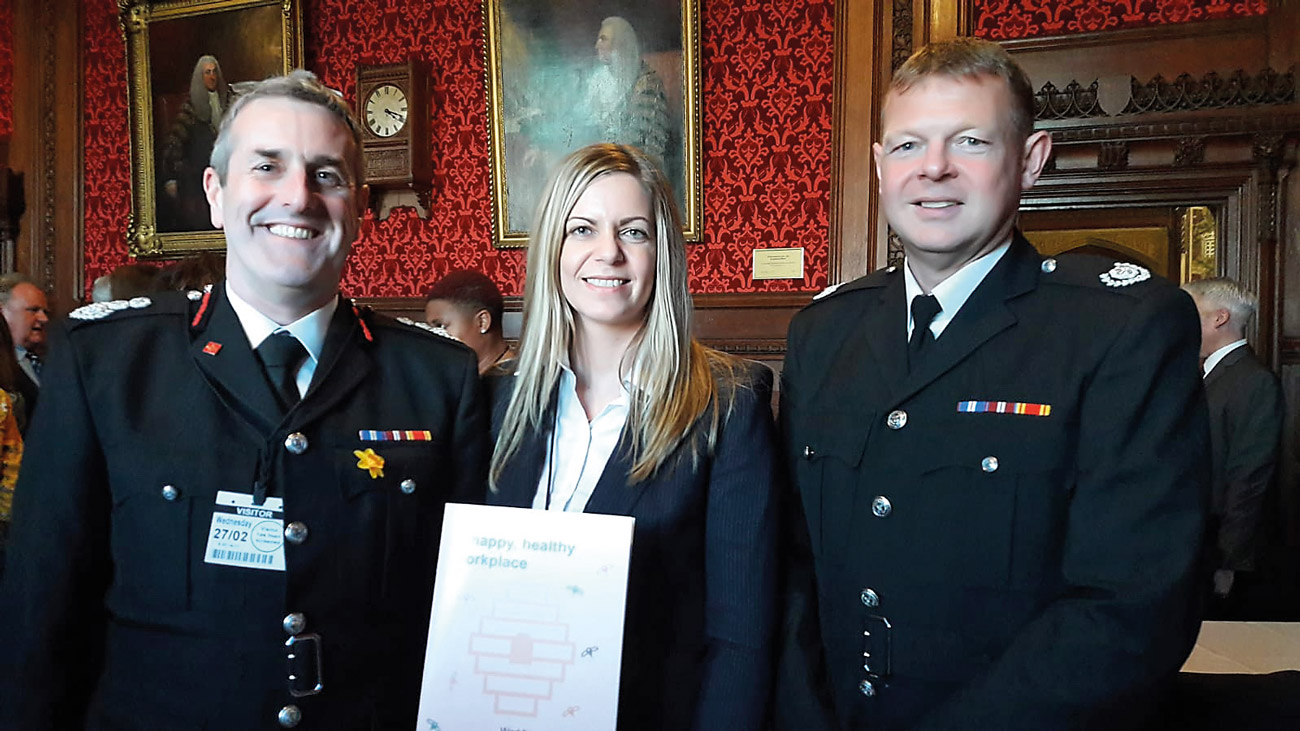
The mental-health support that we offer at MFRS has been recognised with numerous awards and most recently saw us featured in the ‘A Happy, Healthy Workplace’ report. The report – written and compiled by the Secretariat of the Positive Practice in Mental Health Collaborative and the National Collaborating Centre for Mental Health – highlights positive practice in mental health across multiple sectors including NHS trusts, clinical commissioning groups, police forces, third-sector providers, front-line charities and service user groups. MFRS is the only fire and rescue service to be included in the report, demonstrating that we really are passionate about the well-being of our staff. After all, one of our core values as a service is to ensure our people are the best they can be.
The report describes MFRS as an ‘outstanding example of organisations that work for the good of their staff, while valuing their contributions and caring for their physical and mental health’.

Our approach
MFRS mental-health leaders have developed and embedded initiatives within the service to reduce the stigma attached to mental ill health, enabling staff to speak more openly and to access help and support, as and when required. They are committed to offering our staff the same support for their mental health and well-being as they do for their physical health, continuing to build and improve on their current psychological well-being initiatives.
Kelly Patterson, Senior Occupational Health Officer & Psychological Therapist at MFRS, said: ‘Through proactive involvement and championing work streams, senior leadership have encouraged and supported our mental-health initiatives from the outset. With this level of support in place, combined with a collaborative and inclusive approach from all interested representative bodies, the service has developed a network of champions at every level.
‘We recognise that not everyone will wish to access support through the usual formal channels. Because of this, we have introduced and developed a more informal peer-support network within the service. The network is available to help support colleagues at times when their health and well-being may be affected due to various life difficulties.’
The network is made up of volunteer staff who are passionate about supporting their colleagues’ health and well-being. They provide confidential support, which colleagues may be more comfortable with compared to more formal interventions. Peer support is designed to be used in conjunction with existing welfare systems, with peer supporters referring staff to Occupational Health services such as counselling and the Employee Assistance Programme, and giving their colleagues the support and confidence to seek further assistance when they need it.
As well as its own initiatives, MFRS also campaigns to promote the services offered by the Fire Fighters Charity (FFC), which has long supported the mental health of individuals from across the UK’s fire and rescue community.
Staff regularly hold fundraisers for the FFC, including car washes and endurance events. In September 2018, a team of firefighters from Aintree swapped their fire boots for walking boots and trekked 100 miles from Liverpool to Penrith to raise vital funds of the FFC, whilst at the same time raising awareness of mental health.
The fundraiser was the idea of firefighter Mark Buchanan, a lifelong champion of mental health. Mark said: ‘Raising awareness of mental health is something that has always been a passion of mine. A lot of work goes into raising awareness of mental health within the fire service and it’s important to keep that conversation going.
‘Often when firefighters attend a difficult incident, the impact of what they have witnessed and had to deal with doesn’t really hit them until later when they may be at home with their family or friends. But MFRS is a very open environment and whenever something happens, we all sit down as a crew and discuss it. Defusing sessions allow crews to open up after particularly difficult jobs.’
Trauma support for staff
In 2013, following an 18-month research programme and assessment of other fire and rescue services, MFRS created and introduced a Critical Incident Stress Management (CISM) team. The team is committed to supporting staff who have attended or experienced a traumatic incident either in or out of the workplace.
As well as a team of defusing Officers, MFRS has also built a team of 18 ‘debriefers’ who offer post-incident support to crews and teams following the more serious or unusual incidents that may provoke a more unpleasant emotional response.
In the six years since the process began, more than 260 critical incidents have been declared with most of our staff being defused at some point. We have undertaken 30 Critical Incident Debriefs with over 140 attendees and feedback from each session has been positive. The success of this programme has resulted in other services approaching MFRS for assistance in implementing it in their own organisation.
But these initiatives are not just for operational staff. There are approximately 1,000 staff employed by MFRS at 24 community fire stations, a marine rescue unit, Training & Development Academy, Service Headquarters and operational workshops.
Mark Thomas, Group Manager at MFRS, explained: ‘We provide education, training and support to each member of the service and work in partnership with many stakeholders, both internally and externally, to benchmark our progress and ensure we continue to be proactive leaders in staff mental health and well-being support.
‘As an emergency service, it is reasonably foreseeable that our staff – and particularly our operational staff – will face traumatic incidents regularly throughout their career. We maintain a legal and moral duty to ensure that we support our employees’ mental health and well-being throughout this time so that they may live happy, healthy lives both during their time in the service and when they have retired.’
Blue Light champions
MFRS works closely with Mind and has 34 Blue Light Champions available for people to speak to should the need arise. These champions have all undergone mental-health first-aid training and are ready and willing to help promote mental-health conversations across the service by sharing their own personal experiences. All of our vulnerable persons’ advocates who work within the community of Merseyside have also received this training.
Kelly explained: ‘Mental health conditions have emerged as the single biggest cause of long-term absence from the workplace. Research carried out by Mind found that 85% of fire and rescue respondents said they had experienced stress or poor mental health. We have recognised that as a service and have been proactive in our approach to educating staff around mental health.
‘Championing mental health isn’t something new at MFRS, but we continue to build on our initiatives and adapt to the needs of our workforce. We now have more employees trained in this area than any other health-related training programme that we have ever previously run.
‘We recognise that staff are more likely to meet someone with a mental-health condition than they are to meet someone requiring physical first aid and that’s why we have made mental health first aid a mandatory training element for all of our new firefighter recruits when they join MFRS.
‘We’re extremely proud of the work we have done around mental health at MFRS and even more so of our staff who have taken this on board. Without the support of not only the service’s senior leadership but also our crews out on station and those working behind the scenes to ensure the service runs smoothly, we would not have had the success we have had.’
As part of the Blue Light collaboration with Mind, MFRS has previously created a Merseyside Blue Light mental health film, featuring staff who have experienced mental ill health in the past. As well as our own MFRS staff, the film also features representatives from the police, ambulance service, and search and rescue teams. The film can be viewed here: https://www.youtube.com/watch?v=f737T01hdtM
For more information, go to www.merseyfire.gov.uk

You must be logged in to post a comment.