
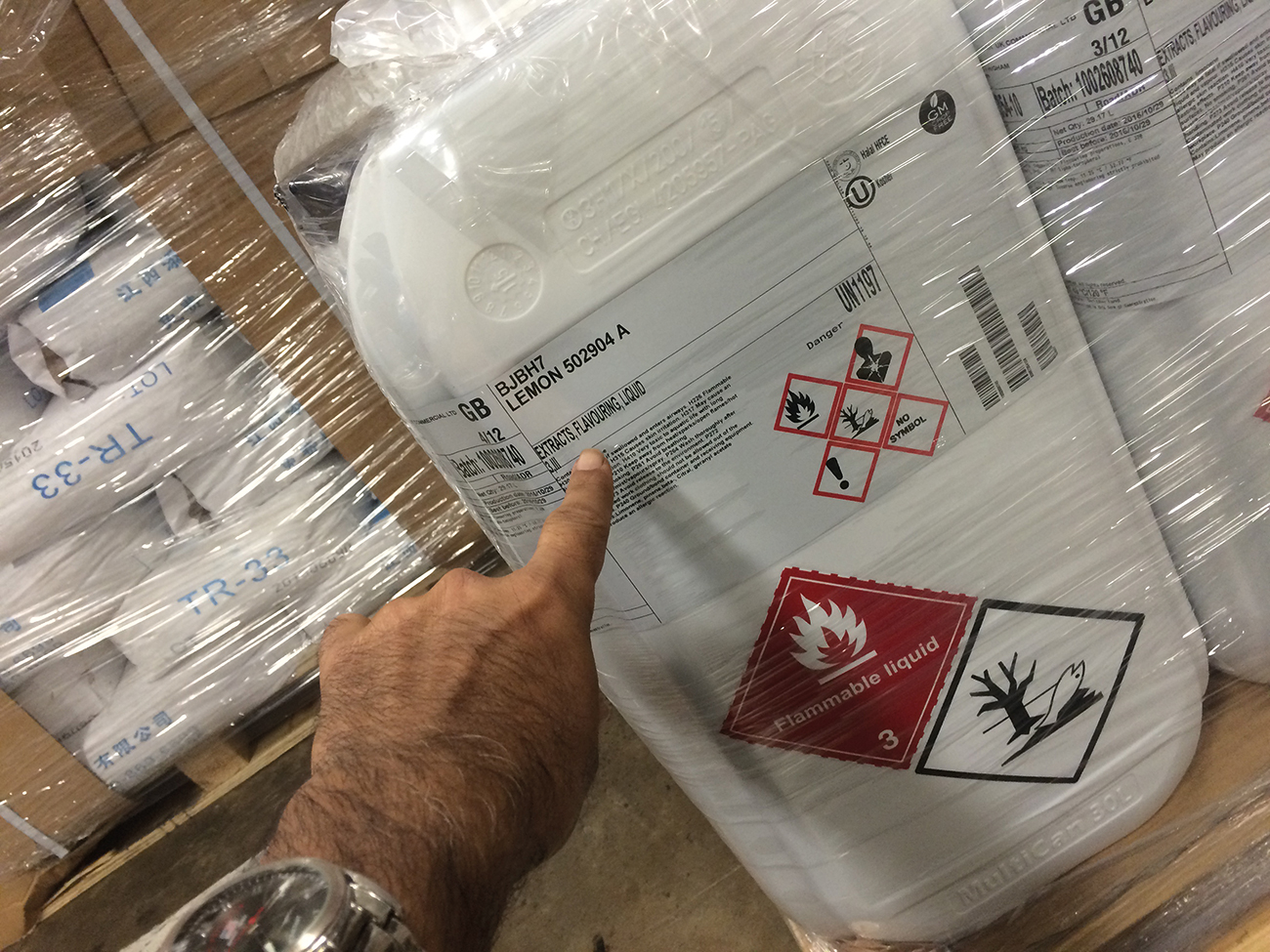
This feature provides an updated insight into probably the largest ADR category of packaged (and bulk) dangerous goods carried on the British road network – flammable liquids; and, crucially for firefighters, it explains what measures must be in place at a production and/or logistics site which handles Class 3 product.
So, ‘over the thumb’, my experience in both bulk as well as packaged (including parcel) dangerous goods supply chains approximates the UK Road Network to carry the following splits of dangerous goods as regulated under ADR.
- Class 3 Flammable Liquids ~ 40%
- Class 8 Corrosive Liquids ~ 20%
- Class 9 Environmentally Hazardous / Miscellaneous ~20%
- Classes 2, 4.1, 4.2, 4.3, 5.1, 5.2 and 6.1 make up the balance of ~20%
Due to issues related to security, I have not included information regarding the carriage of Class 1 (Explosive), Class 7 (Radioactive) and Class 6.2 (Biologically Infectious). Classes 1 and 7 (and some selected class 6.2) cannot be mix-loaded with other ADR Classes for obvious reasons.
Also, tonnages of DG shipped under the Limited Quantity Regulations (LQ) for retail domestic and automotive use, such as nail varnish, aerosols, cleaning products etc. have not been included.
ADR Class 3 flammable liquids both in bulk tankers, as well as packaged/palletised products (contained within IBCs, drums, cans and parcels) constitute the largest tonnage of categorised dangerous goods shipped on UK roads.
Despite the UK exiting the European Union, domestic British carriage regulations of dangerous goods run in concert with ADR on the European mainland and Southern Ireland.
Let’s consider the physics and chemistry of Class 3, flammable liquids.
Firstly, we need to understand the term Flash Point
The flash point is the lowest temperature at which vapours of a volatile material will ignite, when given an ignition source, with Oxygen present. If you recall ‘the fire triangle’, in order for a fire to start, you require:
- A source of fuel
- Heat or a naked flame, or spark
- Oxygen
We are ignoring pyrophoric material such as Silicon Tetrahydride (SiH4) which if released can catch fire without heat or a spark, due to reactivity with atmospheric Oxygen.
The flash point is often confused with:
- Fire Point (the lowest temperature at which vapour of the material will keep burning after the ignition source is removed) and
- Autoignition Point (the temperature that results in spontaneous autoignition)
The fire point is higher than the flash point, because at the flash point, more vapour may not be produced rapidly enough to sustain combustion. Neither flash point nor fire point depends directly on the ignition source temperature, but ignition source temperature is far higher than either the flash or fire point.
As a young chemist working in the petroleum industry, I often measured Flash Points of liquids (with ASTM / IP methods by Pensky-Martens apparatus) as it is a key metric in the classification of flammable liquids. Once classified as either non-flammable, low flash or high flash in terms of flammability, we can then risk assess the activity, in order to determine a safe system of work (SSoW) for storage/carriage (logistics).
But we also have to determine the extent of the flammability of the volatile liquid.

A flammable liquid is a volatile fluid that has a flash point at ambient (or at a lower) temperature but one that does not exceed 60°C (at atmospheric pressure).
To determine the level of risk in terms of relative flammability of Class 3, we use transport category/packing groups to further subdivide Class 3.
In terms of refined petroleum from distillation, we see that petrol/gasoline is PG I as it is the most flammable (and therefore the most problematical in a release or leakage situation), while Diesel/Derv is of a lower hazard, due to its higher initial boiling point and higher flash point. While Jet Fuel (aka Jet A1) which is within the kerosene fraction, resides between the two ‘cuts’ (gasoline to diesel).
In practical terms, a spillage of petrol (aka gasoline/motor spirit) is far, far more worrying than a spillage of diesel in terms of risk of ignition from a spark or heat due to the higher flash point of PG III. Even in Russia or Ukraine, a spillage of petrol poses a risk of fire, even on Ice, while a diesel spillage in sub-zero temperatures forms a petroleum jelly/wax, one that will not ‘flash’ unless exposed to temperatures at the flash point.
So, with fuels, solvents, oils, surface-coating products (including paints, varnishes, adhesives), cleaning products, alcohols, ethers, lacquers et al. derived from petroleum refining, we can understand why Class 3 makes up such as large proportion of dangerous goods on our roads, close to half of all ADR products.
Because of Class 3, and the preponderance of flammable liquids in our society, we have to have a robust Fire and Rescue Service on standby at all times, and why Fire Risk Assessments are mandatory for all industrial organisations – and this includes site plans for emergency services should attendance on site be required.
When it comes to storage of Class 3 materials, the site has a legal responsibility to ensure:
- Risk Assessments especially Fire Risk Assessments are documented, and regularly reviewed.
- Countermeasures, fire detection, fire prevention, fire alarm systems, fire extinguishers and onsite fire (emergency) drills/protocols are in place, reviewed, updated and documented.
- Operational Safe Systems of Work (SSoW) and Standard Operational Procedures (SOP) are coupled to robust Change Control Protocols that factor the flammability risk in the assessment.
- Staff Training (including statutory first aid) is carried out and documented.
- An understanding and adherence to limits of storage in terms of named substances as well as aggregated quantities of risk Class 3 and their associated risk phrases (R1 to R68 and combinations) and safety phrases (S1 to S64 and combinations).
- sub-COMAH Regulations
- lower tier COMAH regulations
- higher tier COMAH regulations
Remember the Globally Harmonized System of Classification and Labelling of Chemicals (GHS) – which is intended to form a set of standardized phrases about the hazards of chemical substances and mixtures that can be translated into different languages.
- The Dangerous Substances and Explosive Atmospheres Regulations 2002 (DSEAR) which require employers to control the risks to safety from fire, explosions and substances corrosive to metals. Note that in 2015, these regulations were augmented so they also cover substances that are corrosive to metals and gases under pressure. It places a formal requirement on employers to assess the risks for substances if classified for these properties and put in place suitable control and mitigation measures.
- And crucially good housekeeping, ensuring flammability and combustibility risks are managed adroitly. Site perimeter, security issues, proximity of flammable material (Class 3) to Oxidising and Organic Peroxides (Class 5.1 and 5.2), to gases (Class 2), overflowing bins, dust, scrap wood, broken pallets and waste paper must be kept away from flammable materials.
The site/operational Dangerous Goods Safety Advisor (DGSA) involvement is essential.
There are several resources available from the Health and Safety Executive (HSE) related to managing Fire and Explosion risks and hazards, with PDF files that can be accessed from this link www.hse.gov.uk/fireandexplosion/resources.
For more information, email akarim1462@aol.com
About the Author

Ali S Karim BSc FRSC CChem FCILT FEI CSci Technical Consultant.

You must be logged in to post a comment.